
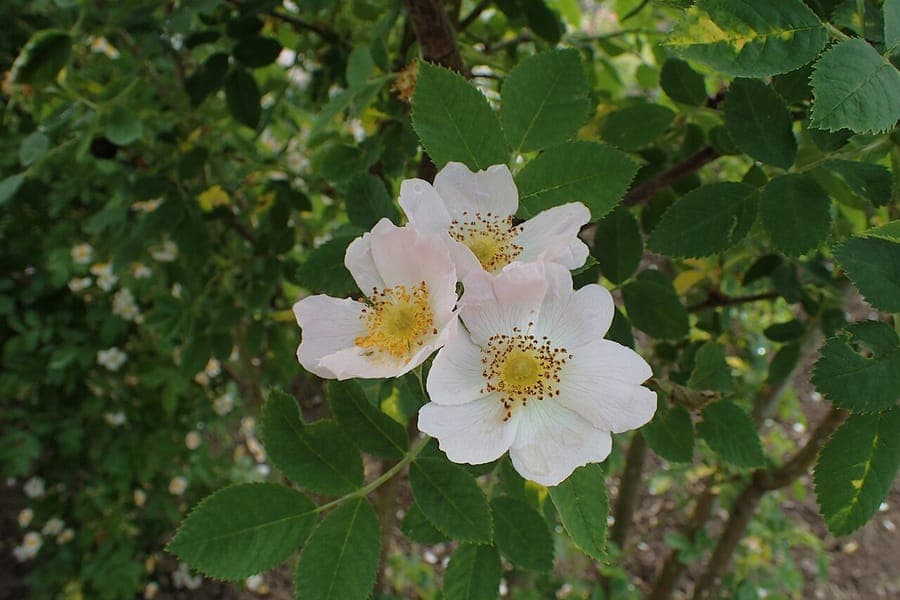
Krzysztof Ziarnek, Kenraiz / CC BY-SA 4.0, via Wikimedia Commons
Hairy dog-rose: complete guide
Rosa caesia
Want to see Hairy dog-rose: complete guide in your garden?
1 minute, no credit card
Overview
Rosa caesia, commonly known as hairy dog-rose, is a tough, native shrub rose found across northern and central Europe. It's not the flashiest rose in the border, but it's one of the most reliable for naturalistic planting schemes. With its dense, thorny growth and long-lasting hips, it's a magnet for wildlife and a solid backbone in any ecological garden. On gardenworld.app, you can design a planting scheme that highlights Rosa caesia's structure and seasonal interest, integrating it with other native species.
This rose thrives in tough conditions-chalky soils, exposed sites, and cold winters. It reaches 120–180 cm in height with a spread of about 100 cm. Unlike cultivated roses, it doesn't need constant care or chemical sprays. It's a plant for gardeners who value resilience over perfection. Once established, it asks for almost nothing and gives back with flowers, hips, and habitat.
Appearance & bloom cycle
The stems are upright and densely armed with sharp thorns, often displaying a purplish-brown hue. The leaves are pinnate, made up of 5–7 leaflets with a distinctive grey-green, almost blue tint-hence the species name caesia, meaning 'ash-coloured'. The undersides are softly hairy, giving them a velvety texture. This is one of the easiest ways to ID it in the field.
Flowering occurs from June to July. The blooms are single, five-petalled, and range from pale pink to nearly white, about 4–5 cm across. The golden stamens attract bees, hoverflies, and butterflies. After pollination, round, bright orange-red hips form, 1–1.5 cm in diameter. These persist well into winter and are rich in vitamin C-great for tea or for birds like redwings and fieldfares.
Ideal location
Hairy dog-rose wants full sun-aim for a light rating of 8/10. That means at least 6 hours of direct sunlight daily. In shade, it becomes leggy, flowers poorly, and is more prone to mildew. Pick an open spot with good air circulation to keep foliage dry.
It works well in informal hedges, woodland edges, or as a standalone shrub in a wildlife corner. Its thorns make it excellent for deterring intruders along fences or pathways. If you're unsure whether your garden gets enough sun, gardenworld.app offers sun-mapping tools to help you place Rosa caesia exactly where it'll thrive.
Soil requirements
This rose is adaptable but prefers well-drained, calcareous soils. The ideal pH is between 7.5 and 8.0. It does well in chalky or sandy loams but struggles in heavy, waterlogged clays. If your soil is dense, improve drainage by mixing in grit and compost.
It's more lime-tolerant than many garden roses and actually benefits from alkaline conditions. Avoid acidifying amendments. If your soil tests below pH 7, a light application of ground limestone may help, but Rosa caesia is forgiving and often establishes without adjustment.
Free design
Want to see Hairy dog-rose: complete guide in your garden? Make a free design now.
Watering
Once established, this rose is drought-tolerant. Young plants in their first growing season need weekly watering during dry spells. Focus on deep, infrequent soakings rather than frequent sprinkles-this encourages deep root development.
Always water at the base to prevent fungal diseases. Avoid wetting the foliage, especially in the evening. In typical UK or northern European summers, additional watering is rarely needed after year two.
Pruning
Minimal pruning is required. The best time is late winter to early spring (February to early March), before bud break. Remove dead, damaged, or crossing stems. Cut back the oldest canes to 30–40 cm to encourage new growth from the base.
Don't prune in autumn-this removes the winter hips, which are an important food source. If you want to enjoy the hips through winter, delay pruning until late winter, just before new growth starts.
Maintenance calendar
- January: Check for storm damage. Plan pruning.
- February: Begin light pruning. Remove dead wood.
- March: Finish pruning. Apply a thin layer of compost if desired.
- April: Water young plants in dry spells. Watch for bud swell.
- May: No feeding. Prepare for bloom.
- June–July: Flowering period. Do not prune.
- August: Hips begin to ripen. Reduce watering.
- September: Leave hips for wildlife. No intervention.
- October: Let fallen leaves decompose as natural mulch.
- November–December: Final check. Protect young plants with straw in harsh winters.
Winter hardiness
Rosa caesia is fully hardy down to -25°C, making it suitable for USDA zones 4–8. It handles cold, wind, and snow with ease. In the UK, Scandinavia, and northern Europe, it grows without winter protection. Young plants may benefit from a light mulch in their first winter, but mature shrubs are self-sufficient.
Companion plants
Pair hairy dog-rose with other native perennials and shrubs. Good companions include dogwood (Cornus sanguinea), guelder rose (Viburnum opulus), meadowsweet (Filipendula ulmaria), and honeysuckle (Lonicera periclymenum). For contrast, plant it with summer-sedums like Hylotelephium spectabile or wild thyme (Thymus serpyllum).
Avoid aggressive spreaders that might overcrowd it. Maintain 80–100 cm spacing from other medium-sized shrubs.
Closing
Hairy dog-rose isn't a rose for show gardens-it's a plant for real gardens. It supports wildlife, withstands tough conditions, and adds year-round structure. Its simple beauty fits perfectly in naturalistic designs.
Looking to place Rosa caesia in your garden with confidence? Use gardenworld.app to visualize its growth and pairing options. You can find this plant at garden centres across the UK, often labelled as 'wild rose' or 'dog rose'. Look for it at local nurseries or larger chains for reliable stock.
Want to see Hairy dog-rose: complete guide in your garden? Make a free design now.
Upload a photo, pick a style, and get a photorealistic design with plant list in under a minute.
No credit card required


Similar plants
Siberian crab apple: complete guide
Malus x robusta
Complete guide to the Siberian crab apple (Malus x robusta): location, soil, pruning, winter hardiness and the best companion plants for your garden.
Chinese flowering crabapple (Malus x spectabilis): complete guide
Malus x spectabilis
Meet the Chinese flowering crabapple (Malus x spectabilis): a classic spring bloomer with carmine buds and pink blossom.
Potentilla crassinervia: complete guide
Potentilla crassinervia
Potentilla crassinervia, the Corsican cinquefoil, grows wild on Corsica and Sardinia's peaks. Discover how to grow this hardy alpine rock garden gem.