
HermannSchachner / CC0, via Wikimedia Commons
Field rose: complete guide
Rosa arvensis
Want to see Field rose: complete guide in your garden?
1 minute, no credit card
Overview
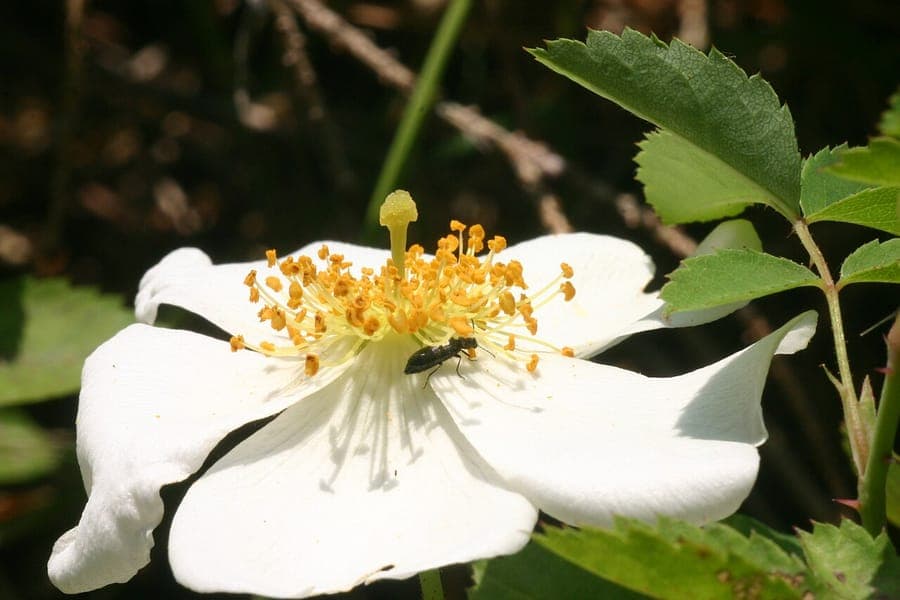
Rosa arvensis, commonly known as the field rose, is a graceful, climbing wild rose native to much of central and western Europe, including the UK, France, and Germany. It thrives in hedgerows, woodland edges, and open fields, where it scrambles through shrubs and over banks. Unlike many cultivated roses, it has a restrained, natural beauty-slender arching stems, delicate white flowers, and excellent resilience. It grows 2 to 3 meters tall or long, depending on support, and spreads slowly via underground runners, forming loose thickets over time.
This is a low-maintenance plant ideal for wildlife gardens, informal hedges, or natural screening. On gardenworld.app, you can map out a planting scheme that matches the field rose's sprawling habit, ensuring it has room to climb without overcrowding other plants.
Appearance & bloom cycle
The field rose produces small, single flowers, about 2–3 cm in diameter, with five pure white petals and a bright yellow center. Blooming occurs from late June through August, depending on local conditions. The scent is light and honeyed-pleasant but not overpowering. After flowering, small, oval, deep red hips develop and persist into winter, providing food for birds like thrushes and finches.
Foliage is pinnate, with 5–7 glossy, dark green leaflets that turn yellow before falling in autumn. Stems are slender, flexible, and armed with small, hooked prickles that help the plant scramble through surrounding vegetation. It's semi-evergreen in milder climates but typically loses most leaves in colder zones.
Ideal location
The field rose prefers partial shade to light sun (light level 5 out of 10). Full sun can stress the plant in hot summers, especially on dry soils, while deep shade reduces flowering. An east- or north-facing fence, a woodland edge, or a spot beneath light-canopy trees works well.
It's perfect for cottage gardens, wildlife borders, or natural hedges. Because it climbs by scrambling, it benefits from a trellis, fence, or nearby shrubs to lean on. Avoid planting it too close to aggressive perennials that might smother it. Use gardenworld.app to visualise how the rose will grow over the next few years, helping you plan spacing and support structures.
Soil requirements
Rosa arvensis is adaptable but performs best in well-drained, humus-rich soil with a pH between 6.5 and 7.0. It tolerates clay if not waterlogged, and sandy soils if given enough organic matter. Avoid highly acidic or compacted soils. If your soil is poor, mix in compost or leaf mould at planting time.
While drought-tolerant once established, it grows more vigorously in consistently moist (but not wet) soil. Prolonged dry spells in summer may slow growth, so occasional deep watering helps.
Free design
Want to see Field rose: complete guide in your garden? Make a free design now.
Watering
Water deeply after planting-about 10–15 liters per week during the first growing season, especially in dry periods. After year one, supplemental watering is rarely needed unless drought persists for more than three weeks. Mulch around the base with compost or bark to retain moisture and suppress weeds.
Rainwater is preferred; hard tap water can build up lime in the soil over time, affecting nutrient uptake on sandy sites.
Pruning
Pruning is minimal. The best time is late winter to early spring (February–March), before new growth starts. Focus on removing dead, damaged, or overcrowded stems. Cut back long, leggy shoots to encourage bushier growth.
Important: Rosa arvensis blooms on previous year's wood, so avoid hard pruning. Cutting too far back will reduce flowering the following summer.
Maintenance calendar
- January: Check for winter damage. No pruning.
- February: Begin light pruning. Remove dead wood.
- March: Final pruning. Apply compost around the base.
- April: New shoots emerge. Monitor for aphids.
- May: Plant prepares to bloom. Watch for mildew in humid areas.
- June–August: Flowering period. Do not prune.
- September: Flowers fade. Hips begin to ripen.
- October: Hips mature. Leave on plant for birds.
- November: Leaf drop. Protect young plants if early frost hits.
- December: Dormant. No care needed.
Winter hardiness
The field rose is fully hardy down to -15°C (USDA zone 6). Mature plants survive harsh winters without protection. Young plants benefit from a mulch of leaves or straw around the base in their first two winters to prevent frost heave.
Companion plants
Pair the field rose with native understory plants like dog's mercury (Mercurialis perennis), wood anemone (Anemone nemorosa), or sweet woodruff (Galium odoratum). For vertical interest, combine with honeysuckle (Lonicera periclymenum) or ivy (Hedera helix).
Avoid invasive species like Japanese knotweed or aggressive grasses that could outcompete it.
Closing
The field rose is a quiet achiever in the garden-tough, beautiful, and ecologically valuable. It supports pollinators, feeds birds, and adds seasonal interest without demanding constant care. Whether trained along a fence or left to ramble through a shrub border, it brings a touch of wild charm.
Available at many garden centres in spring, particularly in the UK and northern Europe. Look for bare-root plants from trusted suppliers. With thoughtful placement-planned easily on gardenworld.app-the field rose becomes a lasting feature in any naturalistic garden design.
Want to see Field rose: complete guide in your garden? Make a free design now.
Upload a photo, pick a style, and get a photorealistic design with plant list in under a minute.
No credit card required


Similar plants
Siberian crab apple: complete guide
Malus x robusta
Complete guide to the Siberian crab apple (Malus x robusta): location, soil, pruning, winter hardiness and the best companion plants for your garden.
Chinese flowering crabapple (Malus x spectabilis): complete guide
Malus x spectabilis
Meet the Chinese flowering crabapple (Malus x spectabilis): a classic spring bloomer with carmine buds and pink blossom.
Potentilla crassinervia: complete guide
Potentilla crassinervia
Potentilla crassinervia, the Corsican cinquefoil, grows wild on Corsica and Sardinia's peaks. Discover how to grow this hardy alpine rock garden gem.