
Walter Siegmund (talk) / CC BY-SA 3.0, via Wikimedia Commons
Prickly rose: complete guide
Rosa acicularis
Want to see Prickly rose: complete guide in your garden?
1 minute, no credit card
Overview
Rosa acicularis, commonly known as the Prickly rose, is a tough, cold-hardy wild rose native to northern regions across North America and Eurasia. Unlike cultivated garden roses, this species thrives with minimal care and delivers real ecological value. It's a subshrub that grows 1 to 1.5 meters tall, forming dense thickets over time. If you're designing a naturalistic garden or restoring a wild edge, this plant earns its place.
Found across Alaska, Canada, and into northern Europe, it's perfectly adapted to USDA hardiness zones 3 to 7. That means it survives brutal winters with temperatures dropping to -40°C. It's not showy in the traditional sense, but its resilience and wildlife appeal make it a standout. On gardenworld.app, you can design a garden layout that integrates Rosa acicularis into native hedgerows or pollinator-friendly borders.
Appearance & bloom cycle
The Prickly rose has slender, thorny canes that give it its name. The stems are covered in small, sharp prickles - not the large hooks of some roses, but enough to deter deer and rabbits. The foliage is pinnately compound, with 5 to 9 oval-lanceolate leaflets that turn a fresh green in spring and remain healthy through summer.
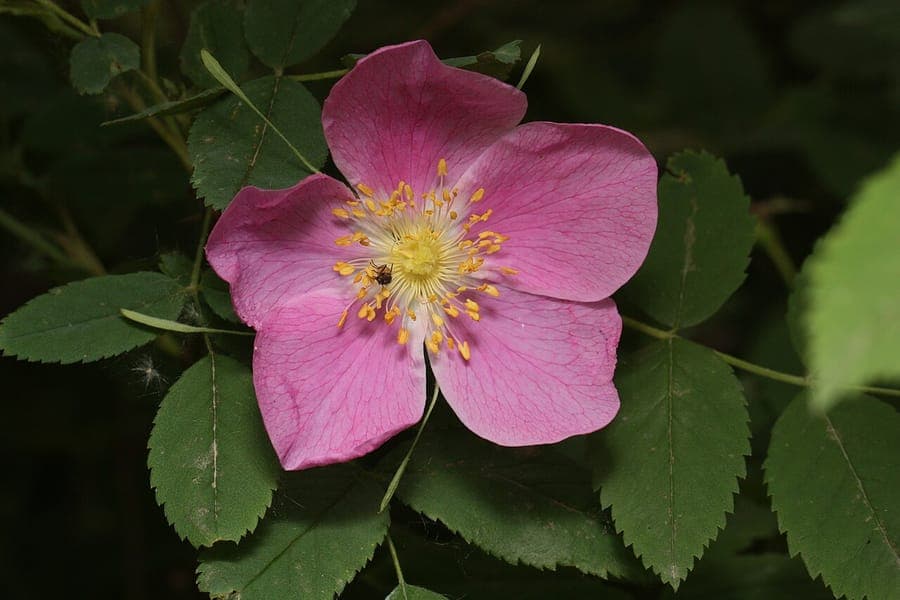
Flowers appear in late June to early July, each about 5 to 6 cm wide, with five deep red to pinkish-red petals surrounding a bright yellow center of stamens. The bloom period lasts around three weeks. After flowering, small, oval hips develop. These turn orange-red in autumn and often persist through winter, providing food for birds like grouse and waxwings.
Unlike repeat-flowering hybrids, Rosa acicularis blooms only once per season. But that single flush is worth the wait - the scent is subtle but sweet, and the open flowers welcome bees, hoverflies, and moths.
Ideal location
This rose prefers full sun to light shade. For best flowering, aim for at least 6 hours of direct sunlight daily. In deep shade, the plant becomes leggy and flowers poorly. A woodland edge, open meadow, or sunny back corner of the garden suits it well.
It's ideal for native plantings, erosion control on slopes, or as part of a wildlife hedge. Because it spreads slowly by root suckers, give it space - at least 1 meter between plants. Avoid planting near footpaths where the thorns could snag clothing.
In the UK and northern US, it's perfect for rural or cottage-style gardens. Check gardenworld.app to see how it pairs with ferns, grasses, and other cold-tolerant perennials in a layered planting scheme.
Soil requirements
Rosa acicularis is adaptable but prefers well-drained loam or sandy loam with a pH between 6.8 and 7.5. It tolerates slightly acidic to neutral soils but struggles in waterlogged conditions. Avoid heavy clay unless it's amended with grit and compost to improve drainage.
This rose doesn't need rich soil - in fact, overly fertile ground can lead to excessive leafy growth at the expense of flowers. When planting, mix in a shovelful of compost, but skip synthetic fertilizers. It's evolved to grow in modest conditions, so let it do its thing.
Free design
Want to see Prickly rose: complete guide in your garden? Make a free design now.
Watering
During the first growing season, water weekly if rainfall is less than 2.5 cm. Use a soaker hose to deliver moisture directly to the roots and reduce fungal risk. Once established, the plant is drought-tolerant and rarely needs supplemental watering, except during prolonged dry spells in summer.
Avoid overhead watering, especially in the evening, to prevent black spot and powdery mildew. Mulch with leaf litter or wood chips to retain moisture and suppress weeds - just keep the mulch a few inches away from the crown to prevent rot.
Pruning
Pruning is minimal. The best time is late winter or early spring (February to March), before new growth starts. Remove dead, damaged, or crossing canes to improve airflow. Cut back any overly long stems to maintain shape, but never remove more than one-third of the plant.
Since it flowers on previous year's wood, heavy pruning reduces blooming. Avoid shearing it into a tight hedge - this ruins its natural form and stresses the plant. Instead, let it grow loosely, allowing its arching habit to shine.
Maintenance calendar
- Jan: Inspect for winter dieback
- Feb: Prune dead wood, shape lightly
- Mar: Check for aphids, ensure soil is thawed
- Apr: Monitor emerging shoots
- May: Watch for rose slug, apply organic mulch
- Jun: Bloom begins, water during dry weeks
- Jul: Peak flowering, support pollinators
- Aug: Hips start forming, reduce watering
- Sep: Leave hips for birds, no pruning
- Oct: Let fallen leaves decompose as natural mulch
- Nov: No action needed
- Dec: Protect young plants with straw if exposed
Winter hardiness
Rosa acicularis is exceptionally cold-hardy (USDA 3–7). Mature plants withstand temperatures down to -40°C without protection. The hips add winter interest and feed birds. Don't cut them back - they're part of the plant's seasonal rhythm.
Young plants may benefit from a light mulch of straw around the base in their first winter. Avoid piling mulch against the stems. Snow cover actually insulates the plant, so don't clear it away in winter.
Companion plants
Pair it with native grasses like Deschampsia cespitosa or wildflowers such as Campanula rotundifolia and Arnica montana. These share similar soil and light needs and create a cohesive, low-maintenance planting.
Avoid invasive species like Japanese knotweed. Good shrub companions include Vaccinium spp. and Amelanchier alnifolia, which bloom around the same time and support similar wildlife.
Closing
Rosa acicularis isn't for those seeking perfect, fragrant tea roses. It's for gardeners who value resilience, ecology, and beauty in a natural form. It asks for little - just space, sun, and patience.
You won't find it at every garden centre, but check local nurseries in spring or look for it at trusted retailers like OBI or Hornbach in Europe. With the right spot and minimal care, this wild rose will thrive for decades, quietly enriching your garden's ecosystem.
Want to see Prickly rose: complete guide in your garden? Make a free design now.
Upload a photo, pick a style, and get a photorealistic design with plant list in under a minute.
No credit card required


Similar plants
Siberian crab apple: complete guide
Malus x robusta
Complete guide to the Siberian crab apple (Malus x robusta): location, soil, pruning, winter hardiness and the best companion plants for your garden.
Chinese flowering crabapple (Malus x spectabilis): complete guide
Malus x spectabilis
Meet the Chinese flowering crabapple (Malus x spectabilis): a classic spring bloomer with carmine buds and pink blossom.
Potentilla crassinervia: complete guide
Potentilla crassinervia
Potentilla crassinervia, the Corsican cinquefoil, grows wild on Corsica and Sardinia's peaks. Discover how to grow this hardy alpine rock garden gem.