
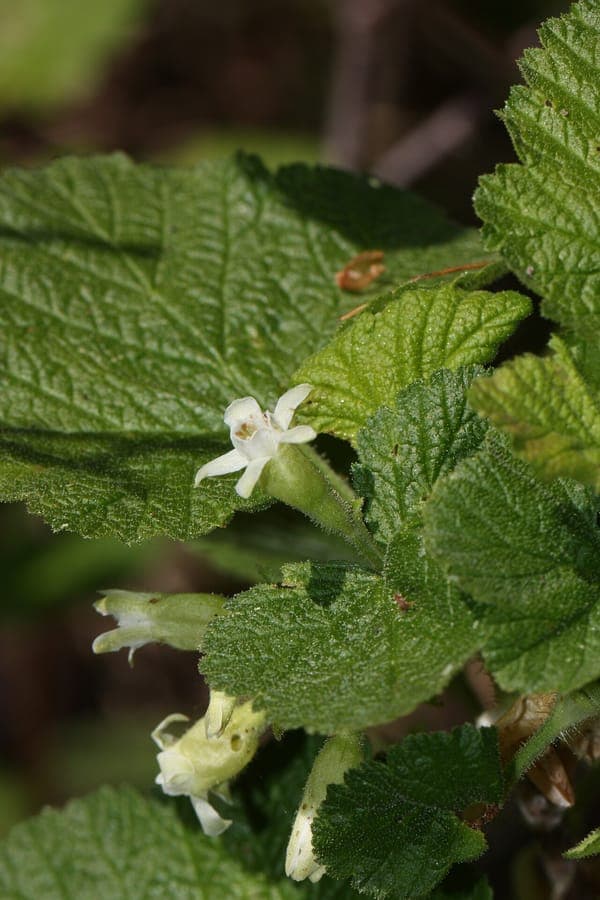
Walter Siegmund (talk) / CC BY-SA 3.0, via Wikimedia Commons
Sticky currant: complete guide
Ribes viscosissimum
Want to see Sticky currant: complete guide in your garden?
1 minute, no credit card
Overview
Sticky currant, scientifically known as Ribes viscosissimum, is a distinctive North American shrub that brings native charm to temperate gardens. This member of the Grossulariaceae family thrives across a broad range of western North American habitats, from the mountainous regions of Montana and Wyoming to the sunny slopes of California and the Pacific Northwest. The plant earns its name from the characteristic viscid hairs coating its stems and leaves, which create a shimmering appearance and a pleasant tactile quality. Gardeners appreciate sticky currant for its resilience, attractive form, and ecological value.
Appearance and bloom
Sticky currant develops into a well-branched, multi-stemmed shrub typically reaching 1.0 to 1.5 meters in height and spread. The foliage features small, rounded leaves with deep serrations and a distinctly coarse texture due to microscopical glandular hairs. From March through May, delicate white flowers emerge in pendulous racemes, attracting bees and other pollinators that enhance garden biodiversity. Following pollination, black berries develop that, while not human-edible, provide food for birds and wildlife. The overall habit is tidy and compact, requiring minimal pruning to maintain its natural shape.
Ideal location
Sticky currant performs best with at least four hours of direct sunlight daily. The plant is adaptable to both full sun and light shade positions, though flowering is most abundant in full sun conditions. Ensure adequate space for the plant to expand - position it at least 1 meter from competitors. This shrub works effectively as a specimen plant but also integrates well into mixed shrub borders or groups of three to five for naturalistic effect. Avoid deep shade, which reduces flowering and promotes legginess.
Soil
While sticky currant is not soil-specific, it thrives in well-draining soil with pH between 5.8 and 8.4. The plant tolerates both acidic and neutral soils. Amend planting holes generously with finished compost and aged leaf mold to improve soil structure and water retention. For heavy clay soils, incorporate 30-40% sand or perlite to ensure drainage. Over-wet soils promote root rot; raised beds or mound planting may be necessary in poorly drained sites.
Free design
Want to see Sticky currant: complete guide in your garden? Make a free design now.
Watering
Once established (after the first growing season), sticky currant is moderately drought-tolerant and requires supplemental water only during extended dry spells. During the establishment year following planting, water deeply once weekly in the absence of significant rainfall. In summer droughts or heat waves exceeding 30 degrees Celsius, additional irrigation prevents stress. Use the finger test: probe 5 cm into soil. If dry, irrigate thoroughly. Mulch with 5 cm of wood chips to conserve moisture and moderate soil temperature.
Pruning
Sticky currant responds well to light maintenance pruning. Conduct pruning in early spring before growth commences. Remove all dead, diseased, and crossing branches, then thin the centre to improve air circulation and reduce disease pressure. Since flowering occurs on two-year-old wood, aggressive pruning significantly reduces bloom. An annual light tidy-up - removing no more than 20 percent of stem volume - maintains shape without sacrificing floral display.
Maintenance calendar
March: Spring pruning and application of balanced organic fertilizer. April-May: Monitor for spider mites and aphids; prune immediately after flowering if needed. June-July: Observe for pest pressure; supplemental water during dry periods. August: Collect seed or cuttings for propagation. September-October: Clear fallen leaves; inspect for disease. November-December: Final inspection; dormancy period.
Winter hardiness
Sticky currant is exceptionally winter-hardy, suitable for USDA hardiness zones 4 to 8, enduring temperatures as low as -30 degrees Celsius. This makes it ideal for Northern Europe, including the Netherlands, Belgium, and Germany. No winter protection is necessary in these regions. The plant retains much of its foliage through winter in temperate climates, providing structural interest during dormancy.
Companion plants
Sticky currant pairs beautifully with other native North American species. Combine with other Ribes varieties for structural diversity. Underplant with low-growing groundcovers such as Sedum album or Gaultheria procumbens. Taller companions like elderberry (Sambucus nigra) or serviceberry (Amelanchier) create pleasing textural contrasts. Avoid nutrient-demanding plants nearby, as sticky currant flourishes with modest fertility.
Closing
Sticky currant is a valuable addition to any front garden, offering year-round interest, low maintenance, and native plant credentials. Its North American origin and proven hardiness make it ideal for sustainable, ecological garden designs. Whether establishing a native plant habitat or simply seeking an attractive, adaptable shrub, sticky currant delivers outstanding results.
Want to see Sticky currant: complete guide in your garden? Make a free design now.
Upload a photo, pick a style, and get a photorealistic design with plant list in under a minute.
No credit card required


Similar plants
Canadian gooseberry: complete guide
Ribes oxyacanthoides
Discover the Canadian gooseberry, an extremely hardy North American fruit shrub with bristly stems and tart berries for jams and orchards.
Ribes bracteosum: complete guide to this Pacific Northwest shrub
Ribes bracteosum
Grow stink currant, a hardy Pacific Northwest shrub with deep-lobed foliage, fragrant blooms, and dark berries attractive to birds.
Ribes acerifolium: complete guide
Ribes acerifolium
Discover Mapleleaf currant - a stunning native shrub with maple-like leaves and interesting berries. Ideal for natural gardens.