
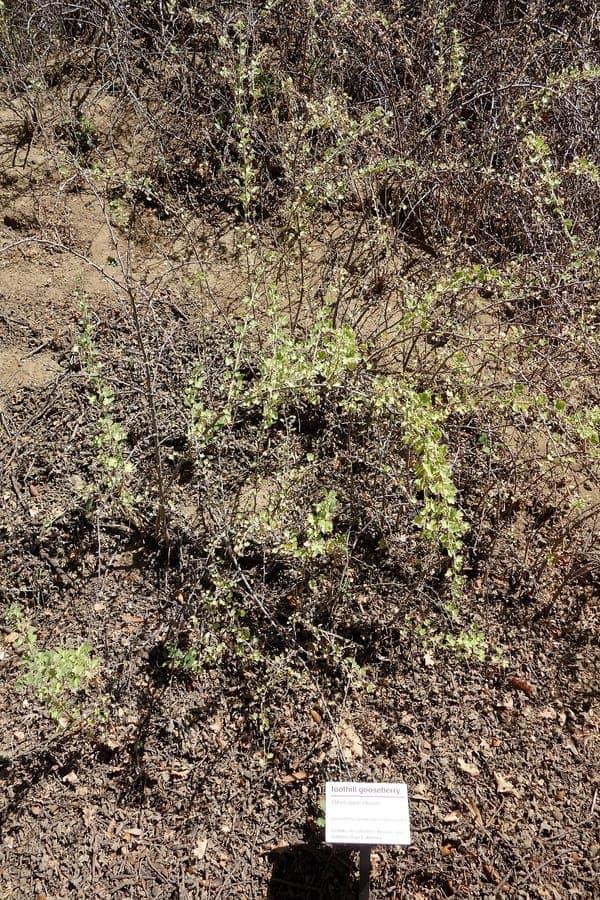
Daderot / CC0, via Wikimedia Commons
Ribes quercetorum: complete guide
Ribes quercetorum
Want to see Ribes quercetorum: complete guide in your garden?
1 minute, no credit card
Overview
Ribes quercetorum, also known as Oak gooseberry or Rock gooseberry, is a frost-hardy American berry-producing shrub. This plant naturally grows in mountainous areas from California to Baja California in Mexico. It is a fascinating choice for dry gardens and landscape projects focused on robustness.
The plant belongs to the Grossulariaceae family, well-known for diverse berry producers. Oak gooseberry distinguishes itself through adaptation to water scarcity and high-altitude tolerance.
Appearance and Bloom
Oak gooseberry is a deciduous shrub approximately 1 to 1.5 meters tall. The plant has a compact, broad-spreading form with finely branched stems. Notable are the many small thorns covering the branches, offering protection from browsing.
The leaves are small, round, and lightly pubescent, characteristic of mountain-origin plants. The foliage appears delicate and acquires beautiful yellow-red tones in autumn. The flowers are small, approximately 5-8 mm, appearing in April-May. They are light pink to white, discreet blooms attracting bird pollinators.
From June to August, fruits ripen into small, approximately 0.8 cm berries of dark purple to black. These berries are not edible but valuable food for birds.
Ideal Location
Oak gooseberry thrives best in full sun locations. The plant accepts light part shade, though flowering and berry production may decline. In very hot areas, light afternoon shade provides protection from scorch.
The plant is completely indifferent to drought once established. This makes it ideal for water-conscious gardens, sloping mountain sites, and rocky soils where regular irrigation is unavailable.
Plant in locations with well-drained soil where water does not stagnate. The thorns can serve well as natural fencing or hedging.
Soil
Ribes quercetorum grows in virtually all soil types, from sand to clay, as long as drainage is good. The plant prefers neutral to slightly acidic pH but tolerates chalky soils. In lean mountain soils, the plant thrives as well as in fertile grounds.
At planting, compost-containing soil can help, though this is not strictly necessary. Mulching of 5 cm helps stabilize moisture balance during warm periods.
Free design
Want to see Ribes quercetorum: complete guide in your garden? Make a free design now.
Watering
Once established (after the first season), Oak gooseberry is extremely drought-tolerant. Regular watering is needed for young plants in the first year. Water deeply and limit frequency to encourage strong root systems.
During growing season (April-August), water when the top 5 cm feel dry. Once mature, water only in extreme drought. Avoid waterlogging strongly, as this can cause plant rot.
Pruning
Oak gooseberry requires very minimal pruning. Let the plant grow naturally unless shape adjustments are needed. In late winter (February-March), dead or damaged branches can be removed.
Wearing gloves is essential due to numerous thorns. Old branches can be carefully pruned from the center to encourage renewal, but this is very rarely needed.
Maintenance Calendar
Spring (March-May): Prune dead wood. Begin watering. Observe flowering.
Summer (June-August): Continue watering during dry periods. Follow berry formation.
Autumn (September-November): Reduce watering. Enjoy autumn colors. Leave berries for birds.
Winter (December-February): Hardy plant requires no protection. Check plant health.
Winter Hardiness
Oak gooseberry is frost-hardy to about -15C, ideal for most European climate zones. The plant tolerates mountain winters well and grows in colder mountainous areas. Frost and snow pose no problem for this species.
Companions and Partners
Oak gooseberry associates well with other mountain native plants such as Ceanothus, Mahonia, and echeveria. The plant combines beautifully with rocky ground covers like thyme or sedum. For bird gardens, plant near other bird food sources.
Closing
Ribes quercetorum offers special value for dry, mountainous gardens. If you seek a water-independent, bird-attractive shrub, Oak gooseberry is an excellent choice.
You will find young plants at specialty nurseries. For inspiration and design ideas, visit gardenworld.app. GardenWorld helps you integrate mountain natives into your garden.
Want to see Ribes quercetorum: complete guide in your garden? Make a free design now.
Upload a photo, pick a style, and get a photorealistic design with plant list in under a minute.
No credit card required


Similar plants
Canadian gooseberry: complete guide
Ribes oxyacanthoides
Discover the Canadian gooseberry, an extremely hardy North American fruit shrub with bristly stems and tart berries for jams and orchards.
Ribes bracteosum: complete guide to this Pacific Northwest shrub
Ribes bracteosum
Grow stink currant, a hardy Pacific Northwest shrub with deep-lobed foliage, fragrant blooms, and dark berries attractive to birds.
Ribes acerifolium: complete guide
Ribes acerifolium
Discover Mapleleaf currant - a stunning native shrub with maple-like leaves and interesting berries. Ideal for natural gardens.