
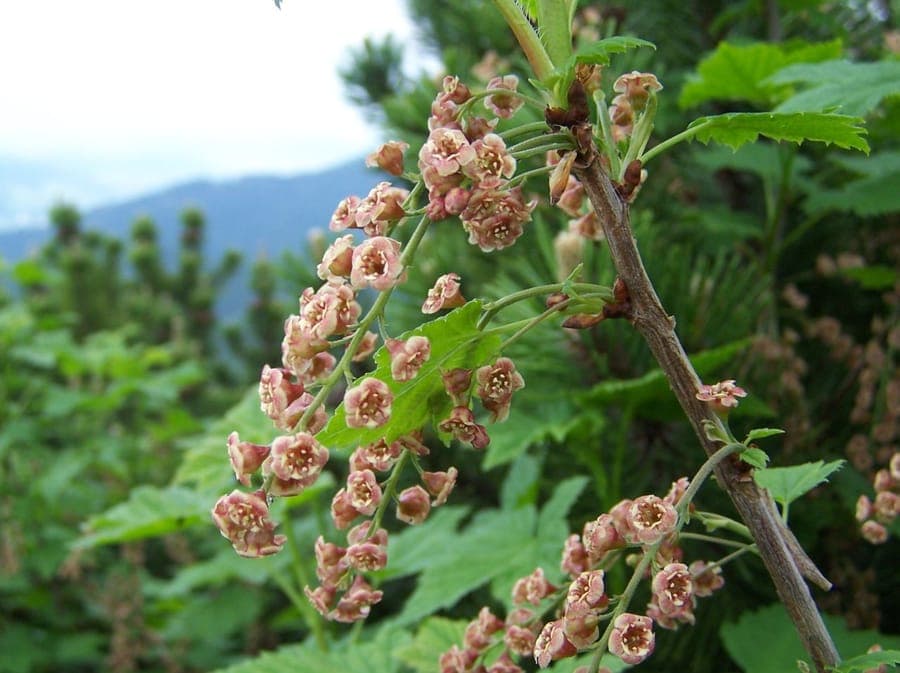
opioła Jerzy / CC BY 2.5, via Wikimedia Commons
Rock currant: complete guide
Ribes petraeum
Want to see Rock currant: complete guide in your garden?
1 minute, no credit card
Overview
Ribes petraeum, commonly known as rock currant, is a hardy, shade-tolerant shrub native to rocky slopes and forest edges across central and southern Europe. It's an underrated choice for UK and northern European gardens, particularly in areas where other shrubs struggle due to poor soil or low light. Growing to a height of 80–120 cm with a spread of about 70 cm, it has a loose, upright habit and thrives in challenging conditions.
This shrub is often overlooked in favour of more showy Ribes like redcurrants or gooseberries, but the rock currant stands out for its resilience in dry shade and minimal care requirements. It's perfect for naturalistic planting schemes, woodland gardens, or as a structural element in a mixed border. The foliage is soft grey-green, slightly downy underneath, and turns a pale yellow in autumn before dropping.
You can use gardenworld.app to design a planting plan that highlights the rock currant's strengths, especially in shaded corners where few shrubs succeed. The app helps you visualise spacing, companion plants, and seasonal changes.
Appearance & bloom cycle
The rock currant blooms in May, producing delicate, nodding flower clusters that hang about 4–6 cm long. Each tiny flower is pale pink to greenish-white with a faint sweet scent, most noticeable in the morning. The flowers attract early pollinators like hoverflies and solitary bees.
By late July, small berries (6–8 mm in diameter) begin to form, ripening to a deep burgundy or almost black by early August. They're edible but quite tart-better left for birds and small mammals than for jam-making. The fruit adds interest and supports wildlife without creating a mess, as it's usually consumed quickly.
Foliage remains attractive throughout summer, with a fine texture that contrasts well with coarser plants. Autumn colour is modest, but the plant keeps its leaves longer than many shrubs, offering structure into early winter.
Ideal location
Rock currant thrives in partial shade (light level 5/10), making it ideal for north- or east-facing slopes, under open-canopy trees like birch or alder, or at the base of stone walls. Full sun is possible in cooler, moister climates, but in drier regions, it can lead to leaf scorch and reduced flowering. Deep shade results in leggy growth and fewer blooms.
It's a natural fit for rock gardens, woodland edges, and shaded borders. Avoid hot, south-facing spots unless the soil is consistently moist.
Free design
Want to see Rock currant: complete guide in your garden? Make a free design now.
Soil requirements
The plant prefers well-drained, neutral soil with a pH of 6.5 to 7.0. It tolerates sandy soils but benefits from added organic matter to retain moisture. Heavy clay should be improved with grit or composted bark to prevent waterlogging. While rock currant is drought-tolerant once established, young plants need consistent moisture to develop a healthy root system.
It doesn't like waterlogged roots or highly acidic conditions, so avoid boggy areas or peat-heavy mixes.
Watering
During the first two growing seasons, water deeply once a week during dry spells-about 10 litres per plant. After that, it's largely self-sufficient. In prolonged droughts (over 3 weeks without rain), give a deep soak to prevent stress. Rainwater is preferred, as tap water with high lime content can gradually raise soil pH.
Pruning
Minimal pruning is needed. In late winter or early spring (February–March), remove any dead, damaged, or crossing stems at the base. Avoid hard pruning-it can disrupt the natural shape and reduce flowering. If the shrub becomes too dense, thin out a few of the oldest stems to improve airflow.
Maintenance calendar
- Jan: Inspect for winter damage, remove broken branches
- Feb: Light pruning if needed
- Mar: Check for root rot in wet soils, add compost if soil is poor
- Apr: Thin out crowded growth, apply mulch
- May: Flowering period, watch for aphids
- Jun: Monitor for drought stress in young plants
- Jul: Berries begin to ripen
- Aug: Birds may strip fruit; no need to harvest
- Sep: Leave fallen fruit for wildlife
- Oct: Let leaf litter accumulate as natural mulch
- Nov: Check planting site for frost pockets
- Dec: Minimal care; protect young plants in harsh winters
Winter hardiness
Rock currant is hardy to USDA zone 5 (–26°C). In the UK (zones 7–8), it requires no winter protection. Established plants handle snow and frost well, though young stems may suffer in extreme cold. Avoid de-icing salt near the root zone.
Companion plants
Pair with shade-loving perennials like epimedium, barrenwort, or hostas. Ferns such as Dryopteris affinis work well, as do spring bulbs like Eranthis hyemalis. For shrub layer companions, consider Daphne laureola or Symphoricarpos. Avoid invasive groundcovers like ivy or spreading geraniums that could smother it.
With gardenworld.app, you can create a layered planting scheme that includes rock currant as a mid-level shrub, with automatic suggestions based on light, soil, and growth rate.
Closing
The rock currant is a quiet achiever-unspectacular but dependable. It brings structure to shady areas, supports pollinators and birds, and asks for little in return. Look for it at garden centres across the UK or order from specialist nurseries. It's a smart, sustainable choice for low-maintenance, wildlife-friendly gardens.
Want to see Rock currant: complete guide in your garden? Make a free design now.
Upload a photo, pick a style, and get a photorealistic design with plant list in under a minute.
No credit card required


Similar plants
Canadian gooseberry: complete guide
Ribes oxyacanthoides
Discover the Canadian gooseberry, an extremely hardy North American fruit shrub with bristly stems and tart berries for jams and orchards.
Ribes bracteosum: complete guide to this Pacific Northwest shrub
Ribes bracteosum
Grow stink currant, a hardy Pacific Northwest shrub with deep-lobed foliage, fragrant blooms, and dark berries attractive to birds.
Ribes acerifolium: complete guide
Ribes acerifolium
Discover Mapleleaf currant - a stunning native shrub with maple-like leaves and interesting berries. Ideal for natural gardens.