
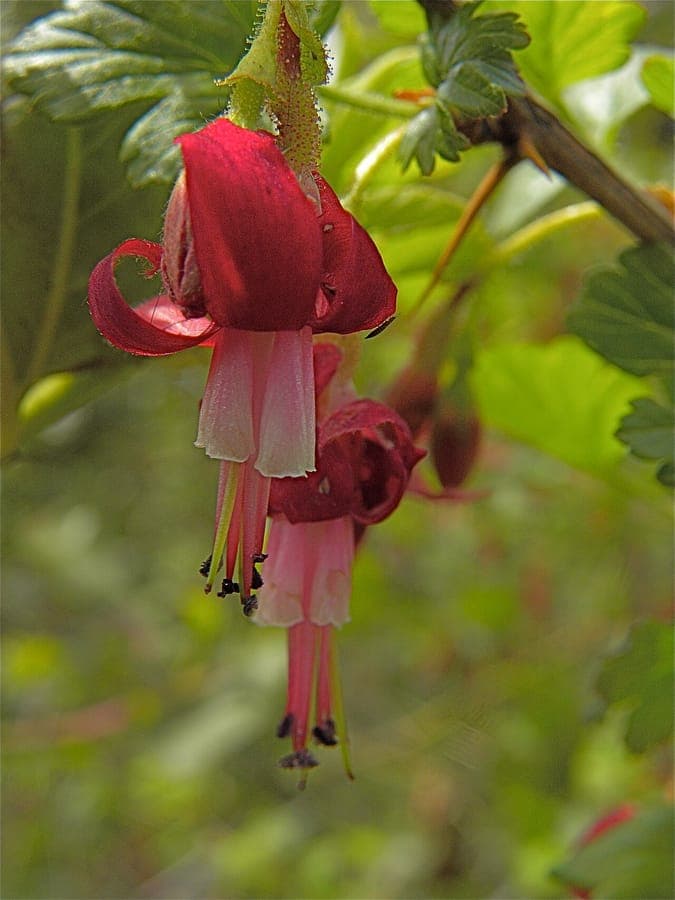
Peter Stevens from Seattle / CC BY 2.0, via Wikimedia Commons
Ribes lobbii: complete guide
Ribes lobbii
Want to see Ribes lobbii: complete guide in your garden?
1 minute, no credit card
Overview
The sticky gooseberry, scientifically known as Ribes lobbii, is a fascinating and unique shrub native to the mountain regions of the Pacific North-West of North America. The plant ranges from British Columbia in the north to Northern California in the south. This plant is characterized by its sticky leaves, interesting flowers, and thorny stems. It is a plant with great ecological value and unique characteristics.
Ribes lobbii belongs to the Grossulariaceae family, the same family as currants and gooseberries. The plant grows naturally in mountain forests and is highly adapted to well-draining soils. This makes it an interesting addition to gardens with well-draining soil in temperate climates.
Appearance and Bloom
The sticky gooseberry grows to approximately 50 to 120 centimeters tall and forms a dense, compact growth pattern. The stems are thick, dark brown to purplish-red, and very thorny. These thorns are sharp and provide the plant with a defensive barrier. This is quite different from many other currants and gooseberry species.
The leaves are small, approximately 1 to 2 centimeters long, and have a very characteristic property: they are sticky. This is due to microscopic hairs on the leaf surface that secrete a sticky substance. This gives the leaves a shiny appearance and they do indeed feel sticky to the touch.
Flowers appear from April to May and are very attractive. They are red to purplish-red in color and grow in small clusters. The flowers have an aromatic scent that attracts many insects. After flowering, berries develop that are approximately 10 to 15 millimeters in diameter. These berries are brownish to reddish and are not very edible for humans.
Ideal Location
The sticky gooseberry grows best in full sun to partial shade. The plant thrives in locations with 5 to 7 hours of direct sunlight per day. In warm climates, some afternoon shade may be beneficial. The plant also tolerates semi-shade well, although this results in fewer flowers.
The plant is well-suited to west-facing slopes and locations where very good drainage is possible. This can be against rock outcrops, on slopes, or on raised beds.
Soil
The sticky gooseberry has very specific soil requirements. The plant grows best on well-draining, acidic soils with a pH between 5.0 and 6.5. Heavy clay soils are problematic for this plant because they cause water logging.
The plant feels at home on rocky and stony terrain and grows well on poor soils. This makes it ideal for gardens where other plants cannot grow due to poor soil quality.
Make the planting hole approximately 40 centimeters deep and wide. Use a mixture of sand, compost, and ericaceous soil for best results. Raise the planting level by 5 to 10 centimeters to ensure good drainage.
Free design
Want to see Ribes lobbii: complete guide in your garden? Make a free design now.
Watering
The sticky gooseberry is drought tolerant and requires minimal watering once well-established. The deep root system helps the plant withstand dry periods.
During the first growing season, water regularly until the plant is well-established. This typically takes 4 to 6 weeks. Water when the top 3 centimeters of soil feel dry. Avoid water stagnation absolutely.
In normal years with adequate rainfall, you won't need much supplemental watering after this establishment period. In extremely dry summers, some supplemental watering can be helpful.
Pruning
The sticky gooseberry requires minimal pruning. The plant grows naturally compact. However, in spring (March/April), you can remove dead branches. Make sure to wear gloves due to the sharp thorns!
If you want to keep the plant tidier, best remove older branches (older than 4 years) in spring. This stimulates new, flower-rich growth. Also remove low-hanging branches that touch the ground.
Avoid aggressive pruning; this plant does not respond well to heavy pruning. Don't prune more than 1/4 of the volume in one year.
Maintenance Calendar
March-April: Remove dead branches (with gloves!). Prune for shape improvement. Check drainage.
April-May: Flowers appear. Red to purplish flowers. Very aromatic. Check watering needs.
June-August: Flowering finished. Berries grow. No watering needed unless extremely dry.
September-October: Berries ripen. Winter preparation. Clean up fallen leaves.
November-February: Dormant period. Minimal maintenance needed.
Winter Hardiness
The sticky gooseberry is extremely hardy and tolerates temperatures down to minus 30 degrees Celsius. This makes it suitable for many Northern and Central European gardens. The plant is fully cold-hardy.
Companion Plants
The sticky gooseberry combines well with other West-American shrubs and alpine plants. Try:
Douglas fir (Pseudotsuga menziesii) - natural mountain combination
Arbutus and other West-American species - ecological combination
Sandy rocky places - natural habitat simulation
Other Ribes species - family mix
Closing
The sticky gooseberry is a perfect choice for gardens with well-draining soil and full sun. This plant offers unique visual and aromatic experiences with its sticky leaves and aromatic flowers. Once planted, this plant will last for many years with minimal care. This is a valued plant for gardeners who want to add botanical uniqueness and West-American flora to their gardens.
Ribes lobbii is not always offered in Dutch garden centers. Specialized nurseries and online suppliers offer this plant best. This is a plant for gardeners who love botanical rarities.
Want to see Ribes lobbii: complete guide in your garden? Make a free design now.
Upload a photo, pick a style, and get a photorealistic design with plant list in under a minute.
No credit card required


Similar plants
Canadian gooseberry: complete guide
Ribes oxyacanthoides
Discover the Canadian gooseberry, an extremely hardy North American fruit shrub with bristly stems and tart berries for jams and orchards.
Ribes bracteosum: complete guide to this Pacific Northwest shrub
Ribes bracteosum
Grow stink currant, a hardy Pacific Northwest shrub with deep-lobed foliage, fragrant blooms, and dark berries attractive to birds.
Ribes acerifolium: complete guide
Ribes acerifolium
Discover Mapleleaf currant - a stunning native shrub with maple-like leaves and interesting berries. Ideal for natural gardens.