
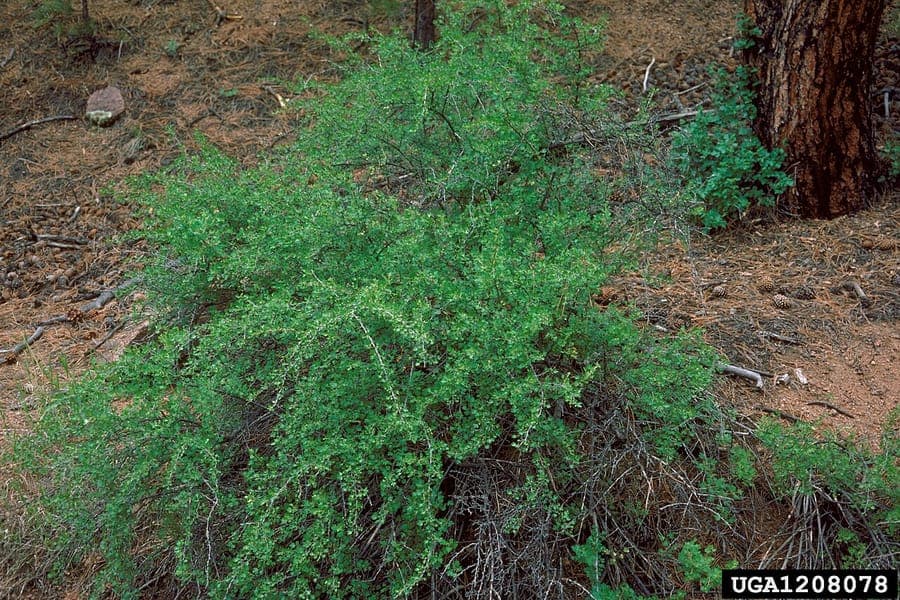
Dave Powell, USDA Forest Service, Bugwood.org / Public domain, via Wikimedia Commons
Ribes inerme: complete guide
Ribes inerme
Want to see Ribes inerme: complete guide in your garden?
1 minute, no credit card
Overview
The white-stem gooseberry, scientifically known as Ribes inerme, is an interesting wild fruit plant native to the mountain regions of Western Canada and the western United States. This plant is characterized by its white stems (hence the name), dark green leaves, and inconspicuous flowers followed by dark berries. It is a low-maintenance plant that thrives in dry, mountainous terrain.
Ribes inerme belongs to the Grossulariaceae family, the same family as currants and gooseberries. This family contains more than 150 species distributed worldwide. The plant grows from Western Canada to the western United States and is, despite its origin, far more tolerant of European climates than one might expect.
Appearance and Bloom
The white-stem gooseberry grows to approximately 50 to 100 centimeters tall and forms a dense, compact growth pattern. The stems are thin, whitish-green to gray in color (unlike the brown stems of many other currants) and thornless (without spines or prickles). This thornlessness is unique among many currants and is why this plant is called "inerme" (meaning "unarmed").
The leaves are green, small, approximately 1 to 3 centimeters long, and have a round to slightly toothed shape. They are densely packed on the stems and give the plant a delicate appearance.
The flowers appear from May to June but are very small and inconspicuous. They are yellowish-green and appear in clusters of 3 to 5 flowers. The flowering period is short, usually several weeks. After flowering, dark, shiny berries develop that are approximately 8 to 10 millimeters in diameter. These berries are blue-black to black and can be eaten raw.
Ideal Location
The white-stem gooseberry grows best in full sun to partial shade. The plant thrives in locations with 4 to 6 hours of direct sunlight per day. In very hot climates, some afternoon shade may be beneficial. The plant also tolerates shade well, although this may result in less fruit production.
The plant is very wind- and weather-resistant, making it ideal for open, mountainous locations. Place it where wind can blow freely without damaging the plant.
Soil
Ribes inerme is not very fussy about soil types and grows well in poor, dry soils. The pH should be between 6.0 and 7.5, meaning the plant prefers neutral to slightly alkaline soil. This is very different from many other currants which prefer more acidic soil.
The plant is very drought tolerant and thrives in poor, sandy soils. This makes it ideal for gardens on sandy soil or in mountainous areas where soil quality is limited. It can also grow well on rocky or stony ground.
Make the planting hole only 30 centimeters deep and wide. Mixing with compost is not strictly necessary, although it will do no harm.
Free design
Want to see Ribes inerme: complete guide in your garden? Make a free design now.
Watering
The white-stem gooseberry is very drought tolerant and, as an established plant (after the first growing season), requires minimal supplemental watering. This makes it an ideal choice for dry areas or gardens with water-saving ideals.
During the first growing season, water regularly until the plant is well-established. This typically takes 3 to 4 weeks. Water when the top 3 centimeters of soil feel dry. In normal years with adequate rainfall, you won't need to water again after this establishment period.
In extremely dry summers (such as 2022 in the Netherlands), some supplemental watering can be helpful, but it is not essential.
Pruning
The white-stem gooseberry requires minimal pruning. The plant grows naturally compact. However, in spring (March/April), you can remove dead branches. Pruning for shape improvement is not necessary.
If you want the plant to remain productively fruiting, best remove older branches (older than 3 years) in spring. This stimulates new, fruitful growth. Also remove low-hanging branches that touch the ground.
Don't remove more than 1/4 of the total volume in one year, or you'll weaken the plant.
Maintenance Calendar
March-April: Remove dead branches. Prune for shape improvement. Water if dry.
May-June: Flowers appear. Inconspicuous blooms. Check watering needs.
July-August: Berry set. Berries grow and color. No watering needed unless extremely dry.
September-October: Harvest berries when fully black. Clean up fallen leaves.
November-February: Dormant period. Minimal maintenance needed.
Winter Hardiness
The white-stem gooseberry is extremely hardy and tolerates temperatures down to minus 30 degrees Celsius. This makes it suitable for all Dutch and Belgian gardens. The plant is fully cold-hardy and requires no protection.
Companion Plants
The white-stem gooseberry combines well with other drought- and mountain-tolerant plants. Try:
Dog rose and rose shrubs - natural combination
Anthemis (Chamomile-like) - fine contrast
Grasses (Festuca, Carex) - structure
Juniperus (Juniper) - permanent structure
Closing
The white-stem gooseberry is an excellent choice for gardens with dry, poor soils or mountainous terrain. This plant is low-maintenance and produces nutritious berries each year. Once established, this plant will last for many years with minimal care. Interest in this plant is growing in Europe as more gardeners seek water-saving plant species that still produce food.
Ribes inerme is not always offered in Dutch garden centers. Specialized nurseries and online suppliers offer this plant best. Try asking for it at larger garden centers too.
Want to see Ribes inerme: complete guide in your garden? Make a free design now.
Upload a photo, pick a style, and get a photorealistic design with plant list in under a minute.
No credit card required


Similar plants
Canadian gooseberry: complete guide
Ribes oxyacanthoides
Discover the Canadian gooseberry, an extremely hardy North American fruit shrub with bristly stems and tart berries for jams and orchards.
Ribes bracteosum: complete guide to this Pacific Northwest shrub
Ribes bracteosum
Grow stink currant, a hardy Pacific Northwest shrub with deep-lobed foliage, fragrant blooms, and dark berries attractive to birds.
Ribes acerifolium: complete guide
Ribes acerifolium
Discover Mapleleaf currant - a stunning native shrub with maple-like leaves and interesting berries. Ideal for natural gardens.