
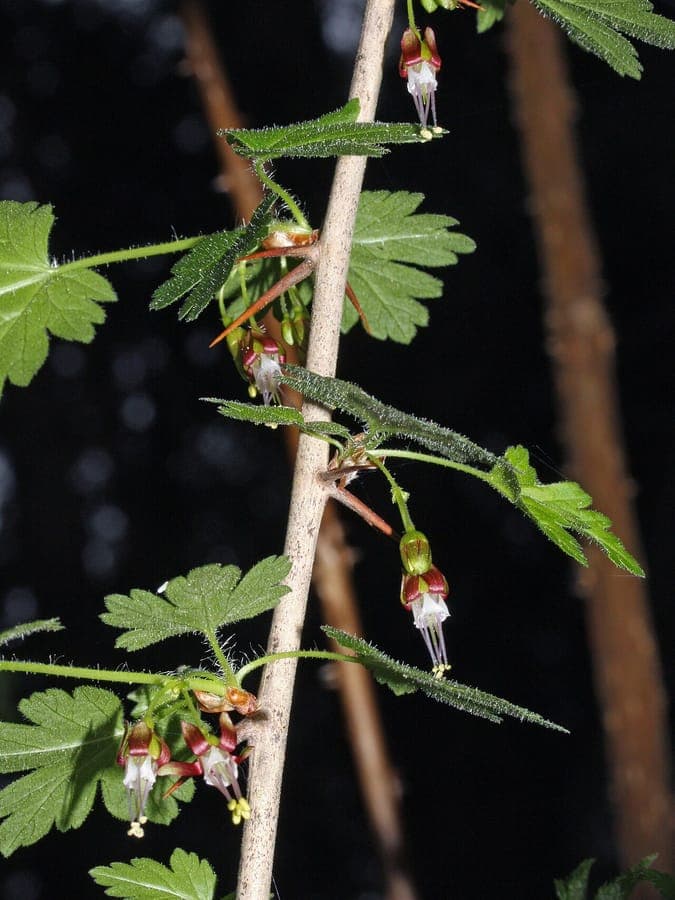
Walter Siegmund (talk) / CC BY-SA 3.0, via Wikimedia Commons
Wild black gooseberry: complete guide
Ribes divaricatum
Want to see Wild black gooseberry: complete guide in your garden?
1 minute, no credit card
Overview
Ribes divaricatum, commonly known as wild black gooseberry, is a deciduous shrub in the Grossulariaceae family. Native to the Pacific Northwest - stretching from British Columbia down through Washington, Oregon, and into California - this hardy plant thrives in woodland edges, stream banks, and moist forest clearings. It's not originally from the UK or broader Europe, but it adapts well to temperate gardens, especially those aiming for a natural, wildlife-friendly design.
In recent years, more gardeners have discovered its value. The plant supports early pollinators and offers edible berries that, while tart, make excellent jams and syrups. You'll find it increasingly stocked at garden centres, particularly those focusing on native or ecological species. Unlike cultivated gooseberries, it's more rugged, with pronounced thorns and a loose, open growth habit.
If you're planning a layered planting scheme, the wild black gooseberry fits perfectly in the mid-storey. On gardenworld.app, you can build a custom garden plan that integrates this shrub with companion plants for year-round interest and structural balance.
Appearance & bloom cycle
This shrub reaches 1.5 to 2 meters in height, with a spread of about 1.2 meters. Its stems are zigzagging and widely spreading, often with dark purple to reddish bark that peels slightly with age. Young stems are armed with sharp, stout spines - sometimes in clusters of three - making it less ideal near pathways.
Flowering occurs from February to April, depending on local climate. The pendulous, bell-shaped flowers hang in small clusters of 2 to 6, each about 1 to 1.5 cm long. They range from pale yellow to creamy white, often with a hint of green. What's special is their timing: they bloom before the leaves emerge, offering nectar when few other plants do.
By June, green berries form, ripening to deep purple or near-black by early July. The fruit is round, 8–12 mm in diameter, with a whitish bloom typical of many Ribes species. Birds love them, so netting may be needed if you want to harvest for kitchen use.
Ideal location
For best results, plant in partial shade - east or north-east facing spots work well. Full sun is acceptable if the soil stays reliably moist, but intense afternoon sun in summer can stress the plant, especially when young. Deep shade, on the other hand, reduces flowering and fruit set.
This shrub excels in woodland gardens, native hedgerows, or as part of a wildlife border. It pairs beautifully with ferns, wild ginger (Asarum), and early spring bulbs. Avoid tight corners or high-traffic areas due to the spiny stems.
If you're visualizing where to place it, gardenworld.app lets you map out your garden layout and test plant combinations before buying.
Free design
Want to see Wild black gooseberry: complete guide in your garden? Make a free design now.
Soil requirements
Wild black gooseberry prefers moist, well-drained soil rich in organic matter. A pH between 5.5 and 7.0 is ideal. It tolerates clay if not waterlogged, and sandy soils as long as they're amended with compost. Avoid highly alkaline or chalky soils - this plant prefers slightly acidic to neutral conditions.
At planting, mix in a generous amount of compost or well-rotted manure. No need for synthetic fertilisers; this shrub evolved in nutrient-cycling forest systems and does best with natural inputs.
Watering
During the first growing season, water weekly with 10–15 liters per plant, especially during dry spells. Once established, it's moderately drought-tolerant, but prolonged dry periods in early summer can reduce berry production. Always aim to keep the root zone moist but not soggy.
Use rainwater when possible. Tap water with high lime content may affect long-term health, leading to chlorosis in leaves.
Pruning
Minimal pruning is required. The best time is late winter or early spring, before new growth starts. Focus on removing old, weak, or crossing branches to improve air circulation and encourage new shoots.
If shaping is needed, cut back up to one-third of the oldest stems to the base. Wear thick gloves - those spines are no joke. Avoid heavy pruning in summer, as it may remove next year's flower buds.
Maintenance calendar
- Jan: Check structure, remove any winter damage
- Feb: Watch for early blooms, protect from late frosts
- Mar: Light pruning, inspect for aphids
- Apr: Apply compost mulch, keep soil covered
- May: Monitor moisture, especially in dry springs
- Jun: Fruit begins to swell, avoid wetting foliage
- Jul: Harvest berries, check for fungal issues
- Aug: Reduce watering unless drought persists
- Sep: Leave fallen fruit for wildlife
- Oct: Let leaves decompose naturally as mulch
- Nov: Final inspection, light tidying if needed
- Dec: Protect young plants with burlap if extreme cold is forecast
Winter hardiness
This shrub is hardy to USDA zone 6 (-20°C), making it suitable for most of the UK, Ireland, and northern Europe. In colder zones, young plants may benefit from a protective wrap. It loses its leaves in autumn but the purple-tinged stems add winter texture, especially when lightly dusted with frost.
Companion plants
Great companions include red osier dogwood (Cornus sericea), serviceberry (Amelanchier), and native honeysuckle (Lonicera ciliosa). Underplant with foamflower (Tiarella), barren strawberry (Waldsteinia), or twinflower (Linnaea borealis) for a natural look.
For a bird-friendly garden, combine with elderberry or snowberry to create dense, protective thickets. These combinations offer food and shelter across seasons.
Closing
The wild black gooseberry is a quiet performer, not flashy but full of ecological value. It supports pollinators, feeds birds, and adds subtle beauty to the garden with its early blooms and dangling fruit. With minimal care, it can thrive for decades.
Whether you're expanding a cottage garden or designing a wildlife corridor, this shrub earns its place. For layout ideas and planting combinations, head to gardenworld.app and create a plan that puts function and nature first.
Want to see Wild black gooseberry: complete guide in your garden? Make a free design now.
Upload a photo, pick a style, and get a photorealistic design with plant list in under a minute.
No credit card required


Similar plants
Canadian gooseberry: complete guide
Ribes oxyacanthoides
Discover the Canadian gooseberry, an extremely hardy North American fruit shrub with bristly stems and tart berries for jams and orchards.
Ribes bracteosum: complete guide to this Pacific Northwest shrub
Ribes bracteosum
Grow stink currant, a hardy Pacific Northwest shrub with deep-lobed foliage, fragrant blooms, and dark berries attractive to birds.
Ribes acerifolium: complete guide
Ribes acerifolium
Discover Mapleleaf currant - a stunning native shrub with maple-like leaves and interesting berries. Ideal for natural gardens.