
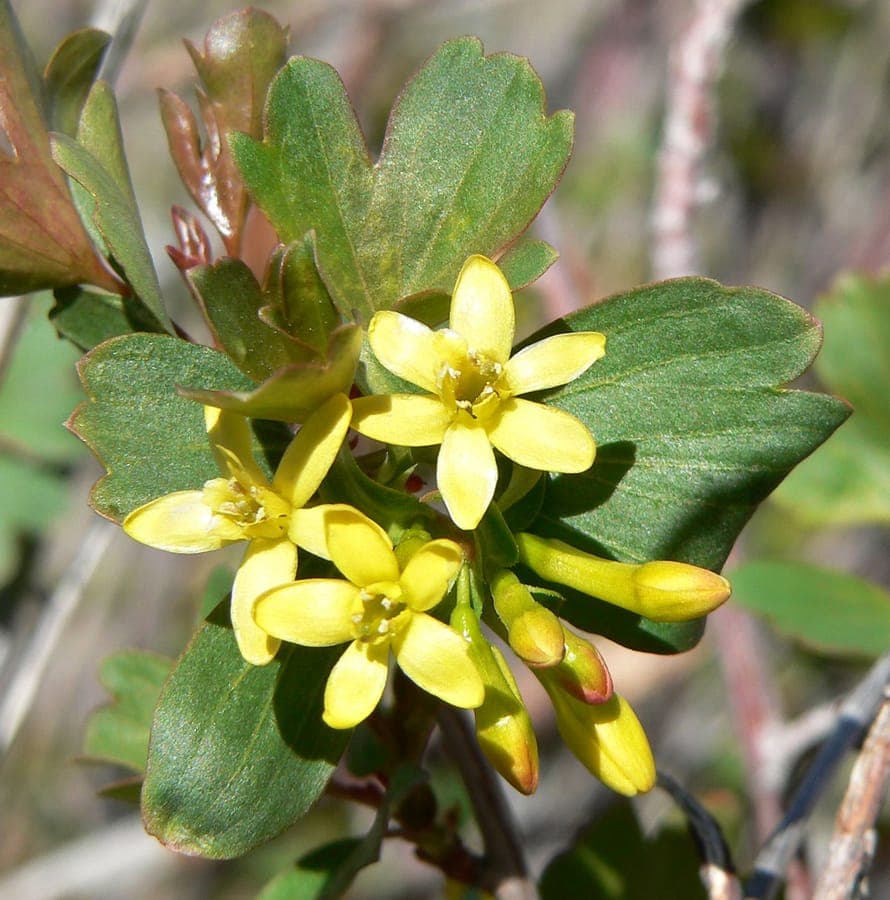
Stan Shebs / CC BY-SA 3.0, via Wikimedia Commons
Golden currant: complete guide
Ribes aureum
Want to see Golden currant: complete guide in your garden?
1 minute, no credit card
Overview
Golden currant (Ribes aureum) is a tough, adaptable shrub that earns its place in any garden that values resilience, beauty, and utility. Native to western and central North America-from Alberta down to Arizona and east to Iowa-this member of the Grossulariaceae family thrives in diverse conditions, from rocky slopes to riparian zones. In the garden, it brings early spring color, edible fruit, and a magnet for pollinators.
On gardenworld.app, you can design a layout that integrates Golden currant into a wildlife hedge or mixed edible border, helping you visualize spacing and companion planting.
Appearance & bloom cycle
Golden currant grows 4 to 6 feet (120–180 cm) tall and spreads 3 to 5 feet (90–150 cm) wide with an open, arching habit. The palmate leaves are medium green, turning slightly yellow in fall, and have a soft, slightly aromatic feel when brushed. In late April to early June, depending on your zone, clusters of tubular golden-yellow flowers appear-some with a faint purple tinge-hanging in racemes up to 5 cm long.
These blooms are rich in nectar and among the first to attract hummingbirds, native bees, and early butterflies. By midsummer, fruits develop: round, translucent berries 0.3 to 0.5 inches (8–12 mm) in diameter. They ripen from green to golden yellow or amber, sometimes with a russet blush. The flavor is sweet-tart, excellent for jams, pies, or eating fresh. Note: some selections are self-fertile, but fruit set improves with a second plant nearby for cross-pollination.
Ideal location
Plant Golden currant in full sun to light shade. For best flowering and fruiting, aim for at least 5–6 hours of direct sunlight daily. In hotter zones (7–8), afternoon shade helps prevent leaf scorch. It's ideal for informal hedges, naturalized areas, slope stabilization, or as a specimen in a cottage garden.
Space plants 4 feet (120 cm) apart for a loose hedge, or 6 feet (180 cm) if you want individual specimens. The shrub spreads slowly by root suckers; use a root barrier if containment is needed. On gardenworld.app, use the spacing calculator to map out exact distances and avoid overcrowding.
Soil requirements
Golden currant tolerates a wide range of soils-sand, loam, clay-as long as drainage is adequate. Ideal pH is 6.0 to 8.0. It handles alkaline soils better than most Ribes species. While it survives in poor soils, it performs best in moderately moist, organically rich ground.
Amend heavy clay with compost or grit to improve drainage. In sandy soils, add compost to boost moisture retention. A yearly top-dressing of compost in early spring is usually sufficient for nutrition. Avoid high-nitrogen fertilizers-they promote leafy growth at the expense of flowers.
Free design
Want to see Golden currant: complete guide in your garden? Make a free design now.
Watering
During the first growing season, water deeply once a week, applying 10–15 liters per plant. After establishment (12–18 months), it's moderately drought-tolerant but responds well to occasional deep watering during dry spells. Established plants need water only when the top 5 cm of soil feels dry.
Use mulch-shredded bark or leaf mold-around the base to conserve moisture and suppress weeds. Avoid piling mulch against the crown to prevent rot.
Pruning
Prune in late winter to early spring (February to March), before bud break. Remove dead, damaged, or crossing branches. Every year, cut out one-third of the oldest stems at ground level to encourage new, productive growth. This keeps the shrub vigorous and open.
Avoid heavy pruning in fall or early winter, as flower buds for next spring are already set. If shaping is needed, do it lightly right after flowering, but know you may sacrifice some fruit.
Maintenance calendar
- Jan: Inspect for winter damage, plan pruning
- Feb: Begin pruning, remove dead wood
- Mar: Apply compost, monitor for swelling buds
- Apr: Flowers appear, pollinators active, watch for aphids
- May: Peak bloom, ensure water in dry periods
- Jun: Fruit begins to form, reduce pruning
- Jul: Harvest berries, check for powdery mildew
- Aug: Reduce watering, allow slight stress to harden off
- Sep: Watch for suckers, transplant or remove
- Oct: Mulch base, prepare for winter
- Nov: Final inspection, minimal care needed
- Dec: Dormant period, no action required
Winter hardiness
Golden currant is hardy in USDA zones 4–8, tolerating winter lows down to -34°C (-30°F). It reliably survives most UK and US winters without protection. Young plants may benefit from a layer of mulch in their first winter, especially in sandy or exposed sites.
No winter covering is needed, though heavy snow can help insulate the root zone. In zone 8, ensure some summer moisture to prevent stress.
Companion plants
Pair Golden currant with drought-tolerant perennials like penstemon, echinacea, or salvia. For edible pairings, plant alongside serviceberry, elderberry, or chokeberry. Low-growers like creeping thyme or oregano work well at the base, suppressing weeds and adding fragrance.
Avoid moisture-hungry plants like hostas or ferns unless you're using irrigation zones to separate needs.
Closing
Golden currant is an underrated gem: low maintenance, wildlife-supportive, and productive. It fits into wildlife gardens, edible landscapes, or even urban yards with limited space. Plant in fall or early spring from reputable garden centres. Look for healthy, disease-free stock at local nurseries or chains like OBI or Hornbach in Europe, or general garden centres in North America.
If you're unsure where to place it, gardenworld.app offers design tools to help you integrate it seamlessly into your garden's ecosystem.
Want to see Golden currant: complete guide in your garden? Make a free design now.
Upload a photo, pick a style, and get a photorealistic design with plant list in under a minute.
No credit card required


Similar plants
Canadian gooseberry: complete guide
Ribes oxyacanthoides
Discover the Canadian gooseberry, an extremely hardy North American fruit shrub with bristly stems and tart berries for jams and orchards.
Ribes bracteosum: complete guide to this Pacific Northwest shrub
Ribes bracteosum
Grow stink currant, a hardy Pacific Northwest shrub with deep-lobed foliage, fragrant blooms, and dark berries attractive to birds.
Ribes acerifolium: complete guide
Ribes acerifolium
Discover Mapleleaf currant - a stunning native shrub with maple-like leaves and interesting berries. Ideal for natural gardens.