
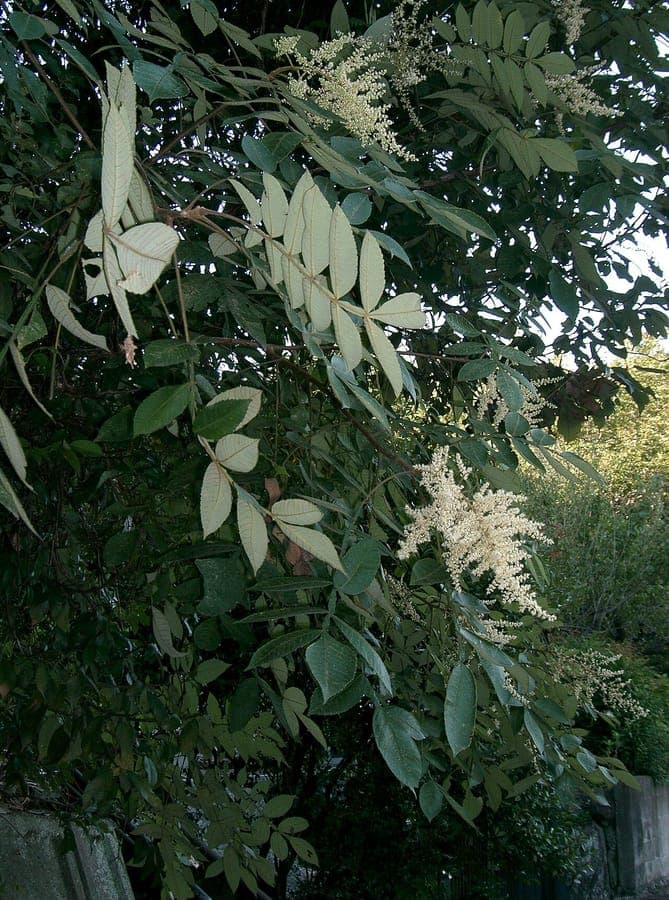
KENPEI / CC BY-SA 3.0, via Wikimedia Commons
Chinese gall: complete guide
Rhus chinensis
Want to see Chinese gall: complete guide in your garden?
1 minute, no credit card
Overview
The Chinese gall (Rhus chinensis), also known as Chinese sumac or nutgall tree, is a fascinating Asian tree belonging to the Anacardiaceae family. Originating from Pakistan, China, Japan, and other East to South Asian regions, this plant offers an unusual combination of ornamental merit and ecological value. The characteristic galls appearing on leaves inspired its nomenclature.
This tree is valued for its elegant, compound leaves, spectacular autumn coloration, and clusters of small flowers and berries. In mixed woodlands and larger gardens, it serves as a striking accent tree. Growing 5 to 8 meters tall, it provides wildlife food and ecological benefits.
Appearance and Bloom
The Chinese gall displays compound leaves with many small, glossy leaflets that assume stunning red to orange hues in fall. The trunk is polished and dark brown to gray with characteristic fluted bark. The flowers are small and greenish-yellow, gathered in compound panicles at branch tips.
Following bloom, small round fruits develop, first green, then orange-red, finally brown to black. These berries often persist through winter, providing valuable food for birds and wildlife. Foliage displays red tinges in spring before turning green.
Ideal Location
The Chinese gall thrives in sunny locations receiving at least 6 hours of direct daily sunlight. In very warm climates, some afternoon shade is beneficial. The tree is highly adaptive to various growing conditions and flowers even in partly shaded environments, though autumn color is less intense.
The tree tolerates urban conditions and pollution excellently, making it suitable for city gardens and park settings. A sheltered location provides protection against very strong winds.
Soil
The Chinese gall is remarkably soil-tolerant and grows well in virtually all soil types, from acidic to alkaline. Ideal is well-drained, nutrient-rich soil, but the tree also thrives in poorer soils. pH between 5.5 and 8 is suitable.
Good drainage matters; stagnant water causes root rot, especially on younger plants. Adding compost or organic material at planting promotes growth. This tree requires no special soil preparation and grows in most gardens without amendment.
Free design
Want to see Chinese gall: complete guide in your garden? Make a free design now.
Watering
Once well-established, the Chinese gall is quite drought-tolerant. However, for optimal growth and flowering, regular watering in the first year is crucial. Water 2-3 times weekly during the growing season, depending on rainfall and temperature.
Once established (after 1-2 growing seasons), reduce watering substantially. During dry summers, supplemental water remains beneficial. In winter, water needs minimize except during dry periods.
Pruning
The Chinese gall grows naturally into an attractive form requiring minimal pruning. Remove dead, damaged, or diseased branches as observed. Growth can be shaped through careful pruning in early spring or late summer. Avoid heavy pruning in late autumn and winter, which may cause frost damage.
For tree form, remove lower lateral branches as the tree matures, creating a clean trunk and screening of understory. Annual pruning is unnecessary and may actually damage the tree's natural form.
Maintenance Calendar
March to April: Inspect frost damage, remove dead wood, light formation pruning. May to June: Regular watering, enjoy flowering, replenish mulch. July to August: Continue watering, observe bloom and fruit set. September to October: Spectacular autumn color, reduced watering. November to February: Winter maintenance, rake fallen leaves, retain bird food.
Winter Hardiness
The Chinese gall is hardy in zones 6a through 10a (-23 to -1 degrees Celsius). However, young plants may experience frost damage in zones 6 and 6b. Plant in sheltered locations and mulch the base the first year. Once established, the tree is extremely robust and tolerates winter and summer extremes.
In very cold climates (zone 5), consider as a container plant for overwintering in a cold frame or protected environment.
Companion Plants
The Chinese gall serves excellently as background for other plants due to its large stature and autumn color. Combine with supporting plants like Juniperus squamata or Sarcococca hookeriana. For wildlife-friendly gardens, plant Mahonia aquifolium or Ilex crenata beneath.
In large settings, combines well with other deciduous trees displaying different fall patterns for extended seasonal interest. Ornamental grasses like Miscanthus provide nice contrast.
Closing
The Chinese gall is a wildlife-friendly, low-maintenance tree offering spectacular autumn color and valuable bird nutrition. With minimal pruning and moderate watering, it forms a perfect accent tree for larger gardens. Plant today and enjoy years of beauty and ecological benefits. Find availability at local garden centers and learn more at gardenworld.app and gardenworld.app.
Want to see Chinese gall: complete guide in your garden? Make a free design now.
Upload a photo, pick a style, and get a photorealistic design with plant list in under a minute.
No credit card required


Similar plants
Skunkbush sumac: complete guide
Rhus trilobata
Everything about Rhus trilobata: siting, soil, autumn colour, pruning, and how this tough ornamental shrub earns a place in any garden.
Winged sumac: complete guide
Rhus copallinum
Everything about Rhus copallinum, the winged sumac with spectacular autumn colour. Location, pruning and garden value in full detail.
Aromatic sumac: complete guide
Rhus aromatica
Full guide to aromatic sumac (Rhus aromatica): planting, soil, care, pruning and companion plants for dry, sunny gardens and slope stabilisation.