
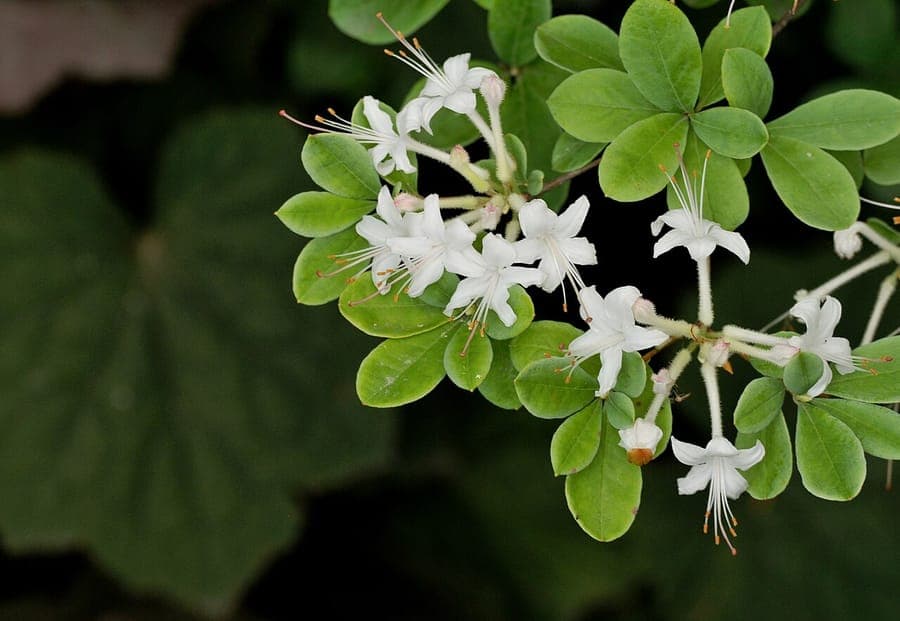
HorsePunchKid / CC BY-SA 4.0, via Wikimedia Commons
Clammy azalea: complete guide
Rhododendron viscosum
Want to see Clammy azalea: complete guide in your garden?
1 minute, no credit card
Overview
The Clammy azalea (Rhododendron viscosum), also known as swamp azalea or swamp honeysuckle, is a native North American shrub celebrated for its wonderfully fragrant flowers. Belonging to the Ericaceae family, this elegant plant originates from the eastern United States and parts of Canada. The name "viscosum" refers to the sticky texture of the flowers, a characteristic that makes this plant truly distinctive.
The Clammy azalea is prized for its white to pink flowers that appear in June and July. Growing slowly to an average height of 1 to 2 meters, it forms a dense, multi-stemmed shrub perfect for naturalistic garden designs, hedging, and woodland plantings.
Appearance and Bloom
The Clammy azalea is recognizable by its lance-shaped, green leaves that gradually transition to red or purple hues in autumn. The flowers are the true highlight: funnel-shaped, light pink to white with long stamens that extend far beyond the flower. Each flower cluster contains ten to twenty blooms that open sequentially, extending the bloom period considerably.
The flowers release a sweet, honey-like fragrance that intensifies in the evening. This makes the plant particularly attractive to butterflies, bees, and hummingbirds. Following blooms, characteristic seed capsules form and remain on the plant late into the season, adding visual interest.
Ideal Location
The Clammy azalea thrives in partial shade environments. While the plant tolerates some full sun, it blooms more prolifically and remains healthier in filtered shade beneath larger trees. In very warm regions, afternoon shade helps conserve moisture and prevents leaf scorch.
A sheltered location protected from strong winds is ideal. The plant is frost-hardy down to -25 degrees Celsius, making it suitable for most temperate climates.
Soil
Azaleas are true lovers of acidic, well-draining soil. The Clammy azalea grows optimally in soil with a pH between 4 and 7. Begin with rich, organic potting soil amended with humus and leaf mold. A blend of 50% garden soil, 30% peat moss, and 20% sand creates the perfect structure.
Ensure excellent drainage by placing broken pottery shards or gravel in the planting hole. Soil should remain moist but never waterlogged; stagnant water leads to root rot. Apply a 5 cm layer of organic mulch annually around the base, keeping it away from the stem.
Free design
Want to see Clammy azalea: complete guide in your garden? Make a free design now.
Watering
The Clammy azalea loves consistently moist soil but not waterlogged conditions. Water regularly, especially during the growing season from March through September. Check that the top 2-3 cm of soil feels moist before watering. During dry spells or hot summers, daily watering may be necessary.
In autumn and winter, reduce watering frequency accordingly. Rainwater collection is ideal, as azaleas are sensitive to chlorine and other chemicals in tap water. If using only tap water, allow it to sit for 24 hours before applying.
Pruning
The Clammy azalea grows naturally into an attractive rounded form requiring minimal pruning. Prune immediately after flowering (July-August) to avoid removing next year's flower buds. Remove spent flowers and damaged branches.
For denser growth, light pruning of young plants encourages additional lateral shoots. For older plants, careful rejuvenation pruning (10-15% yearly) stimulates renewal. Avoid aggressive pruning, which damages flowering potential.
Maintenance Calendar
March to April: Check root ball, remove dead wood, begin fertilizing. May to June: Water regularly as bloom begins, replenish mulch. July to August: Bloom ends, deadhead spent flowers, light pruning. September to October: Gradually reduce watering, prepare for winter. November to February: Minimal maintenance, frost protection for young plants.
Winter Hardiness
The Clammy azalea is hardy in zones 4b through 9a (-25 to -20 degrees Celsius minimum). Young plants may experience frost damage, so first-winter protection with straw or burlap is recommended. Mature plants are extremely robust.
In regions with severe winters (zone 4), plant in sheltered locations with wind and sun protection. Heavy frost events can damage buds, so avoid placement in low-lying frost pockets.
Companion Plants
The Clammy azalea combines beautifully with other acid-loving plants. Underplant with dwarf varieties of Hosta to create attractive contrast. Group with other Rhododendron varieties for successive bloom times.
Canopy-height companions work well with shade-loving groundcovers such as Mitchella repens or dwarf ferns. Larger companions might include Kalmia latifolia or Enkianthus campanulatus.
Closing
The Clammy azalea represents an outstanding choice for gardeners seeking fragrant blooms and easy maintenance. With proper drainage and regular watering, this North American native becomes a gorgeous addition to any partial-shade border. Plant today and enjoy next spring's enchanting fragrant flowers. Learn more plant guides at gardenworld.app and gardenworld.app.
Want to see Clammy azalea: complete guide in your garden? Make a free design now.
Upload a photo, pick a style, and get a photorealistic design with plant list in under a minute.
No credit card required


Similar plants
Zenobia pulverulenta: complete guide
Zenobia pulverulenta
Everything about Zenobia pulverulenta (honeycup): siting, acid soil, pruning and the fragrant white bells, in this complete care guide.
Dwarf huckleberry: complete guide
Gaylussacia dumosa
Everything about dwarf huckleberry (Gaylussacia dumosa): acidic soil, partial shade, pruning and care for this compact North American berry shrub.
Drooping leucothoe: complete guide
Leucothoe fontanesiana
Everything about drooping leucothoe (Leucothoe fontanesiana): shade tolerance, soil, watering, pruning, hardiness and companion plants.