
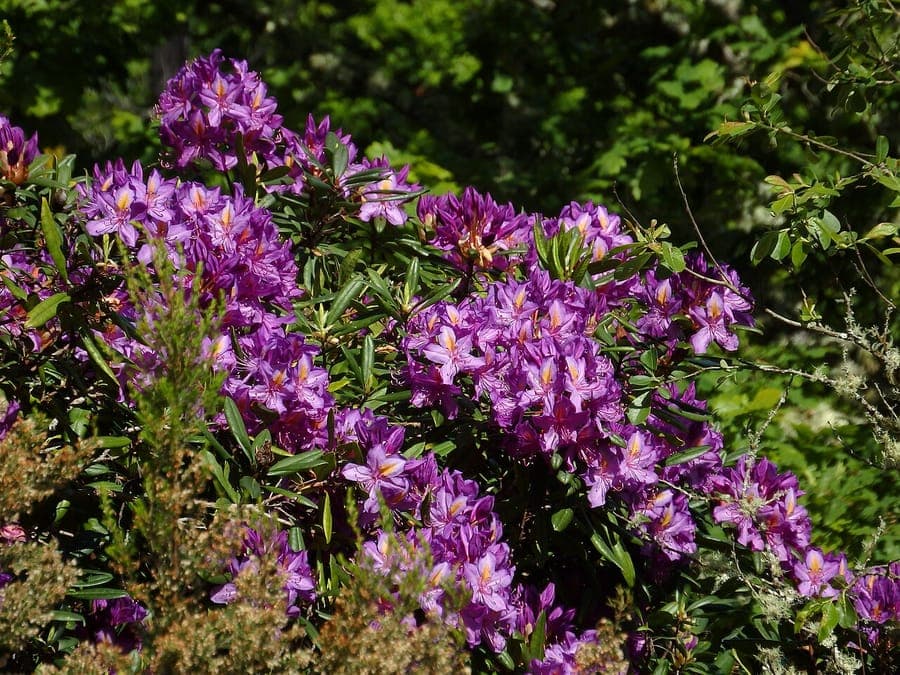
Duartefrade / CC BY-SA 3.0, via Wikimedia Commons
Pontian rhododendron: complete guide
Rhododendron ponticum
Want to see Pontian rhododendron: complete guide in your garden?
1 minute, no credit card
Overview
Rhododendron ponticum, commonly known as the Pontian rhododendron, is a tough, evergreen shrub that thrives in cool, damp climates. Native to southern Europe and parts of the Middle East, it's now naturalised in the UK, Ireland, and western France. While it can become invasive in woodland areas due to prolific seeding and layering, in a controlled garden setting it's a bold statement plant. It grows up to 4 metres tall with a spread of 3 metres, forming dense thickets over time. If you're planning a woodland-style garden or need structure in a shaded border, this shrub deserves consideration.
On gardenworld.app, you can design a garden layout that integrates Rhododendron ponticum with other acid-loving plants for year-round interest.
Appearance & bloom cycle
This rhododendron has leathery, dark green leaves that are 10–20 cm long and remain through winter. The foliage forms a dense canopy, excellent for screening. In May, large trusses of funnel-shaped purple flowers appear-about 15–20 blooms per cluster. Each flower is 4–5 cm across, with dark spotting inside the throat. The blooming period lasts 2–3 weeks, depending on weather. After flowering, woody seed capsules develop and split open in autumn, releasing fine seeds.
Plants grown in too much shade produce fewer flowers, while full sun can scorch leaves-especially in young specimens. Aim for dappled light under trees or an east-facing wall.
Ideal location
Choose a sheltered spot with partial shade-around light level 4 out of 10. An east or north aspect is ideal. Avoid hot, south-facing walls unless there's overhead canopy protection. Wind protection is crucial; winter winds dry out leaves and cause bronzing. Planting near hedges or buildings helps reduce exposure.
In mixed borders with camellias or magnolias, Rhododendron ponticum adds height and evergreen presence. Use gardenworld.app to visualise spacing and mature spread when planning your planting scheme.
Soil requirements
This shrub demands acidic soil with a pH between 5.0 and 5.5. It will not survive in alkaline or even neutral soils. The ideal ground is moist, well-drained and rich in organic matter-think forest loam or amended sandy soil. If your soil is heavy clay, improve drainage with pine bark fines and leaf mould. Avoid liming and steer clear of mortar debris, which leaches lime into the soil.
Test your soil annually. If leaves turn yellow between veins (chlorosis), treat with iron chelates and apply ericaceous compost or fertiliser.
Free design
Want to see Pontian rhododendron: complete guide in your garden? Make a free design now.
Watering
Water deeply once a week during dry spells, especially in the first two years. Always use rainwater-tap water is often too alkaline. Never let the rootball dry out completely. Mulch annually with pine needles or ericaceous compost to retain moisture and suppress weeds. Keep mulch away from the main stem to prevent rot.
Established plants are fairly drought-tolerant but still benefit from watering in prolonged dry summers.
Pruning
Pruning isn't usually required, but you can deadhead spent flower trusses to encourage energy into growth rather than seeding. Cut just below the truss, being careful not to damage next year's buds. If the plant becomes too large, cut back main stems after flowering-these can resprout from old wood, but slowly. Avoid hard pruning in late summer or autumn, as this may stimulate tender growth vulnerable to frost.
Use clean, sharp tools and disinfect between cuts to prevent disease spread.
Maintenance calendar
- Jan: Check for wind rock and frost damage. Stake if needed.
- Feb: Lightly water container plants on mild days.
- Mar: Apply ericaceous fertiliser as growth begins.
- Apr: Monitor for pests like vine weevil and lace bugs.
- May: Peak bloom-enjoy and consider deadheading.
- Jun: Finish deadheading by early June. Mulch if not done earlier.
- Jul: Water during dry periods. Watch for powdery mildew in humid weather.
- Aug: No feeding-new growth risks frost damage.
- Sep: Collect seeds if propagating. Inspect for fungal spots.
- Oct: Top up mulch layer. Protect young plants with fleece if early frosts hit.
- Nov: Remove debris to reduce disease carryover.
- Dec: Check ties on young plants; tighten if loose.
Winter hardiness
Hardy in USDA zones 7–9. In the UK (mostly zone 8), it survives most winters, but young plants benefit from fleece protection during prolonged cold. Avoid de-icing salt nearby-runoff harms roots. Mulching helps insulate roots from freeze-thaw cycles.
Companion plants
Pair with other acid-lovers: Azalea mollis, Pieris forrestii, Camellia japonica, and ferns like Polystichum setiferum. Avoid lime-requiring plants such as lavender, mock orange, or herbaceous peonies. Underplant with epimedium or hellebores for spring interest.
Closing
Rhododendron ponticum is a resilient, long-lived shrub that brings structure and dramatic bloom to shaded gardens. It's not one for small spaces, but in larger plots it's unmatched for impact. Be mindful of its invasive potential-remove seed heads if you're near natural woodlands. Buy from reputable garden centres in spring, when plants are in bloom and easier to assess. OBI or Hornbach stock good specimens in Germany, while Truffaut and Jardiland carry them in France. In the UK, check local garden centres. On gardenworld.app, you can simulate how this rhododendron matures over time and whether it complements your garden's layout.
Want to see Pontian rhododendron: complete guide in your garden? Make a free design now.
Upload a photo, pick a style, and get a photorealistic design with plant list in under a minute.
No credit card required


Similar plants
Zenobia pulverulenta: complete guide
Zenobia pulverulenta
Everything about Zenobia pulverulenta (honeycup): siting, acid soil, pruning and the fragrant white bells, in this complete care guide.
Dwarf huckleberry: complete guide
Gaylussacia dumosa
Everything about dwarf huckleberry (Gaylussacia dumosa): acidic soil, partial shade, pruning and care for this compact North American berry shrub.
Drooping leucothoe: complete guide
Leucothoe fontanesiana
Everything about drooping leucothoe (Leucothoe fontanesiana): shade tolerance, soil, watering, pruning, hardiness and companion plants.