
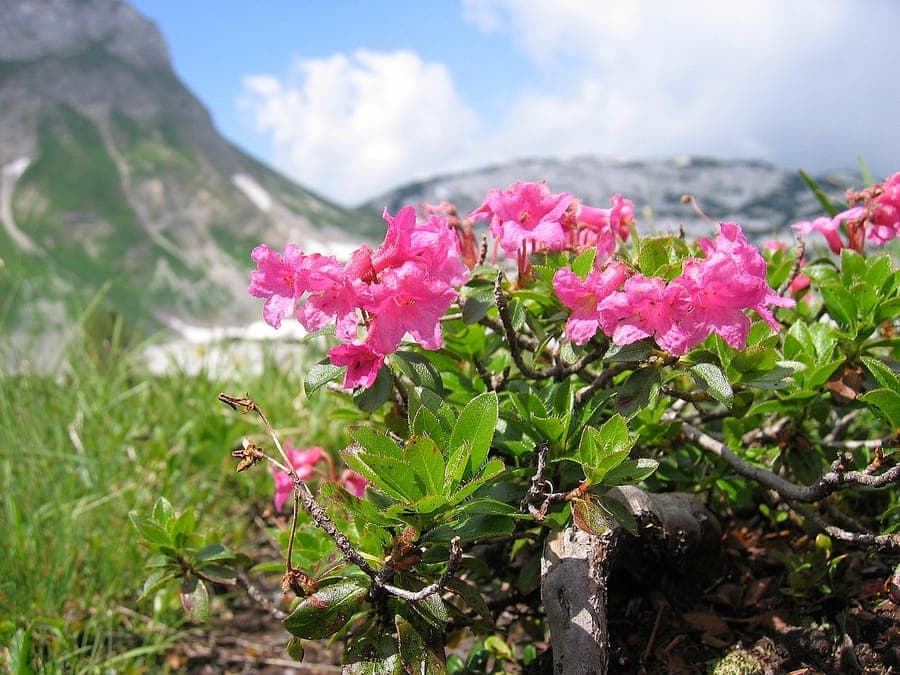
User:Tigerente / CC BY 2.5, via Wikimedia Commons
Hairy alpenrose: complete guide
Rhododendron hirsutum
Want to see Hairy alpenrose: complete guide in your garden?
1 minute, no credit card
Overview
Rhododendron hirsutum, the hairy alpenrose, is an alpine subshrub native to the limestone-rich slopes of the southern Alps. Found in Austria, northern Italy, Switzerland, and parts of the former Yugoslavia, this plant stands out in its family - Ericaceae - for thriving in neutral to slightly alkaline soils, unlike most rhododendrons that demand acidic conditions. It's compact, hardy, and blooms with rich purple flowers from late spring into summer. For gardeners in the UK and US zones 5–8, it's a smart pick for rock gardens or sunny, well-drained slopes.
On gardenworld.app, you can visualise how this plant fits into a low-maintenance alpine scene, paired with gravel, stone, and drought-tolerant companions.
Appearance & bloom cycle
This subshrub reaches 30–60 cm in height and spreads about 40 cm wide. It grows slowly, forming a dense, woody base with leathery, oblong leaves densely covered in fine hairs - giving it a soft, silvery underside and the 'hirsutum' name. The foliage stays semi-evergreen in mild winters.
From May through July, clusters of bell-shaped purple flowers emerge at the stem tips. Each bloom is 2–3 cm long, with a deeper hue on the outside and a paler throat. The flowers attract bumblebees and hoverflies, making it a quiet but valuable pollinator plant. Deadheading isn't necessary - the seed capsules add winter texture.
Ideal location
Aim for a light level of 7 out of 10 - meaning full morning sun with light afternoon shade. In the UK, a south-facing rock crevice or gravel bank works well. In the US, especially in zones 7–8, provide protection from hot afternoon sun to prevent leaf scorch. East- or southeast-facing slopes are ideal.
Avoid deep shade - this reduces flowering. Also avoid exposed, windy ridges unless the plant is sheltered by stones or low walls. On gardenworld.app, you can map microclimates in your garden to find the perfect sunny yet protected spot for your alpenrose.
Soil requirements
pH is critical: aim for 7.0–7.5. This is unusually high for a rhododendron, but essential for R. hirsutum. It needs well-drained, gritty soil rich in limestone. A mix of loam, coarse sand, and crushed gravel works best. Do not use ericaceous compost - it will stunt growth or kill the plant.
If your soil is acidic, grow it in a raised bed or container with a custom alkaline mix. Incorporate garden lime sparingly (about 50 g per 10 L of soil) to maintain pH. Avoid waterlogged clay at all costs - root rot sets in quickly.
Free design
Want to see Hairy alpenrose: complete guide in your garden? Make a free design now.
Watering
Young plants need regular watering during their first growing season, especially in dry spells. Once established, Rhododendron hirsutum is fairly drought-tolerant. Water deeply but infrequently - once a week during prolonged dry periods in June and July.
Use rainwater when possible; tap water with high chlorine content can build up in the soil. Never waterlog - the roots need oxygen. Mulch with fine gravel (not bark) to retain moisture without trapping humidity around the crown.
Pruning
Pruning is minimal. Only remove dead, damaged, or crossing stems in early spring before new growth starts. Do not cut into old wood - this species doesn't regenerate well from bare stems.
If the plant becomes leggy over time, gently thin out older stems to encourage dense new growth. Use clean, sharp secateurs disinfected between cuts to prevent disease spread.
Maintenance calendar
- Jan: Check for frost damage. Protect young plants with pine boughs if needed.
- Feb: No action required.
- Mar: Remove any winter dieback. Avoid fertilising.
- Apr: Inspect for aphids. Begin light watering if soil is dry.
- May: Flower buds swell. Maintain even moisture.
- Jun: Peak bloom. Watch for drought stress.
- Jul: Flowers fade. No pruning.
- Aug: Dormant period. No feeding.
- Sep: No care needed.
- Oct: Clear fallen leaves. Avoid wet mulch.
- Nov: Apply a thin layer of gravel mulch for winter drainage.
- Dec: Monitor for ice damage. No watering in frozen soil.
Winter hardiness
Hardy to USDA zone 5 (-20°C / -4°F). In the UK, it survives most winters without protection, but young plants benefit from a loose cover of horticultural fleece or pine branches. The key is dry roots - wet, frozen soil is the main threat.
Avoid heavy organic mulches that retain moisture. Gravel or crushed stone mulch is better for keeping the crown dry.
Companion plants
Pair with plants that share its need for alkaline, fast-draining soil:
- Campanula carpatica (up to 30 cm)
- Dianthus 'Bath's Pink' (pink blooms, fragrant)
- Sedum spurium (ground-hugging succulent)
- Thymus pseudolanuginosus (woolly thyme)
- Aubrieta × cultorum (early spring purple carpet)
These create a layered, naturalistic rock garden. Keep spacing tight - 25–30 cm between plants - to reduce weed growth and stabilise soil.
Closing
Rhododendron hirsutum isn't a common sight in most garden centres, but it's worth seeking out for its resilience and quiet beauty. It's not flashy, but it's dependable - blooming reliably year after year with little fuss. Look for it at specialist nurseries or alpine plant sales.
In the UK and US, check retailers like garden centres in spring, or order online. In the US, try specialty alpine suppliers; in the UK, local garden centres sometimes stock it. On gardenworld.app, you can design a rock garden layout that includes this plant alongside companions and hardscaping - helping you build a low-maintenance, high-character space.
Want to see Hairy alpenrose: complete guide in your garden? Make a free design now.
Upload a photo, pick a style, and get a photorealistic design with plant list in under a minute.
No credit card required


Similar plants
Zenobia pulverulenta: complete guide
Zenobia pulverulenta
Everything about Zenobia pulverulenta (honeycup): siting, acid soil, pruning and the fragrant white bells, in this complete care guide.
Dwarf huckleberry: complete guide
Gaylussacia dumosa
Everything about dwarf huckleberry (Gaylussacia dumosa): acidic soil, partial shade, pruning and care for this compact North American berry shrub.
Drooping leucothoe: complete guide
Leucothoe fontanesiana
Everything about drooping leucothoe (Leucothoe fontanesiana): shade tolerance, soil, watering, pruning, hardiness and companion plants.