
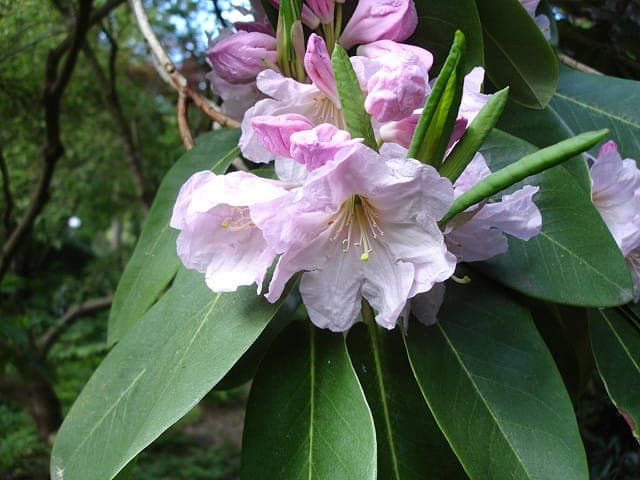
Ulf Eliasson epibase 08:33, 30 November 2006 (UTC) / CC BY-SA 2.5, via Wikimedia Commons
Rhododendron fortunei: complete guide
Rhododendron fortunei
Want to see Rhododendron fortunei: complete guide in your garden?
1 minute, no credit card
Overview
Rhododendron fortunei, named after Robert Fortune, the Scottish plant collector, is a magnolia-like shrub native to China and Indo-China. This semi-wild species belongs to the Ericaceae family and is prized for its subtle charm, fragrant flowers, and elegant appearance. The plant grows naturally in mountainous regions of central to southeastern China, where it thrives beneath forest canopies. In garden design, Rhododendron fortunei serves as both a structural plant and flowering accent.
Appearance and Bloom
Rhododendron fortunei grows into a shrub 2-4 meters tall with a full, compact form. The leaves are glossy green, leathery, and approximately 10-15 centimeters long, with distinct venation. Flowers appear in May-June in clusters of 8-12 blooms per truss. The flowers themselves are pale pink to white, often with yellow markings in the throat, offering a refined and subtle color palette. Each flower measures about 5-6 centimeters across and emits a pleasant fragrance.
Ideal Location
Choose a position for Rhododendron fortunei with light dappled shade to partial shade. Full sun can cause leaf scorch; full shade inhibits blooming. The ideal spot is beneath the leaf canopy of larger trees, where morning sun can dry the foliage but midday sun is filtered. For front yard designs, this works well against north or east-facing walls. Protect from harsh cold winds.
Soil
Rhododendron fortunei demands acidic soil with a pH of 4.5-5.5. Rich, humus-laden soil with good drainage is essential. When planting, amend generously with peat moss, coarse bark, or horticultural grit to improve soil structure. Avoid heavy clay soils, which cause waterlogging. Mulch annually with 5-7 centimeters of unbleached leaf mold or shredded wood chips.
Watering
During the growing season (April-September), water regularly so the soil remains moist but not waterlogged. Careful drainage prevents root rot. During dry periods, daily misting can help prevent leaf edge scorch. In winter, reduce watering once the soil is moderately dry. Soft water or rainwater is preferable to chalky tap water.
Free design
Want to see Rhododendron fortunei: complete guide in your garden? Make a free design now.
Pruning
Pruning is minimal. Remove only dead or damaged wood in early spring (March). After flowering, light selective pruning helps maintain an open form and allows more light into the interior. Old, overgrown shrubs can be cut back hard to 30-50 centimeters above ground; they will usually regrow.
Maintenance Calendar
January-February: Check for frost damage; remove broken branches. March-April: Begin moderate watering; apply acid-loving plant fertilizer. May-June: Enjoy the blooms; mist during dry spells. July-August: Increase watering during dry periods; remove spent flower trusses. September: Gradually reduce watering. October-December: Prepare for dormancy; mulch against frost in harsh climates.
Winter Hardiness
Rhododendron fortunei is moderately hardy (USDA zone 6b-7), roughly equivalent to northern Europe. In temperate regions (Belgium, Netherlands, Germany), they thrive, but severe frost (below -15°C) can damage foliage and young shoots. In northern regions, protect with burlap or reed cloches. A thick mulch layer around the roots improves winter survival.
Companion Plants
Rhododendrons pair well with:
- Skimmia: for red berries in winter
- Heuchera: for contrasting foliage texture and low growth
- Buxus: as balanced green backdrop
- Polystichum setiferum: soft shield ferns for moisture retention
- Hostas: for lush foliage beneath trees
Closing
Rhododendron fortunei deserves a place in any partial shade garden where soil acidity is manageable. Its elegant blooms and fine foliage make it a worthy choice for classical and modern designs. With minimal care and attention to location, watering, and soil, your plant will provide years of pleasant blooms. Begin with a few plants and build toward a complete rhododendron collection. For plant sources, visit Intratuin or Gamma in the Netherlands, or consult GardenWorld.app for personalized garden advice.
Want to see Rhododendron fortunei: complete guide in your garden? Make a free design now.
Upload a photo, pick a style, and get a photorealistic design with plant list in under a minute.
No credit card required


Similar plants
Zenobia pulverulenta: complete guide
Zenobia pulverulenta
Everything about Zenobia pulverulenta (honeycup): siting, acid soil, pruning and the fragrant white bells, in this complete care guide.
Dwarf huckleberry: complete guide
Gaylussacia dumosa
Everything about dwarf huckleberry (Gaylussacia dumosa): acidic soil, partial shade, pruning and care for this compact North American berry shrub.
Drooping leucothoe: complete guide
Leucothoe fontanesiana
Everything about drooping leucothoe (Leucothoe fontanesiana): shade tolerance, soil, watering, pruning, hardiness and companion plants.