
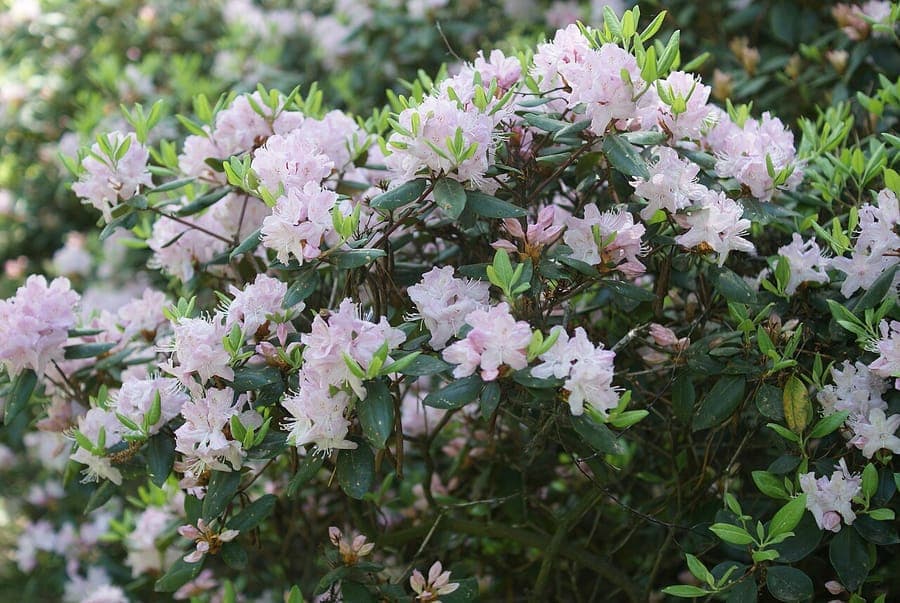
Хомелка / CC BY-SA 4.0, via Wikimedia Commons
Rhododendron carolinianum: complete guide
Rhododendron carolinianum
Want to see Rhododendron carolinianum: complete guide in your garden?
1 minute, no credit card
Overview
Rhododendron carolinianum, commonly known as Carolina azalea, is a compact deciduous shrub native to the mountains of eastern North America. Belonging to the Ericaceae family, this plant offers an ideal size for smaller gardens and landscape borders. With elegant pink-white blooms and a naturally compact form, Carolina azalea serves as a perfect decorative element in landscape design.
This shrub is particularly suited to rock gardens and alpine settings where space is limited. The plant integrates beautifully into mixed plantings and provides years of blooming pleasure with minimal maintenance requirements.
Appearance and Bloom
Rhododendron carolinianum grows as a compact, densely-branched shrub with a rounded form. The foliage is oblong and deep green, frost-resistant and attractive throughout the year. In May-June, the plant produces numerous flowers in shades of pink to white, with subtle yellow details in the flower throat.
The blooms are fragrant and attract pollinators generously. Following flowering, small seed capsules develop. The foliage exhibits attractive fall coloration before dropping.
Ideal Location
Carolina azalea performs best in partial shade to moderate sun exposure. Protect from intense midday sun in warmer climates. The plant can tolerate full sun in cooler regions. Position in sheltered, wind-protected locations to prevent winter damage to new growth.
The compact form makes it suitable for use in borders, rock gardens, and small gardens where larger rhododendrons would be oversized.
Soil
Rhododendron carolinianum requires acidic soil with pH 4.3-5.8. Provide well-draining soil enriched with peat moss or leaf mold. The plant cannot tolerate waterlogging or heavy clay soils.
When planting, incorporate 25-30% peat moss into the planting hole. This supports healthy root development and nutrient uptake by the plant.
Free design
Want to see Rhododendron carolinianum: complete guide in your garden? Make a free design now.
Watering
From planting through the growing season, maintain consistently moist soil. Water deeply and regularly, especially during dry periods. Avoid drought stress as this damages flower bud formation.
During winter months, reduce watering but never allow the soil to dry completely. Mulching helps retain moisture and stabilize soil temperature fluctuations.
Pruning
Carolina azalea requires minimal pruning due to its naturally compact form. Remove only dead branches or damaged parts immediately after flowering ends. For balanced form, weak branches can be gently pruned.
Avoid heavy pruning that disrupts the natural shape. The plant regenerates slowly from severe pruning wounds.
Maintenance Calendar
Seasonal care phases: Spring: Prune after flowering, apply fertilizer, refresh mulch Summer: Consistent watering, pest monitoring Fall: Prepare for dormancy, reduce watering gradually Winter: Provide protective measures as needed
Winter Hardiness
Rhododendron carolinianum is moderately winter-hardy. It tolerates temperatures down to -15 to -18 degrees Celsius. In the Netherlands and Belgium, it grows well in most regions, with shelter beneficial in severe winter areas.
Companion Plants
Suitable for combining with:
- Smaller Rhododendron species
- Kalmia varieties
- Dwarf conifers
- Sarcococca species
- Helleborus hybrids
- Low groundcovers
Closing
Rhododendron carolinianum offers a lovely compact option for gardeners with limited space. The pink-white blooms and winter-green characteristics make it a desirable landscape plant. Available through gardenworld.app for expert plant recommendations and garden design consultation.
Want to see Rhododendron carolinianum: complete guide in your garden? Make a free design now.
Upload a photo, pick a style, and get a photorealistic design with plant list in under a minute.
No credit card required


Similar plants
Zenobia pulverulenta: complete guide
Zenobia pulverulenta
Everything about Zenobia pulverulenta (honeycup): siting, acid soil, pruning and the fragrant white bells, in this complete care guide.
Dwarf huckleberry: complete guide
Gaylussacia dumosa
Everything about dwarf huckleberry (Gaylussacia dumosa): acidic soil, partial shade, pruning and care for this compact North American berry shrub.
Drooping leucothoe: complete guide
Leucothoe fontanesiana
Everything about drooping leucothoe (Leucothoe fontanesiana): shade tolerance, soil, watering, pruning, hardiness and companion plants.