
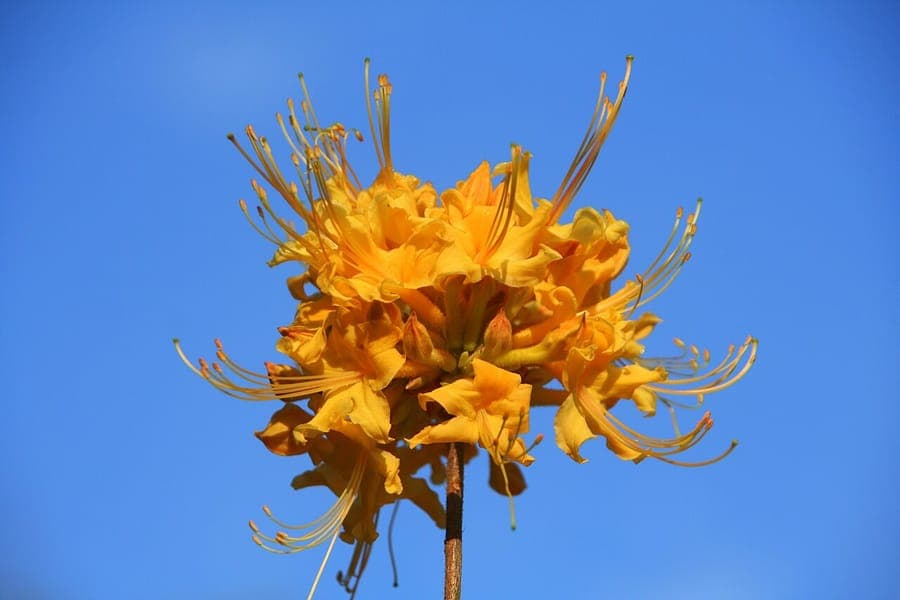
Ezra S F / CC BY 2.0, via Wikimedia Commons
Rhododendron austrinum: complete guide
Rhododendron austrinum
Want to see Rhododendron austrinum: complete guide in your garden?
1 minute, no credit card
Overview
Rhododendron austrinum, also known as Florida azalea or orange azalea, is a spectacular flowering shrub native to the southeastern United States. This shrub is celebrated for its full clusters of colorful flowers in yellow or orange tones. With its compact form and fabulous spring to early summer blooming, Rhododendron austrinum makes a beautiful focal point in any front yard.
Appearance and bloom
Rhododendron austrinum reaches modest heights of about 1.5 to 2 meters and forms a compact, well-branched shrub. Flowers appear in yellow, orange, or yellow-orange tones and come in full, dense clusters. Blooming occurs from early spring to early summer, depending on your climate. After flowers fade, glossy, dark green foliage remains throughout the summer.
Ideal location
Plant Rhododendron austrinum in a spot with partial to light shade conditions. The shrub grows best when receiving at least two to four hours of indirect sunlight. Place the shrub under deciduous trees where it gets morning sun but not full afternoon sun. This ensures the best bloom and prevents leaf scorch. Ensure the location is protected from strong, dry winds.
Soil requirements
Rhododendron austrinum requires acidic, well-draining soil. Ideal is a pH between 4.5 and 6.0. Add plenty of organic material, such as peat-like compost or conifer bark, to improve soil structure. This shrub does not grow well in heavy clay soils. Ensure water doesn't accumulate around the root zone, as this inevitably causes problems.
Watering
Rhododendron austrinum requires regular, thorough watering, especially during the growing season and especially just after planting. Soil should be moist but not waterlogged. During dry periods, you may provide extra water. However, avoid waterlogging, as this can cause root rot. In rainy years, little extra water is needed.
Free design
Want to see Rhododendron austrinum: complete guide in your garden? Make a free design now.
Pruning
Minimal pruning is best for Rhododendron austrinum. Remove only dead or damaged branches. After blooming, you can lightly prune the plant, but this is unnecessary. Remove spent flower clusters after they fade. Never prune hard, as this can damage years of blooming.
Maintenance calendar
Here's a practical maintenance schedule:
January-February: Check for winter damage.
March-May: Enjoy full bloom; water regularly.
June-October: Maintain moist soil; monitor for pests.
November-December: Winter preparation; reduce watering.
Winter hardiness
Rhododendron austrinum is winter hardy to around -15 degrees Celsius, meaning it survives in many British gardens. In regions with very severe winters, flower buds may suffer frost damage. In such areas, protection can help. However, the plant usually comes through colder winters well.
Companion plants
Rhododendron austrinum combines beautifully with:
Hydrangea: Blue-purple flowers in summer Skimmia: Bright red berries in winter Sarcococca: Fragrant white flowers in winter Fatsia japonica: Interesting dark green foliage
Together, these companions create a seasonal display.
Closing
Rhododendron austrinum is a beautiful choice for lovers of flowering shrubs. With its colorful flowers and manageable size, it immediately brings color and character to your front yard. Want to transform your front yard with such beautiful flowering plants? Discover complete design possibilities on gardenworld.app. Have your front yard professionally designed on gardenworld.app!
Want to see Rhododendron austrinum: complete guide in your garden? Make a free design now.
Upload a photo, pick a style, and get a photorealistic design with plant list in under a minute.
No credit card required


Similar plants
Zenobia pulverulenta: complete guide
Zenobia pulverulenta
Everything about Zenobia pulverulenta (honeycup): siting, acid soil, pruning and the fragrant white bells, in this complete care guide.
Dwarf huckleberry: complete guide
Gaylussacia dumosa
Everything about dwarf huckleberry (Gaylussacia dumosa): acidic soil, partial shade, pruning and care for this compact North American berry shrub.
Drooping leucothoe: complete guide
Leucothoe fontanesiana
Everything about drooping leucothoe (Leucothoe fontanesiana): shade tolerance, soil, watering, pruning, hardiness and companion plants.