
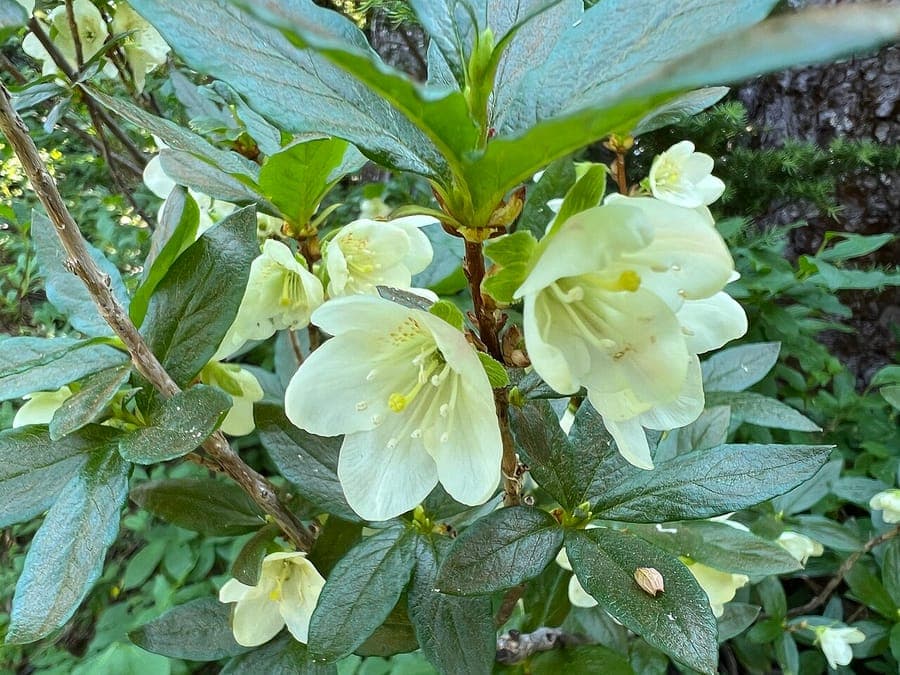
Jhorthos / CC BY-SA 4.0, via Wikimedia Commons
Rhododendron albiflorum: complete guide
Rhododendron albiflorum
Want to see Rhododendron albiflorum: complete guide in your garden?
1 minute, no credit card
Overview
The white-flowered rhododendron, scientifically known as Rhododendron albiflorum, is a stunning mountain shrub native to the rocky mountain slopes of Western Canada and the northwestern United States. This plant is characterized by its delicate white flowers that appear in soft trusses, standing out against the dark, glossy foliage. It is a plant that feels at home in partially shaded locations under conifers or among rock outcrops.
Rhododendron albiflorum belongs to the Ericaceae family, the same family as blueberries, heather, and azalea. The plant grows from Alberta and British Columbia south along the mountain ranges into Colorado and Oregon. Also known as cascade azalea, it has been successfully cultivated in many Northern European gardens. It is a strong, persistent plant that lasts for many years.
Appearance and Bloom
Rhododendron albiflorum grows to approximately 100 to 150 centimeters tall and forms a dense, bushy growth pattern. The stems are greenish-brown and reasonably thick. The leaves are dark green, glossy, and oval. They are approximately 5 to 8 centimeters long and feature a prominent central vein.
Flowers appear from May to June and are truly remarkable for their pristine whiteness. The flowers grow in loose trusses that extend above the foliage. Each flower is approximately 2 to 3 centimeters in diameter with 5 to 7 petals. The flowers are pure white to very pale pink with yellow stamens in the center. The blooming period lasts approximately 3 to 4 weeks, providing an extended show in the garden.
Ideal Location
Rhododendron albiflorum grows best in partial shade, where it receives 3 to 4 hours of filtered sunlight. This can be under deciduous or evergreen trees, or in locations where afternoon and evening sun are filtered by other vegetation. Too much shade will result in fewer flowers and thinner growth. Direct full sun will stress the plant, especially in hot summers.
The plant also thrives in locations with protection from harsh wind. The cascade azalea grew on mountain slopes where it can be windy, but in gardens, a somewhat sheltered location is preferable. This could be against a wall (not south-facing) or protected by other shrubs.
Soil
Rhododendron albiflorum has very specific soil requirements. This plant needs acidic to strongly acidic soil, with a pH between 4.5 and 6.5. This is much more acidic than what many other garden plants require. The soil must be well-draining, as water stagnation can lead to root rot.
The plant originally grows in mountain terrain where the soil consists of processed rock fragments and humus-rich leaf litter. At home, you should use a mixture of ericaceous soil, compost, and sand. Mixture: 50 percent ericaceous soil, 30 percent leaf compost, 20 percent sand. This provides good drainage and the correct pH.
Using water-testing kits, you can determine if your garden soil is suitable. Test kits are available at garden centers. If needed, you can add sulfur powder to lower the pH. This is a process that takes months, so it is better to use ericaceous soil initially.
Free design
Want to see Rhododendron albiflorum: complete guide in your garden? Make a free design now.
Watering
Rhododendron albiflorum requires regular watering, especially during the growing season. The plant tolerates dry periods poorly, especially when young. Ensure the soil remains frost-free and moist, but not waterlogged.
During the growing season (April through September), water when the top 2 to 3 centimeters of soil feel dry. During hot periods, you may need to water daily. Use rainwater if possible - hard water with high lime content is unsuitable and disrupts soil pH.
In winter, when the plant is dormant, give much less water. However, avoid letting the soil dry out completely. A moisture meter can be helpful.
Pruning
Rhododendron albiflorum does not require much pruning. The plant grows naturally compact and neat. You only need to remove dead branches. This can be done in April, after winter has passed.
If you want the plant to grow larger, avoid aggressive pruning. Pruning can be done immediately after flowering (June), when you can remove spent flower trusses. This promotes branching and denser growth. Pruning more than one-third of the volume in one year is not recommended.
Avoid cutting into the heart of the plant unless removing dead branches. The growth pattern of rhododendrons is already quite compact.
Maintenance Calendar
April: Check for winter-damaged branches. Remove dead growth. Water if dry.
May-June: Flowering period. Enjoy the beautiful white flowers. Remove spent flower trusses after blooming.
July-August: Summer growth. Monitor water levels, especially during dry periods. Water regularly.
September-October: Winter preparation. Gradually reduce watering. Check soil pH.
November-March: Winter dormancy. Minimal watering. Protect against extreme frost if needed.
Winter Hardiness
Rhododendron albiflorum is extremely hardy and tolerates temperatures down to minus 30 degrees Celsius. This makes it suitable for all Dutch and Belgian gardens. The plant does not lose its leaves in winter and remains green year-round.
The plant can be sensitive to wet winters. Therefore, ensure very good drainage. In very wet winters, you can apply a layer of sand or grit around the base. Avoid water pooling around the plant for extended periods.
Companion Plants
Rhododendron albiflorum combines well with other shade-loving and acid-loving plants. Try:
Beeches and St. John's Wort (Hypericum) - good for shaded corners
Heather (Calluna and Erica) - same pH requirements
Bilberries and blueberries (Vaccinium) - natural companions
Aspidistra and other foliage plants - beautiful contrast
Closing
Rhododendron albiflorum is a beautiful choice for gardens with adequate shade and acidic soil. This mountain plant adds elegant white flowers to the spring landscape. With proper soil and water management, this plant will provide years of beauty. This is not the easiest plant for beginners, but for experienced gardeners who love rock gardens and alpine plants, this is an absolute must.
Rhododendron albiflorum is not always offered in Dutch garden centers due to its special requirements. Specialized nurseries and online suppliers offer this plant best. Intratuin may sometimes help with special orders.
Want to see Rhododendron albiflorum: complete guide in your garden? Make a free design now.
Upload a photo, pick a style, and get a photorealistic design with plant list in under a minute.
No credit card required


Similar plants
Zenobia pulverulenta: complete guide
Zenobia pulverulenta
Everything about Zenobia pulverulenta (honeycup): siting, acid soil, pruning and the fragrant white bells, in this complete care guide.
Dwarf huckleberry: complete guide
Gaylussacia dumosa
Everything about dwarf huckleberry (Gaylussacia dumosa): acidic soil, partial shade, pruning and care for this compact North American berry shrub.
Drooping leucothoe: complete guide
Leucothoe fontanesiana
Everything about drooping leucothoe (Leucothoe fontanesiana): shade tolerance, soil, watering, pruning, hardiness and companion plants.