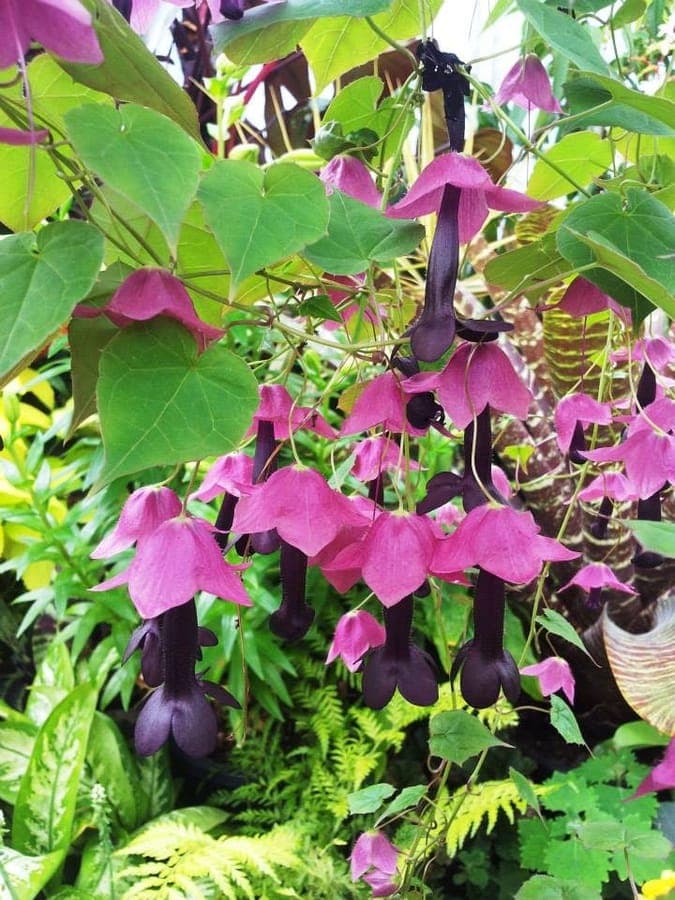
Nzfauna / CC BY-SA 3.0, via Wikimedia Commons
Purple bell vine (Rhodochiton): complete growing guide
Rhodochiton atrosanguineus
Want to see Purple bell vine (Rhodochiton): complete growing guide in your garden?
Full design in HD: €7.99
Look after your Purple bell vine with the GardenWorld app
Identify plants with your camera and get a care calendar with reminders for this plant.


Overview
Purple bell vine (Rhodochiton atrosanguineus) is one of those plants that makes people stop on the pavement. Slender twining stems carry dozens of pendent flowers that look like tiny pink parasols with a dark clapper hanging beneath each one. The plant comes from the mountain forests of southern Mexico, where it scrambles over shrubs and rocks as a perennial. In British and northern European gardens it is usually grown as an annual: you sow in late winter, plant out once the frosts have passed and enjoy flowers from July until the first frost.
It belongs to the plantain family (Plantaginaceae). Seed is widely sold, and young plants turn up in garden centres in late spring. In a single season it reaches 2 to 3 metres, which makes it ideal for an obelisk in a large pot, a balcony trellis, a small arch over a gate or a hanging basket from which it can trail. If you would like to see where a climber like this fits among your other plants, you can have a garden design made on gardenworld.app that takes sun, space and supports into account.
Rhodochiton is not known to be toxic to people or pets.
Appearance and bloom cycle
The leaves are heart-shaped, 4 to 8 cm long, coarsely toothed and a fresh mid-green. The plant does not climb with tendrils or aerial roots but with its leaf stalks, which coil like corkscrews around anything thin they touch. That is why it needs fine supports such as string, netting or twiggy branches.
The flowers are the real show. Each hangs on a long, thread-like stalk. At the top sits a broad, bell-shaped calyx 2 to 3 cm across in magenta-pink to wine red. Beneath it hangs a narrow tubular corolla about 4 to 5 cm long, such a deep purple that it looks almost black from a distance. The corolla drops after a few days, but the pink calyx stays on for weeks while the seed capsule ripens inside it. As a result the plant always looks in full flower, even though each individual bloom is short-lived.
Flowering starts four to five months after sowing, usually in July, and carries on until October or the first frost.
Ideal location and supports
Give purple bell vine a warm, bright spot with morning or late afternoon sun. A south or west-facing wall, a sheltered patio or a balcony all suit it well. In a hot summer, light shade at midday helps a plant in a small pot. It dislikes wind, which snaps the thin stems.
Supports make all the difference. Because the leaf stalks twist around whatever they touch, the support must be thin, ideally no more than 1 cm across. Good options include:
- a wigwam of slim bamboo canes with string woven between them;
- plastic or wire mesh fixed to a fence;
- tensioned wires along a pergola;
- twiggy birch or hazel branches pushed into a large container.
A thick, smooth post or a bare wall gives it nothing to grip. Guide the young shoots towards the support for the first few weeks; after that the plant climbs on its own. In a hanging basket you can skip the support altogether and let the stems cascade.
Soil requirements
Purple bell vine wants a humus-rich, open and free-draining soil that never dries out completely but never stays waterlogged either. In open ground, mix a couple of spadefuls of well-rotted compost into the planting hole.
In containers use a good multipurpose or peat-free container compost, ideally with 10 to 20 per cent perlite added. Choose a pot at least 30 cm across holding around 30 litres: the larger the pot, the more even the moisture and the longer the flowering. A drainage hole and a layer of crocks or clay pebbles in the base are essential.
Sowing and raising plants
Sowing is the usual way to get hold of this climber. Because it is slow to get going, start early, from mid-February to the end of March.
- Fill small pots or a seed tray with fine seed compost and firm it lightly.
- Press the seeds onto the surface. Cover them with no more than a dusting of vermiculite, as they germinate better in light.
- Keep the compost moist and the temperature at 18 to 22 °C, for instance in a heated propagator.
- Germination is erratic and takes two to four weeks, sometimes longer, so be patient.
- Prick out the seedlings into individual 9 cm pots once they have two true leaves, and give each one a small stick to twine around early on.
Keep young plants bright and fairly cool (15 to 18 °C), otherwise they turn leggy. From early May harden them off outdoors during the day, and plant out after mid-May once there is no longer any risk of night frost. Summer cuttings of young shoots also root readily.
Free preview
Want to see Purple bell vine (Rhodochiton): complete growing guide in your garden? Make a free preview of your design.
Watering
Purple bell vine likes an evenly moist root ball. In summer, water as soon as the top 2 cm of compost feels dry; in warm spells a container plant often needs watering daily. Never let it dry out completely, or it will drop its flowers and buds.
From June, feed every two weeks with a liquid fertiliser for flowering plants, preferably one with more potassium than nitrogen. Plants in open ground manage with a monthly feed.
Pruning
This climber needs very little pruning. Pinch out the tip of young plants at around 15 cm: they branch out and send several stems up the support at once.
There is no need to deadhead: the pink calyces stay decorative. If you plan to keep the plant as a perennial, cut it back to about 30 cm in autumn before bringing it indoors.
Maintenance calendar
February to March: sow indoors at 18 to 22 °C. Lightly trim and repot overwintered plants.
April: prick out and pinch the seedlings, give them a small cane, keep them bright and cool.
Early May: harden off outdoors by day, bring them in at night.
Mid to late May: once frosts are over, plant out in pots or a border and put the supports in place.
June to September: water regularly, feed every two weeks and tie in new growth. Flowering from July.
October: collect seed from dry capsules. If you want to overwinter the plant, bring it in before the first frost.
November to January: keep it in a bright, cool place, or compost it and sow again next year. To avoid having to remember all of this, the planting calendar on gardenworld.app reminds you of each step at the right moment.
Winter hardiness and overwintering
Rhodochiton atrosanguineus is not hardy. It will not survive frost and barely grows below 10 °C. In Britain and the Low Countries it is therefore treated as an annual or brought indoors for the winter.
Overwintering works well with container plants. In October, cut the plant back to about 30 cm and move it to a bright, frost-free spot at 8 to 12 °C, such as a cool conservatory or an unheated room with a large window. Water sparingly, just enough to stop the root ball drying out. From March, move it somewhere warmer and brighter, repot it into fresh compost and gradually increase watering. An overwintered plant often flowers as early as June, a month ahead of a seedling.
Companion plants
Purple bell vine is delicate and is easily smothered by coarse growers, so choose partners that leave it room. In a large pot, pair it with low trailing plants around the rim: liquorice plant (Helichrysum petiolare) makes the wine-red tones glow, and an ivy-leaved geranium (Pelargonium peltatum) in white or soft pink also works well.
On the same obelisk or pergola you can grow other annual climbers that are not too vigorous, such as sweet peas (Lathyrus odoratus) for early summer or black-eyed Susan vine (Thunbergia alata) for a warm orange contrast. Rampant species such as cup and saucer vine (Cobaea scandens) are best given a support of their own. In a border, Verbena bonariensis makes an airy purple foreground for a trellis clothed in purple bell vine.
Final thoughts
Rhodochiton atrosanguineus is a climber for anyone who wants something out of the ordinary on a patio or balcony. Sow early, give it a warm spot, thin supports and a pot that stays evenly moist, and from July until the frosts you will have hundreds of pink parasols with dark clappers. Overwinter it indoors and you gain an extra month of flowers and a sturdier plant.
Sow a few seeds this spring and you will soon find that this plant gets the neighbours talking every summer.
Frequently asked questions about Purple bell vine
Is Purple bell vine winter hardy?
Rhodochiton atrosanguineus is not hardy. It will not survive frost and barely grows below 10 °C.
When and how do you prune Purple bell vine?
This climber needs very little pruning. Pinch out the tip of young plants at around 15 cm: they branch out and send several stems up the support at once.
How much water does Purple bell vine need?
Purple bell vine likes an evenly moist root ball. In summer, water as soon as the top 2 cm of compost feels dry; in warm spells a container plant often needs watering daily.
Where does Purple bell vine grow best?
Give purple bell vine a warm, bright spot with morning or late afternoon sun. A south or west-facing wall, a sheltered patio or a balcony all suit it well.
What soil does Purple bell vine need?
Purple bell vine wants a humus-rich, open and free-draining soil that never dries out completely but never stays waterlogged either. In open ground, mix a couple of spadefuls of well-rotted compost into the planting hole.

See it in your garden
See Purple bell vine in your garden
One photo of your garden and a few questions. You see the result in about a minute.
Try it with a photoIdentify this plant in your own garden. Identify a plant
Similar plants
Helichrysum petiolare: complete guide
Helichrysum petiolare
Helichrysum petiolare, the licorice plant, is a graceful trailing plant with silvery-gray foliage perfect for containers and hanging baskets.
Ivyleaf geranium: complete guide
Pelargonium peltatum
Discover ivyleaf geranium, a practical hanging plant with purple and pink flowers. Learn about cultivation, pruning and winter storage in this guide.
Sweet pea: complete guide
Lathyrus odoratus
Sweet pea (Lathyrus odoratus) offers fragrant, colorful flowers on climbing vines. Learn everything about planting, care, and cultivars for your garden.
