Theoperatingsystem / CC BY-SA 4.0, via Wikimedia Commons
Mini monstera (Rhaphidophora tetrasperma): complete guide
Rhaphidophora tetrasperma
Want to see Mini monstera (Rhaphidophora tetrasperma): complete guide in your garden?
Full design in HD: €7.99
Look after your Mini monstera with the GardenWorld app
Identify plants with your camera and get a care calendar with reminders for this plant.


Overview
Rhaphidophora tetrasperma has become one of the most popular indoor climbers of recent years. It grows quickly, has deeply cut, glossy green leaves and looks like a smaller version of the familiar Swiss cheese plant. That is why it is usually sold as mini monstera. You will also see it labelled Monstera minima, Philodendron 'Ginny' or Philodendron 'Piccolo'. All of those labels are botanically wrong, and that matters: once you know the correct name, you also know the right care.
The plant belongs to the arum family (Araceae) and comes from southern Thailand and Peninsular Malaysia. There it grows in tropical rainforest as a climber, starting on the forest floor and hauling itself up tree trunks with aerial roots towards the light. The higher it climbs, the larger and more deeply divided its leaves become. Indoors it behaves in exactly the same way, as long as you give it something to climb.
Mini monstera, but not a Monstera
Rhaphidophora, Monstera and Philodendron are three separate genera within the same family. They look alike because all three climb in tropical forests and often produce cut leaves, but they differ in the structure of their flowers, fruits and seeds.
In practice the difference shows mostly in the leaves. The Swiss cheese plant (Monstera deliciosa) makes huge leaves with holes in the middle of the blade. In Rhaphidophora tetrasperma the splits usually run almost to the midrib, with at most a few small holes beside it. The leaves also stay much smaller, 15 to 30 cm indoors. Monstera minima is not a valid name for this plant. Its care is, however, very similar to that of its better-known relatives, which partly explains the mix-up in shops.
Appearance
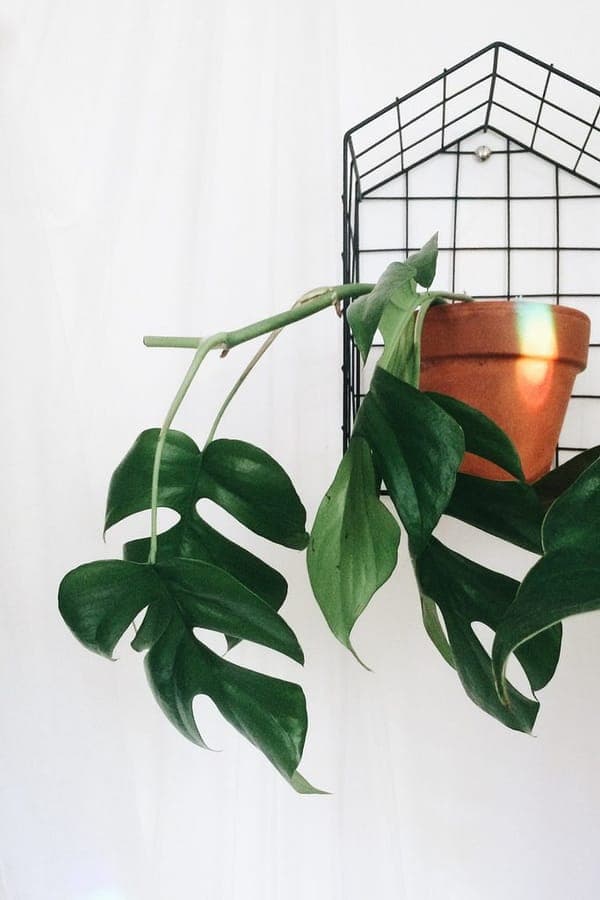
Young plants often have almost entire, elongated leaves. As the plant grows, and especially once it can climb, each leaf develops five to eight deep splits on either side. The leaves are mid-green, glossy and slightly leathery. The stems are green and form an aerial root at every node.
Indoors, with a support pole, the plant reaches 1.5 to 3 m. Without support it trails over the edge of the pot. The photo shows this well: a terracotta pot on a black wire wall grid against a white wall, with long trailing stems and clearly split leaves. It rarely flowers indoors; in the wild it produces a cream spathe around a spadix, like other aroids.
Position in the home
Choose a bright spot with a sturdy support. A moss pole, coir pole or plank against the wall all work well: tie the stems loosely with the aerial roots facing the support. If you prefer a trailing plant, stand it high on a cupboard or in a hanging pot, but expect smaller leaves.
Avoid draughts, cold windows in winter and the direct heat of a radiator. Turn the plant now and then so it does not grow entirely to one side.
Light
Bright, indirect light produces the biggest and best leaves. A spot a metre or two from an east-, west- or south-facing window is ideal. It tolerates some morning sun, but strong midday sun through glass scorches the foliage. In poor light the stems become long and thin with wide gaps between the leaves, and new leaves stay small and unsplit.
Humidity and temperature
The mini monstera grows best at 18 to 27 °C. Below 15 °C growth stops, and below 12 °C it suffers damage. It is not hardy and stays indoors all year.
Humidity of 50 percent or more is ideal, but it copes with ordinary room air. In very dry air, young leaves sometimes stick together as they unfurl and tear. A humidifier, a tray of damp clay pebbles or grouping plants together helps.
Free preview
Want to see Mini monstera (Rhaphidophora tetrasperma): complete guide in your garden? Make a free preview of your design.
Compost and repotting
Use an open mix like that for other aroids: roughly equal parts peat-free houseplant compost, fine bark and perlite. This lets oxygen reach the roots and drains excess water quickly.
Because it grows fast, repot every one to two years in spring into a pot 3 to 5 cm larger. Put the support pole in the new pot at the same time so you do not disturb the roots later.
Watering and feeding
Water when the top 2 to 3 cm of compost feel dry. In summer that is often once or twice a week, in winter every ten days to two weeks. Yellowing lower leaves usually mean too much water; limp, drooping leaves mean too little. Never leave water standing in the outer pot.
From April to September, feed every two to three weeks with a liquid houseplant fertiliser at half strength. Do not feed in winter.
Pruning
Pruning is no problem. Cut long or bare stems back just above a node. A new shoot usually grows from the node below, making the plant fuller. Wear gloves when pruning, because the sap can irritate skin, and keep children and pets away from the trimmings.
Propagation
Cuttings are easy and the best way to get a bushy plant. Cut a piece of stem with at least one node, an aerial root and a leaf. Root it in a glass of water, in damp sphagnum moss or in perlite. At 20 to 25 °C new roots appear in two to four weeks. Once they are a few centimetres long, pot the cutting up. Feel free to put three or four together in one pot, or plant them back beside the parent.
Toxicity to pets
Be aware: Rhaphidophora tetrasperma is toxic to cats and dogs. Like many aroids, it contains insoluble calcium oxalate crystals in the form of fine needles. The genus name even refers to them: Rhaphidophora means needle-bearer. The ASPCA, the American animal welfare organisation whose list of toxic plants is widely used, has no separate entry for this species. Close relatives with the same crystals, such as the Swiss cheese plant, philodendrons and golden pothos, are listed there as toxic to dogs and cats.
Chewing the leaves causes a burning sensation in the mouth and tongue, followed by swelling, drooling, vomiting and difficulty swallowing. Serious poisoning is rare because animals usually stop quickly, but contact your vet if symptoms appear. The plant is not suitable for young children to nibble either.
Care calendar
March-April: Repot if needed, add or extend the support pole and start feeding.
May-August: Rapid growth. Tie in new stems, water and feed regularly. The best time to take cuttings.
September-October: Taper off feeding. Cut back long stems and use them as cuttings.
November-February: Less water, no feeding. Watch for dry air and spider mite from central heating.
The plant calendar on gardenworld.app shows season by season when it is time to repot, feed or take cuttings.
Companion plants
The mini monstera fits well among other aroids with the same needs. The Swiss cheese plant (Monstera deliciosa) and Monstera adansonii make the difference between the genera obvious at a glance. Epipremnum pinnatum and the arrowhead plant (Syngonium podophyllum) also enjoy climbing a pole. In front, Aglaonema commutatum adds patterned foliage. Remember that all of these contain calcium oxalate, so in a home with pets choose a spot out of reach.
Want your green indoor corner to flow into the patio or garden? On gardenworld.app you can have a garden design made in which indoors and outdoors are planned together.
Final thoughts
Rhaphidophora tetrasperma gives you the look of a Swiss cheese plant in a fraction of the space, and it grows fast enough to show progress every season. Give it bright indirect light, an airy compost that dries a little between waterings and, above all, something to climb. Just remember that it is neither a true Monstera nor a Philodendron, and that its calcium oxalate means it belongs out of reach of cats, dogs and small children.
Frequently asked questions about Mini monstera
When and how do you prune Mini monstera?
Pruning is no problem. Cut long or bare stems back just above a node.
How much water does Mini monstera need?
Water when the top 2 to 3 cm of compost feel dry. In summer that is often once or twice a week, in winter every ten days to two weeks.

See it in your garden
See Mini monstera in your garden
One photo of your garden and a few questions. You see the result in about a minute.
Try it with a photoIdentify this plant in your own garden. Identify a plant
Similar plants
Monstera deliciosa: complete guide
Monstera deliciosa
Discover the fruit-salad plant (Monstera deliciosa) - a popular houseplant with characteristic holes in leaves. Professional care and growing tips for success.
Monstera adansonii: complete guide
Monstera adansonii
Tarovine - an elegant climbing plant with unique perforated leaves. Tropical, easy-care, and hugely popular as an indoor plant.
Epipremnum pinnatum: complete guide
Epipremnum pinnatum
Discover Epipremnum pinnatum, the variegated philodendron or tongavine, a stunning tropical climbing plant. Learn care tips, light requirements, watering, and propagation for indoor gardening success.
