
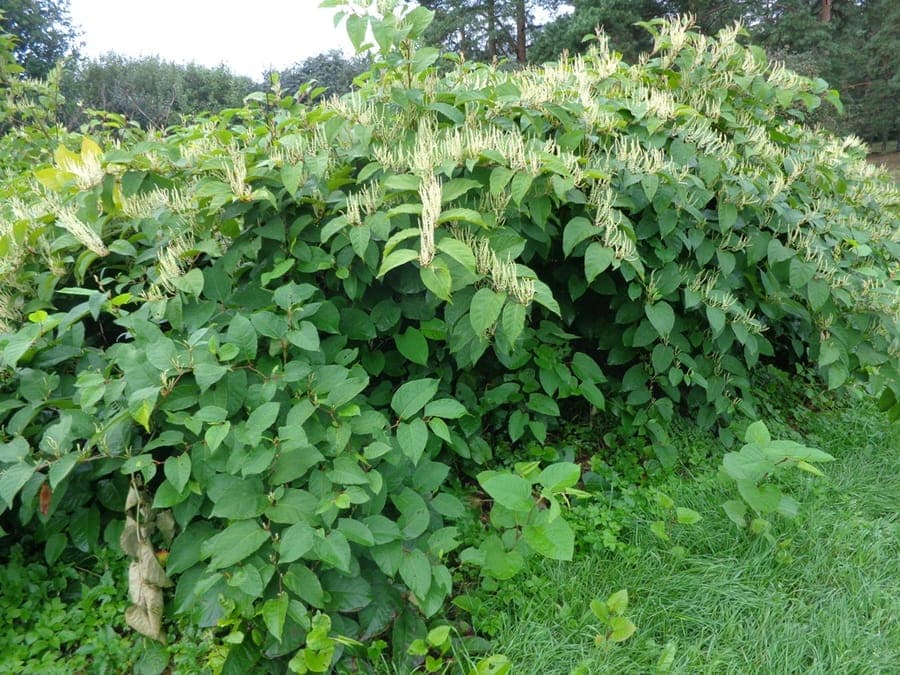
AfroBrazilian / CC BY-SA 3.0, via Wikimedia Commons
Bohemian knotweed: identification and management guide
Reynoutria x bohemica
Want to see Bohemian knotweed: identification and management guide in your garden?
1 minute, no credit card
Overview
Bohemian knotweed, botanically Reynoutria x bohemica (also classified as Fallopia x bohemica or Polygonum x bohemicum), is a vigorous hybrid between Japanese knotweed (Reynoutria japonica) and giant knotweed (Reynoutria sachalinensis). First described by Czech botanists Chrtek and Chrtková in 1983, it was named 'bohemica' after Bohemia, where it was first formally documented. Since then it has spread across Western and Central Europe - established in Germany, France, Belgium, the Netherlands, Great Britain, Ireland, Scandinavia and many other countries - and has also invaded North America from British Columbia to New England.
This guide is explicitly NOT a planting recommendation. Reynoutria x bohemica is one of the most aggressively invasive plant species recorded in Europe and is listed on the IUCN's 100 worst invasive species. In many European countries, intentional planting or allowing it to spread to neighbouring land is illegal or subject to civil liability. The plant outcompetes all native vegetation, damages foundations, paving, riverbanks and infrastructure, and is extraordinarily difficult to eradicate. If you have it on your property, this guide gives you the knowledge to manage and suppress it.
If you are looking for impressive, fast-growing plants that do not carry ecological risk, visit gardenworld.app for curated planting ideas using responsible alternatives.
Appearance and growth cycle
Bohemian knotweed is a large, imposing herbaceous perennial. Its hollow, bamboo-like canes grow afresh each season from deep, fleshy rhizomes and can reach 2 to 4 metres in height within a single growing season - outpacing almost everything around them. The canes are distinctly jointed (like bamboo), partly reddish-green and tough. In winter the above-ground growth dies back completely, but the rhizome system remains fully viable and can extend 3 metres deep and 7 metres laterally.
The leaves are the key identification feature, distinguishing Bohemian knotweed from its parent species. They are larger than those of Japanese knotweed (up to 25-30 cm long and wide) but smaller than those of giant knotweed. The leaf base is broadly heart-shaped to slightly wedge-shaped with a pointed tip. The key botanical distinction lies on the underside of the leaf: Bohemian knotweed has hairs on the veins (inherited from R. japonica) AND scattered hairs over the entire surface (from R. sachalinensis). This combination of both hair types is the most reliable identification marker.
Small cream to pale-yellow flowers appear in branched panicles in August and September. Unlike sterile Japanese knotweed, this hybrid produces viable seeds, making it more dangerous in terms of dispersal potential.
Ideal location
Reynoutria x bohemica is an ecological opportunist that thrives in almost any location: riverbanks and watercourses, brownfield sites, railway corridors, gardens, parks and road verges. It shows a strong preference for moist, nitrogen-rich soils but tolerates dry and nutrient-poor sites as well.
This adaptability is precisely what makes it so problematic. There is almost no habitat where the plant cannot establish. It tolerates both full sun and partial shade, growing fastest in sunny, moist conditions. Control is further complicated by the rhizome's ability to survive months after all above-ground material has been removed.
An important legal note: in England and Wales, under the Wildlife and Countryside Act, it is an offence to cause knotweed to grow in the wild. Similar regulations exist in many European jurisdictions. Property owners have a legal responsibility to prevent the spread of this plant to neighbouring land. Seek legal advice if the spread has already occurred across boundaries.
Soil
From a management perspective, the rhizome biology of Reynoutria x bohemica is what makes this plant so challenging. Rhizome fragments as small as 1 cm in length are capable of producing a new plant. This has critical implications for any earth-moving work on affected sites.
Soil contaminated with knotweed rhizome material is classified as controlled waste in the United Kingdom and subject to strict disposal regulations. Regulations in Belgium and the Netherlands similarly restrict the movement of knotweed-contaminated soil. Never move soil from an affected area to a new location without checking local legal requirements with your municipality or environment agency.
Ground disturbance such as digging or rotary cultivation chops rhizomes into smaller fragments and spreads them throughout the disturbed area - this typically worsens the infestation rather than resolving it. Avoid all unnecessary soil disturbance in affected zones.
Watering
This section addresses water in the context of site management. Knotweed thrives in moist conditions, explaining its prevalence along watercourses and in low-lying areas. Extended flooding (many months) can weaken established plants, but this is rarely a practical management tool in garden settings.
For sites where you are actively managing the plant: drying out the site through drainage improvement does not reliably suppress established rhizomes, which penetrate to moist soil layers far below the surface effects of seasonal drought. Direct your energy instead toward mechanical and chemical suppression.
In the UK, ongoing research into biological control using the Japanese psyllid Aphalara itadori is showing promising results. The insect was first released in England in 2020 and represents the first approved biocontrol agent for an invasive plant species in Europe. This approach is not yet available or approved in most continental European countries.
Free design
Want to see Bohemian knotweed: identification and management guide in your garden? Make a free design now.
Management strategies
Managing Reynoutria x bohemica requires a multi-year, combined approach. There is no quick fix. The four best-evidenced methods are:
1. Mechanical control (cutting and mowing): Cutting or mowing every 2 to 3 weeks throughout the growing season gradually weakens the plant by forcing it to expend its rhizome energy reserves on repeated regrowth. This method requires 3 to 5 years of persistent effort. All cut material must be disposed of carefully - knotweed stems can root if composted. Take cut material to a licensed green waste facility.
2. Herbicide treatment: Glyphosate-based herbicides are most effective when applied to young, actively growing foliage or injected directly into hollow canes. Multiple applications per season over 2 to 4 years are necessary. Always read the product label and follow legal requirements for use near water. Consult a licensed contractor for large infestations or sites near sensitive environments. Garden centres stock appropriate products for small-scale domestic use.
3. Smothering with impermeable membrane: Covering infested areas with heavy-duty black polythene or woven ground-cover membrane for a minimum of 5 years can exhaust rhizome energy reserves. This works best for isolated, well-defined patches. Edges must be thoroughly secured to prevent lateral escape. Vigilant monitoring of the perimeter is essential.
4. Combined approach: The most effective long-term strategy integrates cutting, herbicide application and covering across multiple seasons with regular monitoring. Document the extent of infestation with photographs and a site map to track progress over years. For planning your management zones visually, gardenworld.app can help you map your outdoor space and prioritise areas for treatment.
Maintenance calendar for management
March-April: Begin cutting or mowing as soon as the first reddish shoots emerge. This is also the most effective time for foliar herbicide application - the plant is actively transporting nutrients into the rhizome and herbicide reaches the roots most efficiently.
May-June: Continue cutting every 2 to 3 weeks. Apply second herbicide treatment if using a chemical programme. Monitor for new shoots emerging outside the known infestation boundary.
July-August: Peak growing season - the most intensive management period. Remove any flowering shoots immediately to prevent seed production and further spread.
September-October: Final herbicide treatment of the season. At this point plants are transporting sugars down to rhizomes for winter storage - late-season stem injection with herbicide is particularly effective now.
November-February: Remove dead cane material. Photograph and record the infestation extent. Plan the following season's management programme.
Winter hardiness
Reynoutria x bohemica is extremely cold-hardy (USDA zones 4-9) and survives the harshest winters without any difficulty. The rhizome enters dormancy but is not harmed by frost - in fact, frost kills all above-ground material but leaves the underground system fully intact and ready to regenerate.
The apparent death of the plant in winter can give a false sense of security. The rhizome resumes growth in early spring with full vigour as soon as soil temperatures rise above 5 degrees Celsius. Begin your management measures as soon as the first reddish shoots appear - do not wait until the plant has reached full height.
Alternatives for the garden
If you are seeking large, dramatic plants for screening or rapid coverage, there are proven, non-invasive alternatives. Miscanthus sinensis cultivars offer similar visual impact without ecological risk. Sambucus nigra (elderberry) grows rapidly and provides food and habitat for birds and insects. Phyllostachys aureosulcata planted in a root barrier delivers bamboo aesthetics without rhizome spread.
For fast-growing hedges and privacy screens, Carpinus betulus (hornbeam) and Corylus avellana (hazel) are ecologically responsible choices with high biodiversity value. Visit gardenworld.app for planting ideas that create privacy and visual impact without introducing invasive risks to your garden or neighbourhood.
Closing
Bohemian knotweed commands respect - not for its beauty, but for its formidable capacity to spread and persist. Anyone with this plant on their land faces a multi-year effort requiring consistency, knowledge and sometimes professional assistance. Do not allow it to spread: begin management as soon as you identify it.
Looking to replant your garden once knotweed has been suppressed? On gardenworld.app, you can design planting compositions with native and ecologically responsible plants that beautify your outdoor space without introducing new problems. Early action is always far less costly than years of intensive management.
Want to see Bohemian knotweed: identification and management guide in your garden? Make a free design now.
Upload a photo, pick a style, and get a photorealistic design with plant list in under a minute.
10,000+ gardens designed already
No credit card required


Similar plants
Japanese knotweed: complete guide
Reynoutria japonica
Understand Japanese knotweed (Reynoutria japonica) - its invasive nature, spread mechanisms, and effective management strategies for control.
Giant knotweed: complete guide
Reynoutria sachalinensis
Understand giant knotweed (Reynoutria sachalinensis) - its massive size, invasive nature, and aggressive management requirements.
Black bindweed: complete guide
Fallopia convolvulus
Learn how to manage Black bindweed (Fallopia convolvulus) in your garden: growth habits, ideal conditions, and seasonal care. Perfect for wildflower or low-maintenance designs on gardenworld.app.