
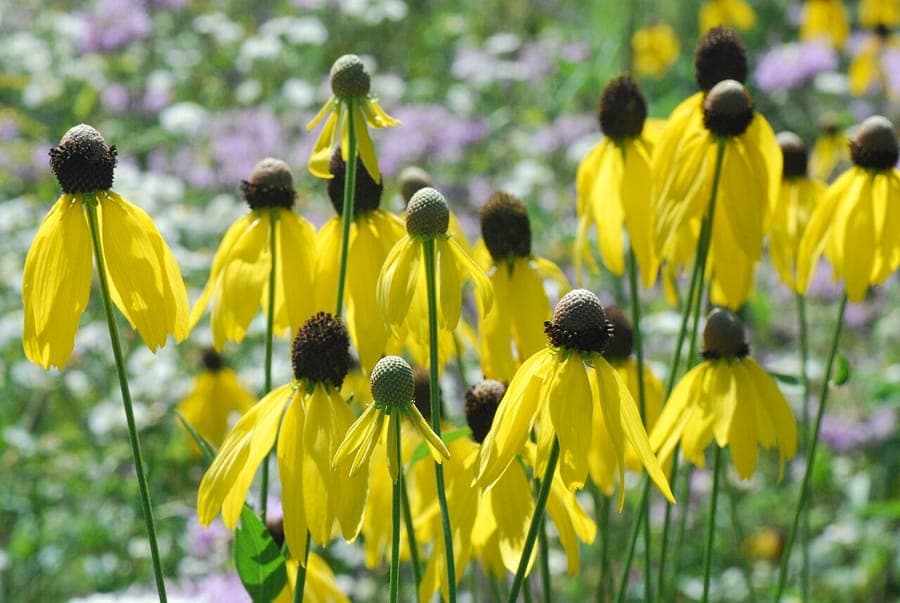
Joshua Mayer from Madison, WI, USA / CC BY-SA 2.0, via Wikimedia Commons
Ratibida pinnata: complete guide
Ratibida pinnata
Want to see Ratibida pinnata: complete guide in your garden?
1 minute, no credit card
Overview
The drooping prairie-coneflower, scientifically known as Ratibida pinnata, is a stunning and low-maintenance wildflower native to the prairies of North America. This plant is characterized by its striking flowers featuring bright yellow petals and a distinctive brown-gray central cone that droops below. It is perfect for natural and prairie-style gardens and ideal for gardeners seeking plants that require minimal maintenance.
Ratibida pinnata belongs to the Asteraceae family, the same family as sunflowers and chamomile. The plant grows from southern Canada through the eastern Midwest of the United States and has naturalized successfully in many European gardens. The name "drooping" refers to the characteristic way the flower petals bend downward, giving the plant its unique and instantly recognizable appearance.
Appearance and Bloom
The drooping prairie-coneflower grows to approximately 60 to 100 centimeters tall and forms a loose, naturally informal habit. The stems are thin, gray-green, and covered with fine hairs. The leaves are deeply cut, almost feather-like (pinnate), which is where the plant gets its scientific name. These leaves are light green with a fine, feathery texture.
Flowers appear from June through September and are truly remarkable. Each flower consists of 4 to 8 yellow petals that droop downward, surrounding a distinctive brown-gray central disc that measures approximately 2 to 3 centimeters tall. These central discs contain the flower's reproductive parts and give the plant its characteristically striking appearance.
Ideal Location
Ratibida pinnata is a sun worshipper. For optimal growth and flowering, this plant requires at least 6 to 8 hours of direct sunlight per day. In areas with extremely hot summers, some afternoon shade may be beneficial, but in most temperate European gardens, full sun is best. The plant will grow in part shade but will produce fewer flowers.
Place the plant in a location where air circulates freely. This helps prevent fungal and moisture-related problems. Avoid dark corners, areas beneath trees, or against walls where little wind reaches. An open, sunny spot in the center of a planting bed or mixed border is ideal.
Soil
The soil pH should be between 5.6 and 6.8 for optimal growth. This means the soil should be slightly acidic to neutral. The drooping prairie-coneflower is not particularly fussy about soil nutrients but thrives in well-draining soil.
The plant tolerates dry, poor soils reasonably well, making it ideal for difficult corners in gardens. Heavy clay soils can be problematic due to water logging. If you have heavy clay, incorporate compost or sand to improve drainage. Before planting, dig a hole to about 30 centimeters deep and amend with compost and sand if you have heavy soil.
Watering
Once established (after the first growing season), Ratibida pinnata is quite drought tolerant. In normal summers without extreme drought conditions, you likely won't need supplemental irrigation. The plant's deep root system helps it withstand dry periods.
During the first growing season, when the plant is newly planted, water regularly until it becomes well-established. This typically takes 2 to 3 weeks. Water when the top 2 centimeters of soil feels dry. Use lukewarm water, preferably early morning or late evening, to avoid leaf scald.
Avoid overwatering, especially during wet summers. This can lead to root rot and fungal infections. During rainy periods, no supplemental watering is needed. Good drainage is far more important than frequent watering.
Free design
Want to see Ratibida pinnata: complete guide in your garden? Make a free design now.
Pruning
Ratibida pinnata requires minimal pruning. However, in August or September, once the flowering period is over, you can cut the flowers and stems back to about 15 centimeters. This stimulates fuller, bushier growth in the following season and provides a neater garden appearance.
In early spring (April), remove dead stems from the previous year. Do this carefully, as new growth is already beginning. Cut only dead wood, not living tissue. If the plant becomes too leggy or sprawls excessively, you can moderately prune the center in May or June.
Deadhead wilted flowers throughout the growing season to encourage more blooms. This process directs the plant's energy toward producing new flowers rather than seeds.
Maintenance Calendar
April-May: Remove dead stems from previous year. Prune to improve form. Water if conditions are dry.
June-August: Flowering period begins. Deadhead wilted flowers regularly. Water only during extreme drought.
September-October: Flowering period ends. Cut back to 15 centimeters in October. Clean up fallen leaves.
November-March: Dormant period. Minimal maintenance needed. Check that snow doesn't bend dead stems and cause damage.
Winter Hardiness
Ratibida pinnata is extremely hardy throughout temperate regions. The plant tolerates temperatures down to at least minus 25 degrees Celsius. This makes it perfect for gardens in all hardiness zones. It will return year after year as long as you ensure proper drainage and no water stagnation.
During very wet winters, you can spread sand or grit around the plant's crown to prevent moisture accumulation. Protect the crown, not the stems, since this is where new growth originates. Good drainage is far more important than winter protection.
Companion Plants
The drooping prairie-coneflower combines well with other wildflowers and ornamental grasses. Try these combinations:
Feather Reed Grass - the fine texture of these grasses contrasts beautifully with the bold flowers.
Black Mondo Grass - low-growing ground cover with dark foliage underneath.
Delphinium - blue flowers complement the yellow blooms.
Phlox - pink and white varieties provide excellent contrast.
Closing
The drooping prairie-coneflower is an excellent choice for gardens that demand minimal maintenance while offering abundant flowers. This plant is sustainable, drought-tolerant, and extremely hardy. Once planted, it will return year after year with minimal care. The striking flowers with their characteristic drooping form give your garden a natural, prairie-like appearance.
Where can you find Ratibida pinnata in European garden centers? Many major garden centers stock seeds and plant material of this wildflower in May and June. Look for this unique American wildflower and enjoy years of effortless beauty once established.
Want to see Ratibida pinnata: complete guide in your garden? Make a free design now.
Upload a photo, pick a style, and get a photorealistic design with plant list in under a minute.
No credit card required


Similar plants
Calendula stellata: complete guide
Calendula stellata
Complete guide to Calendula stellata, the star-flowered marigold from Sicily: location, soil, watering and companion planting tips.
Korean chrysanthemum: complete guide
Chrysanthemum x rubellum
Chrysanthemum x rubellum is a hardy autumn perennial with single pink to copper flowers from August to November. Care and combinations.
Helianthus divaricatus: complete guide
Helianthus divaricatus
Helianthus divaricatus is a North American woodland sunflower with yellow summer blooms, ideal for naturalistic borders and shady edges.