
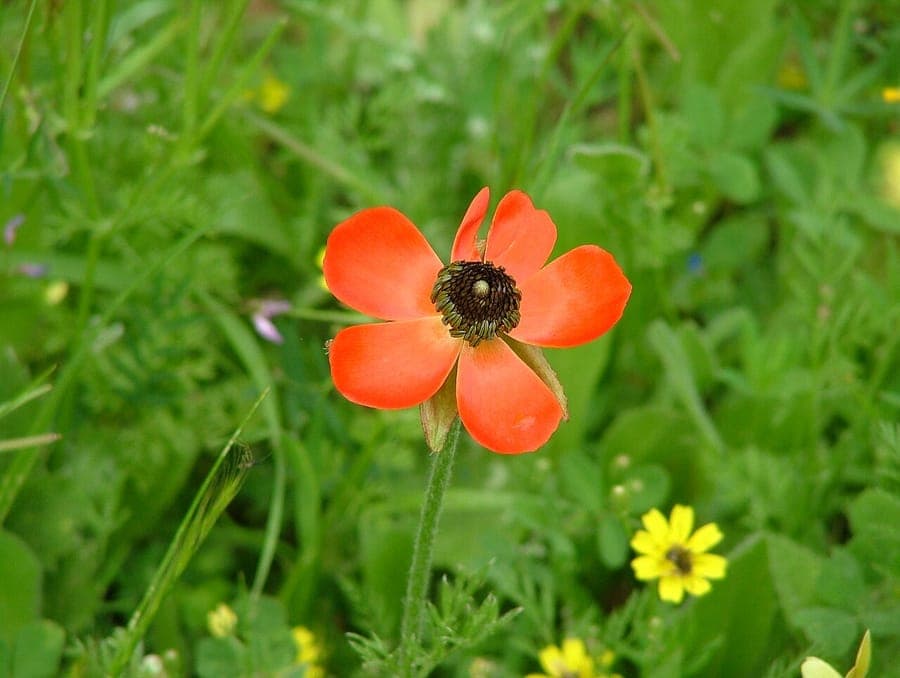
SuperJew / CC BY-SA 3.0, via Wikimedia Commons
Persian Buttercup: complete guide
Ranunculus asiaticus
Want to see Persian Buttercup: complete guide in your garden?
1 minute, no credit card
Persian Buttercup (Ranunculus asiaticus) is a superb cut flower and garden plant native to the Near East, distributed from the South Aegean Islands through western and southwestern Iran. This plant grows from small knobby tubers planted August-September. The blooming season extends March-May, with plants reaching 30-45 centimeters tall. Flowers are extraordinarily full and double with 50-100 petals per bloom, available in colors ranging from pure white through yellow, orange, pink, red, and even purple. Many cultivars display color combinations and bi-colors.
The foliage is gracefully dissected and forms attractive greenery before and during blooming. Each tuber typically produces 3-5 flower stems with one large terminal bloom per stem. In its native habitat, this species grows on rocky slopes and mountain meadows experiencing rainy winters and hot dry summers. This cyclical climate pattern is essential for tuber dormancy and storage. Persian Buttercup was already cultivated in medieval gardens and has been traded along silk routes for centuries.
Winter hardiness varies significantly by cultivar and growing location. In warm climates (USDA zones 8-10), tubers can overwinter in place, but in cooler regions (Netherlands, Belgium) tubers must be dug and stored dry indoors. Planting depth should be 5 centimeters with crown downward. The plant grows best in full sun on well-draining soil. Pre-chilling tubers for 4-6 weeks before planting extends blooming into later months. Popular cultivars like the Tecolote series are extremely double. Garden centers should recognize Persian Buttercup's value as both a garden plant and professional cut flower. Container cultivation is straightforward.
Want to see Persian Buttercup: complete guide in your garden? Make a free design now.
Upload a photo, pick a style, and get a photorealistic design with plant list in under a minute.
No credit card required


Similar plants
Drummond's anemone: complete guide
Anemone drummondii
Discover Drummond's anemone (Anemone drummondii): a silvery-grey mountain plant for cool rock gardens and alpine troughs.
Korean clematis: complete guide
Clematis serratifolia
Clematis serratifolia is a hardy climber with fragrant yellow bell flowers in August-September. Pruning group 3, location and care tips.
Aquilegia brevistyla: complete guide
Aquilegia brevistyla
Discover Aquilegia brevistyla, the elegant North American columbine. Growing tips, shade tolerance, and design ideas for woodland and shadowed gardens.