
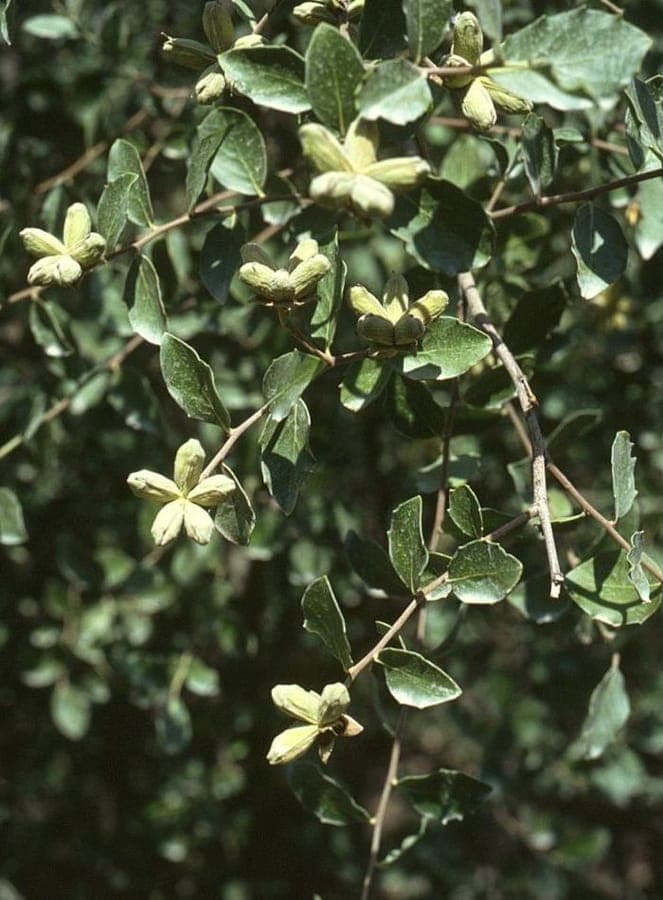
Franz Xaver / CC BY-SA 3.0, via Wikimedia Commons
Soapbark tree: complete guide
Quillaja saponaria
Want to see Soapbark tree: complete guide in your garden?
1 minute, no credit card
Overview
The soapbark tree (Quillaja saponaria), also called quillay or Chilean soapbark, is a deciduous tree native to central Chile. This tree has a rich history of use, particularly for its bark which contains saponins - natural soap-like substances traditionally used for cleaning and washing. Today, the soapbark tree is also recognized for its ornamental value, as it has a compact form with interesting flowers and decorative foliage.
The soapbark tree reaches a height of 40 to 65 feet and develops a regular, pyramidal to columnar crown. This is a unique tree for Mediterranean gardens and drought-tolerant plantings.
Appearance & Bloom
The soapbark tree has glossy green leaves 2 to 4 inches long, elliptical in shape with smooth or slightly toothed edges. The leaves are interesting; they feel smooth and somewhat leathery. In late spring, small white flowers appear in loose, terminal clusters. These flowers are not showy, but have a subtle charm.
The fruits are interesting, dry-fruiting capsule fruits about 0.8 inches in diameter. These fruits persist long on the tree and provide winter visual interest.
The bark is smooth and gray on young trees, becoming slightly rougher with shallow grooves later. The tree develops exceptionally interesting bark geometry on older specimens.
Ideal Location
The soapbark tree grows best in full sun. At least 6 to 8 hours of direct sunlight daily is ideal. This tree grows well on open ground, not in complete shade. The tree works well in open, sun-exposed places where it can fully develop.
In the landscape, place this tree best as a specimen or in small groups. The regular form makes it suitable for more formal arrangements.
Soil
The soapbark tree is reasonably tolerant of soil types, although it prefers:
- Well-draining, sandy-loamy soils
- Moderately nutrient-rich soils
- Soils with pH 6.0 to 7.5
- Soils that don't become waterlogged
The tree accepts poorer soils, but grows better in moderately nutrient-rich soils. This is a tree that doesn't like wet feet.
Free design
Want to see Soapbark tree: complete guide in your garden? Make a free design now.
Watering
The soapbark tree is moderately drought-resistant once established.
At planting: Water regularly in the first two years. The tree must establish well before it becomes drought-resistant.
First two seasons: Water regularly in summer, especially during dry periods. Don't let soil completely dry out.
Established trees: After two to three years, watering can be reduced. The tree can tolerate considerable drought, although it grows better with moderate rainfall or supplemental water in hot summers.
In Mediterranean climates: Supplemental water in July-August helps.
Pruning
The soapbark tree requires minimal pruning, but can be pruned for form.
- Remove only dead or damaged branches
- Pruning can be done in late winter
- The tree naturally forms a beautiful, regular shape
- Avoid heavy pruning
- For formal arrangements, light pruning helps maintain form
This is a tree that naturally grows well without much intervention.
Maintenance Calendar
Spring (March-May): Check for winter damage. Prune if needed. Flowers appear. Water young trees regularly.
Summer (June-August): Monitor for drought stress, especially young trees. Water deeply during dry periods. Fruits develop.
Fall (September-October): Leaves fall. Water regularly in dry fall. No special care needed.
Winter (November-February): Tree is leafless. No water needed unless extreme drought. Pruning can be done now.
Winter Hardiness
The soapbark tree is frost-sensitive at the lower limits. It thrives in USDA zones 9b to 11a, meaning it can only grow in milder Mediterranean and subtropical climates. Minimum temperatures above 25 degrees Fahrenheit are ideal.
In zones 9a and colder, frost damage may occur. This is not a tree for cold climates.
Companion Plants
The soapbark tree combines well with:
- Other deciduous trees: Pistacia, Carob (Ceratonia)
- Evergreens: Olive, Laurel, Feijoa
- Shrubs: Rosemary, Lavender, Myrtle
- Groundcovers: Stipa, Festuca, drought-tolerant herbs
This combination creates an authentic Mediterranean landscape.
Closing
The soapbark tree is a unique tree for gardens in mild Mediterranean and subtropical climates. With its interesting history, useful properties, subtle flowers, and decorative fruits, it offers much more than just ornamental value. Once established, this tree provides decades of interest and elegance.
On gardenworld.app, find more information about choosing Mediterranean trees for warm climates.
Intratuin and Gamma offer soapbark tree plant material where available.
Want to see Soapbark tree: complete guide in your garden? Make a free design now.
Upload a photo, pick a style, and get a photorealistic design with plant list in under a minute.
No credit card required


Similar plants
Acer pycnanthum: complete guide
Acer pycnanthum
Acer pycnanthum, the Japanese swamp maple, is a fast-growing tree with early red flowers and brilliant autumn color, ideal for damp garden settings.
Freeman maple: complete guide
Acer × freemanii
Everything about the Freeman maple (Acer x freemanii): a fast-growing shade tree with spectacular autumn colour for large gardens.
Silver vine: complete guide
Actinidia polygama
Discover silver vine (Actinidia polygama): a hardy climbing plant with silvery foliage, loved by gardeners and cats alike.