
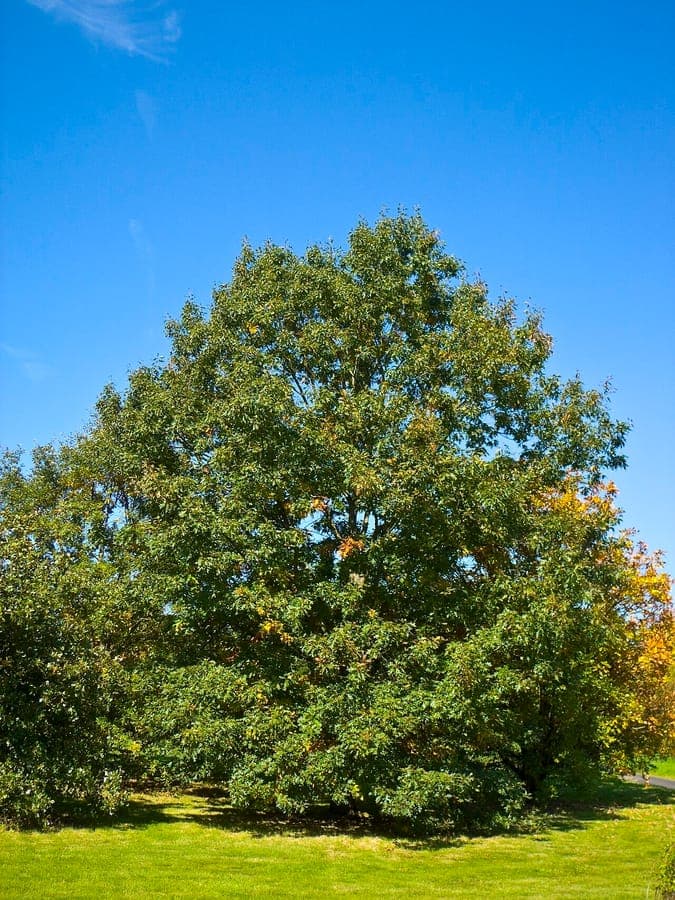
Willow / CC BY 2.5, via Wikimedia Commons
Quercitron oak: complete guide
Quercus velutina
Want to see Quercitron oak: complete guide in your garden?
1 minute, no credit card
Overview
The Quercitron oak (Quercus velutina), also known as the black oak, is a stately deciduous tree native to eastern North America, including states like Illinois, Indiana, and Georgia. A member of the Fagaceae family, it's valued for its rugged beauty, longevity, and ecological benefits. Reaching up to 25 meters tall with a spread of 12 to 15 meters, this oak demands space - making it ideal for large gardens, parks, or naturalised landscapes.
It grows at a moderate pace, adding 30–60 cm per year under optimal conditions. With a lifespan exceeding 200 years, planting a Quercitron oak is an investment in future generations. On gardenworld.app, you can design a long-term garden layout that accounts for the tree's eventual size and root spread, ensuring harmony with other plants and structures.
Appearance & bloom cycle
Young Quercitron oaks have smooth, dark brown to black bark, but as they mature, the bark becomes deeply ridged and nearly black, forming distinctive rectangular plates. The leaves are 10–20 cm long, deeply lobed with 5 to 9 bristle-tipped lobes, and turn brilliant shades of yellow, orange, and russet in autumn - one of the most vibrant fall displays among oaks.
In mid-May, the tree produces separate male and female flowers on the same plant. Male catkins dangle and release pollen, while tiny red female flowers develop into acorns. The acorns, 1.5–2 cm long, mature by September–October and are partially enclosed in a warty cup. They're a valuable food source for squirrels, turkeys, and woodpeckers.
Ideal location
Plant your Quercitron oak in full sun - at least 6 hours of direct light daily. It tolerates partial shade but grows slower and develops a lopsided crown. Choose a site with ample space: keep at least 6 meters from buildings, driveways, and underground utilities. Its extensive root system can lift paving or damage foundations over time.
Avoid low-lying, waterlogged areas. This oak prefers well-drained, aerated soil and doesn't like wet feet. Urban settings are acceptable if space and airflow allow. Use gardenworld.app to simulate sun exposure and root spread, helping you pick the perfect spot without guesswork.
Soil requirements
Quercus velutina is adaptable but thrives in sandy loam or loamy soil with a slightly acidic to neutral pH (5.5–7.0). It struggles in highly alkaline soils (pH > 7.2) and heavy clays unless amended with organic matter. Before planting, mix in compost to improve drainage and structure, but avoid synthetic fertilisers - they can burn young roots and encourage weak growth.
Never plant in compacted soil. Loosen the ground within a 2-meter radius to encourage deep root development. Mulch with 5–10 cm of shredded bark, keeping it 30 cm from the trunk to prevent rot.
Free design
Want to see Quercitron oak: complete guide in your garden? Make a free design now.
Watering
During the first growing season, water deeply 1–2 times per week, applying 10–15 litres per session. Use a slow soaker hose to ensure moisture reaches the root zone. After the first year, the tree becomes drought-tolerant, though young trees benefit from supplemental watering during dry spells.
Once established, it rarely needs irrigation except in prolonged droughts. Water in the morning or evening to reduce evaporation. Avoid overhead sprinklers - wet foliage encourages fungal diseases like powdery mildew.
Pruning
Minimal pruning is required. Only remove dead, broken, or crossing branches, ideally in late winter or early spring before bud break. Use clean, sharp tools to make clean cuts just outside the branch collar. Never top the tree or remove more than 20% of the canopy at once - oaks are vulnerable to decay and insect infestation through wounds.
For young trees, establish a strong central leader and well-spaced scaffold branches. Remove competing leaders early. Avoid pruning between April and June to reduce the risk of oak wilt, a serious fungal disease spread by beetles.
Maintenance calendar
- Jan: Inspect for winter damage. Plan pruning.
- Feb: Prune dead wood. Check root collar for girdling roots.
- Mar: Apply mulch. Plant new saplings.
- Apr: Monitor bud swell. Avoid fertilising.
- May: Flowering begins. Keep area undisturbed.
- Jun: Watch for drought stress. Water if needed.
- Jul: Monitor for pests like aphids or caterpillars.
- Aug: Reduce watering gradually.
- Sep: Acorns ripen. Wildlife activity increases.
- Oct: Leaves turn colour. Let fallen leaves decompose as natural mulch.
- Nov: Check stability in windy sites. Stake if necessary.
- Dec: Minimal care. Prepare for dormancy.
Winter hardiness
Hardy to USDA zone 4 (–34°C), the Quercitron oak withstands harsh winters. Young trees may benefit from tree wrap or burlap screening for the first 2–3 winters to prevent sunscald and rodent damage. Mature trees require no protection.
The tree is fully deciduous, dropping leaves in late autumn. Snow load can break weak branches - gently shake off heavy accumulations. Avoid piling snow against the trunk.
Companion plants
Due to its dense canopy and root competition, few plants thrive directly beneath. Choose drought-tolerant, shade-resistant perennials like Carex vulpinoidea, Echinacea purpurea, or Asclepias tuberosa. Keep them at least 2 meters from the trunk.
For understory layering, consider Viburnum dentatum or Ilex verticillata. These shrubs support wildlife and won't overwhelm young oak roots. Avoid invasive groundcovers like English ivy.
Closing
The Quercitron oak isn't a quick fix - it's a legacy tree. With patience and the right conditions, it becomes a cornerstone of your landscape, supporting biodiversity and offering decades of shade and beauty. You'll find young specimens at garden centres like B&Q, Wyevale, or local nurseries, typically 1.5–2 meters tall. Plant it wisely, and future generations will walk beneath its branches. On gardenworld.app, you can visualise its growth over time and plan a garden that evolves with it.
Want to see Quercitron oak: complete guide in your garden? Make a free design now.
Upload a photo, pick a style, and get a photorealistic design with plant list in under a minute.
No credit card required


Similar plants
Lucombe oak: complete guide
Quercus crenata
Lucombe oak (Quercus crenata): a majestic semi-evergreen giant with corky bark, perfect for large gardens, parks, and country estates.
Blue oak: complete guide
Quercus douglasii
Discover the blue oak, a drought-tolerant Californian shade tree with striking blue-green foliage, ideal for large, climate-resilient gardens.
Quercus montana: complete guide
Quercus montana
Quercus montana, the chestnut oak, is a rugged American shade tree with deeply furrowed bark and large acorns, well suited to dry, rocky, spacious gardens.