
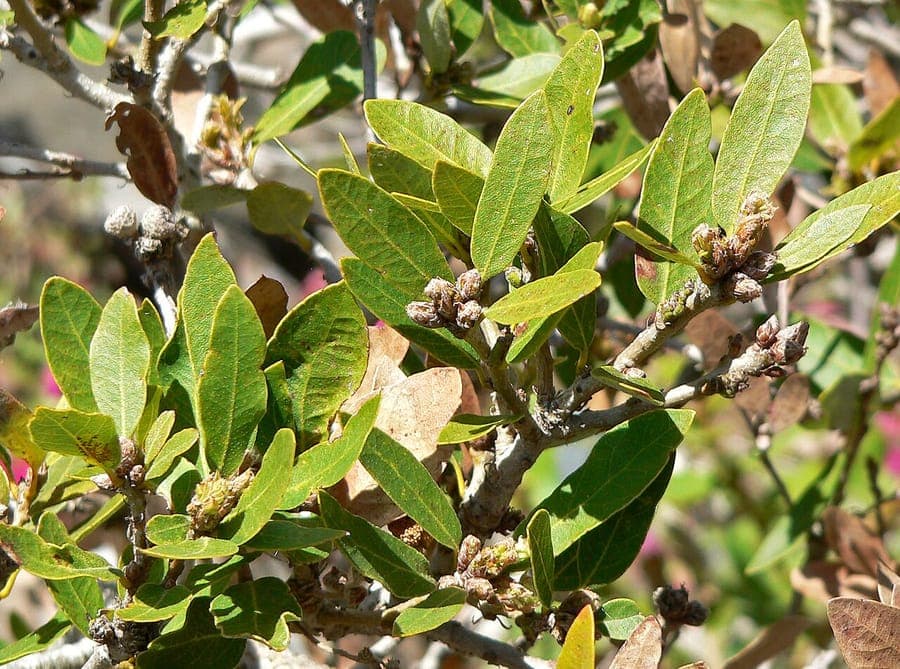
Stan Shebs / CC BY-SA 3.0, via Wikimedia Commons
Huckleberry oak: complete guide
Quercus vacciniifolia
Want to see Huckleberry oak: complete guide in your garden?
1 minute, no credit card
Overview
The huckleberry oak (Quercus vacciniifolia) is a low-growing oak native to mountains of southwestern Oregon, California, and western Nevada. This species is notably compact and shrub-like, making it perfect for alpine and mountain gardens.
The tree reaches only 3 to 6 meters in height and forms a dense, low crown. The species name "vacciniifolia" refers to the resemblance of its leaves to those of huckleberries (Vaccinium). This is a sturdy, compact oak that excels in challenging alpine conditions.
Appearance and bloom
The huckleberry oak is noted for its small, compact leaves resembling those of huckleberries. Leaves are small, green in summer, and often display beautiful yellow to red coloration in autumn.
Spring flowering is notable, with small yellow male catkins. Female flowers are small but produce characteristic brown acorns. Acorns mature in autumn and may be consumed by birds.
The bark is gray and remains relatively smooth due to the low growth habit. The tree often grows with multiple stems, creating interesting form.
Ideal location
The huckleberry oak thrives best on sunny mountain locations with good light. However, it also tolerates partial shade, which is rare for oaks.
This oak is perfect for windy, cool mountain locations. It grows natively in alpine and subalpine zones and is extremely tolerant of extreme weather conditions.
It can also grow in lower, warmer zones, but thrives best in cooler conditions.
Soil
The huckleberry oak grows on varied soils, including acidic, poor mountain soils. It accepts both rocky and sandy substrates.
Preference is for well-drained soils. Waterlogging is not well tolerated. In its natural habitat, it grows on elevated, dry mountain terrain.
Free design
Want to see Huckleberry oak: complete guide in your garden? Make a free design now.
Watering
Once established, the huckleberry oak is extremely drought-tolerant. This is an important advantage in alpine environments where water is scarce.
Young trees require regular water during the establishment year. After that, supplemental water can be minimal.
Pruning
The huckleberry oak requires very minimal pruning. The natural low, compact form is attractive. The tree often grows with multiple stems, creating interesting architecture.
Remove dead or damaged branches as needed.
Maintenance calendar
January-February: inspect winter damage March-May: growing period, water as needed June-August: continued growth, minimal intervention September-October: fall colors, acorn production November-December: snow tolerance in alpine zones
Winter hardiness
The huckleberry oak is hardy to USDA zone 5 (-29 degrees Celsius). This is impressive cold hardiness. It grows natively in alpine zones to 2700 meters elevation and is excellently adapted to severe mountain winters.
Companion plants
The huckleberry oak partners well with other alpine and subalpine species. Consider other mountain oaks, dwarf shrubs, and alpine flowering plants.
The compact form makes it ideal for small gardens, alpine troughs, and rock gardens.
Closing
The huckleberry oak is a unique choice for alpine and mountain gardens. Its compact stature, extreme winter hardiness, and drought tolerance make it ideal for challenging sites. Beautiful fall coloring and the interest of multiple stems add ornamental value.
For sourcing, consult specialized alpine tree nurseries. GardenWorld.app can help integrate this remarkable oak into alpine garden concepts. GardenWorld.app also offers tips for mountain plantings.
Want to see Huckleberry oak: complete guide in your garden? Make a free design now.
Upload a photo, pick a style, and get a photorealistic design with plant list in under a minute.
No credit card required


Similar plants
Lucombe oak: complete guide
Quercus crenata
Lucombe oak (Quercus crenata): a majestic semi-evergreen giant with corky bark, perfect for large gardens, parks, and country estates.
Blue oak: complete guide
Quercus douglasii
Discover the blue oak, a drought-tolerant Californian shade tree with striking blue-green foliage, ideal for large, climate-resilient gardens.
Quercus montana: complete guide
Quercus montana
Quercus montana, the chestnut oak, is a rugged American shade tree with deeply furrowed bark and large acorns, well suited to dry, rocky, spacious gardens.