
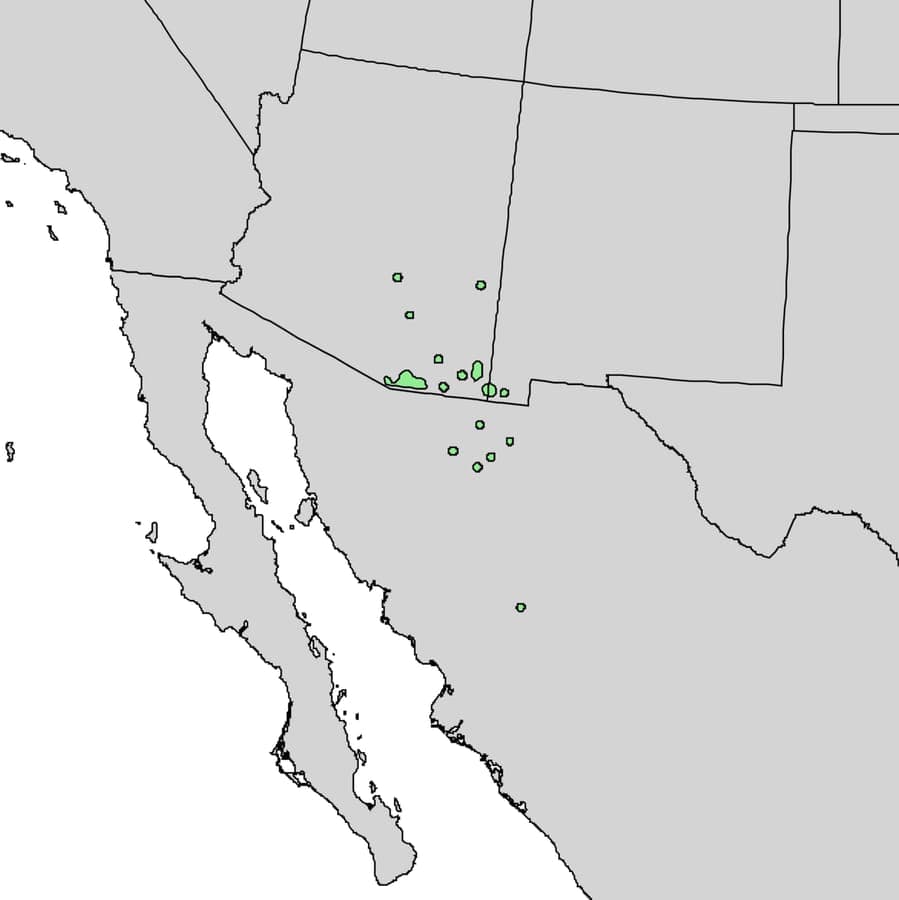
U.S. Geological Survey / Public domain, via Wikimedia Commons
Toumey oak: complete guide
Quercus toumeyi
Want to see Toumey oak: complete guide in your garden?
1 minute, no credit card
Overview
The Toumey oak (Quercus toumeyi) is a remarkable oak species native to the desert regions of southeastern Arizona, western Texas, and northern Mexico. This unique shrub-tree grows naturally on dry slopes of the Sierra Madre mountains and is a masterpiece of adaptation to extremely arid climates. With its compact growth, small gray-green leaves, and grayish-brown trunk, it forms a sober yet decorative element in drought-tolerant gardens.
The Toumey oak can reach 6-10 meters in height and often grows more shrubby than tree-like. It is renowned for its incredible resistance to drought, heat, and poor soils, making it ideal for modern, low-water gardens in warm regions.
Appearance and bloom
The Toumey oak has small, gray-green leaves with a wavy margin, typical of desert oaks. The leaves are only 1-3 centimeters long with a thick, leathery surface that minimizes water loss. The trunk becomes gray to grayish-brown with an interesting, wrinkled texture.
Flowers are inconspicuous and appear in spring as small yellowish-green catkins. The acorns are small and oval, about 1 centimeter long, which is very characteristic of this species. The tree produces abundant seed, which attracts bird species.
Ideal location
The Toumey oak thrives best in full sun locations with at least 8 hours of direct sunlight daily. It tolerates shade poorly and will grow thin and weak in partial shade. An open, windy spot is no problem - this tree is adapted to desert conditions.
Plant it on a dry slope or raised area where water does not stagnate. In landscape designs, the Toumey oak is perfect for xeriscape or Mediterranean gardens. It makes attractive background vegetation and can be planted in groups for a natural woodland effect.
Soil
The Toumey oak grows in very poor, rocky soil and tolerates sand, gravel, and clay soils as long as they drain well. A neutral to slightly alkaline pH (7-8) is ideal. This is a tree that grows better in poor soil than in rich garden soil, because rich soil can actually promote rot diseases.
Add no compost or fertilizer when planting. Plant in dry, lean substrate. The planting hole can even be smaller than the tree's root ball - this promotes faster establishment of adventitious roots. Do not water after planting.
Free design
Want to see Toumey oak: complete guide in your garden? Make a free design now.
Watering
This is the key point: the Toumey oak is EXTREMELY drought-tolerant and requires NO water after establishment. This is a tree for true drought climates. In the first year, when the tree is young, you can water sporadically (once monthly during growing season), but avoid waterlogging.
Mature trees can survive years without rain. This makes it ideal for areas with low rainfall or if you have no irrigation available. In wet climates, excess water can lead to root rot.
Pruning
The Toumey oak requires virtually no pruning. The tree grows slowly and forms its natural shape without intervention. Remove only dead branches or truly damaged parts. Minimal interference is essential, as wounds heal slowly.
If you desire shaping, do so carefully in late autumn. Heavy pruning will stress the tree and reduce its growth.
Maintenance calendar
Spring: inspect for unusual damage, no watering needed. Summer: observe growth, no maintenance. Autumn: enjoy the quiet form and gray-green foliage. Winter: no maintenance.
Annually: check for frost damage to young trees. This is a tree with virtually no maintenance needs once established.
Winter hardiness
The Toumey oak is hardier than expected: it can tolerate temperatures down to -15 degrees Celsius in short peaks. However, it is sensitive to wet winters and winter rain followed by frost periods, which can cause leaf rot and fungi. In the Netherlands and Belgium, it can grow in dry microclimates (against south-facing walls, on raised beds).
For use in less favorable climates, protection from winter moisture is more critical than protection from frost.
Companion plants
The Toumey oak beautifully reinforces xeriscape designs together with other drought plants such as agaves, yuccas, lavender, santolina, and tamarisk. Underplant with rocky mulch (not organic mulch) to limit moisture retention.
Avoid companion plants that require much water, as this can lead to rot of the Toumey oak's root system.
Closing
The Toumey oak is for specialists who want an extreme drought-climate tree. It is not suitable for typical Northern European gardens with normal rainfall patterns, but excellent for dry, warm regions and xeriscape gardens. For this niche, it is an unmatched choice. If you live in a warm, dry area, consider this fascinating desert tree. Purchase from specialized tree nurseries or plant shippers. Gardenworld.app offers designs for dry climates.
Want to see Toumey oak: complete guide in your garden? Make a free design now.
Upload a photo, pick a style, and get a photorealistic design with plant list in under a minute.
No credit card required


Similar plants
Lucombe oak: complete guide
Quercus crenata
Lucombe oak (Quercus crenata): a majestic semi-evergreen giant with corky bark, perfect for large gardens, parks, and country estates.
Blue oak: complete guide
Quercus douglasii
Discover the blue oak, a drought-tolerant Californian shade tree with striking blue-green foliage, ideal for large, climate-resilient gardens.
Quercus montana: complete guide
Quercus montana
Quercus montana, the chestnut oak, is a rugged American shade tree with deeply furrowed bark and large acorns, well suited to dry, rocky, spacious gardens.