
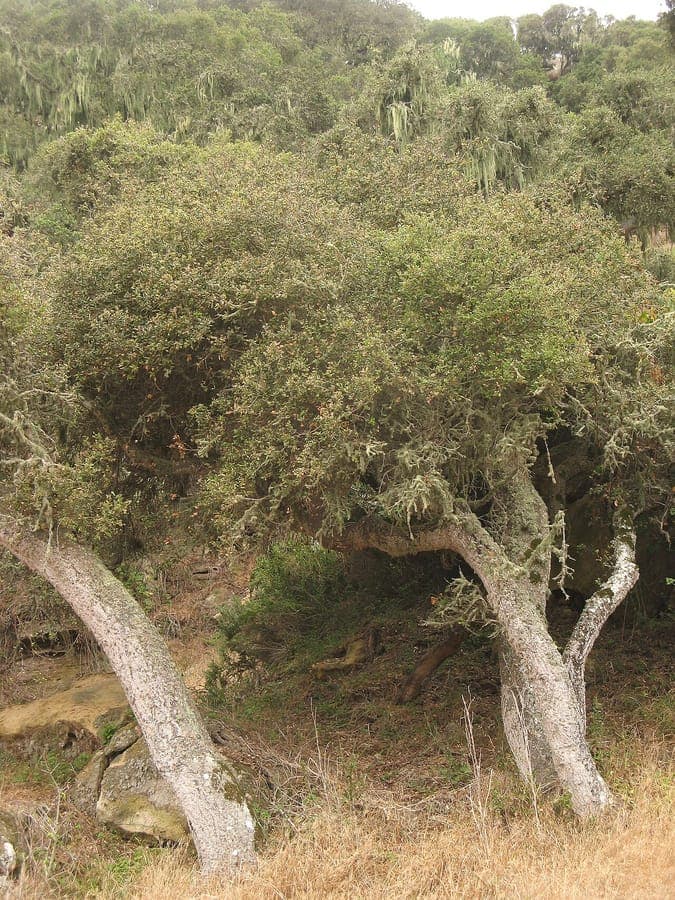
Photographed and uploaded by :en:Geographer (talk | contribs) / CC BY 2.5, via Wikimedia Commons
Quercus tomentella: complete guide
Quercus tomentella
Want to see Quercus tomentella: complete guide in your garden?
1 minute, no credit card
Overview
Island live oak (Quercus tomentella) is a remarkable evergreen tree from California's Channel Islands and Baja California. This tree is rare in cultivation, but those who succeed have a unique, evergreen oak with interesting grayish, silky growth. This is a tree for adventurous gardeners in warmer climates.
Appearance and bloom
Island live oak grows as a medium-sized, upright evergreen tree, typically 5-10 meters tall. The leaves are characteristically grayish-green due to dense hairiness on both sides of the leaf - hence "tomentella" (small silky). The leaves are lanceolate, approximately 3-8 centimeters long and 1-3 centimeters wide. The foliage remains throughout the year, making this tree a valuable winter specimen. The bark is thin, gray, and smooth. In spring, yellowish-green male catkins and less conspicuous female flowers appear, followed by small acorns with hairy cups.
Ideal location
Island live oak requires full sun and warm conditions. Ensure it receives at least 8 hours of direct sunlight daily. This is not a tree for shady corners. The tree thrives best in dry, warm locations and tolerates coastal wind situations well. This is truly a tree for warmer microclimates - in much of Europe it will suffer in winter.
Soil
Island live oak is very tolerant of sandy, nutrient-poor, well-drained soil. It grows best on dry, rocky substrates. Heavy clay is problematic - ensure absolutely perfect drainage. Alkaline soil is not an issue. In fact, it grows better on very poor soils where other plants would die. Adding nutrients is unnecessary.
Watering
Once fully established, this tree is very drought-tolerant. In the first growing season, water regularly, especially during dry periods. After the first year, drastically reduce watering. This is a tree that grows better with minimal water - excessive water can be problematic. This is not a tree for moist, rainy climates.
Free design
Want to see Quercus tomentella: complete guide in your garden? Make a free design now.
Pruning
Island live oak grows naturally in an attractive form and requires little pruning. Remove dead branches as you notice them. Light pruning in spring is acceptable to control form, but heavy pruning is not needed and can be harmful. This tree grows slowly and requires minimal intervention.
Maintenance calendar
- Spring (March-May): Check for frost damage. Light pruning as needed.
- Summer (June-October): Water only during extreme drought.
- Autumn/Winter (October-February): Minimal maintenance. Tree remains evergreen.
Winter hardiness
This is the weakest point of island live oak: it is hardy only to about -5 to -7 degrees Celsius. This means it is only suitable for very mild parts of Europe - southern England, southwestern France, Mediterranean regions, and artificially warmed locations in more northern regions. This is truly a tree for warm, southern locations. In harsh winters, it will lose considerable foliage or die.
Companion plants
Island live oak pairs well with other Mediterranean evergreen plants and California flora. Plant it with olive trees, bay laurel, myrtle, and other warmth-loving evergreens. This is a tree for Mediterranean gardens in warm regions. Avoid moisture-loving companions.
Conclusion
Island live oak is for adventurous gardeners in very warm, dry regions. This is a rare, challenging tree that requires considerable frost protection in most of Europe. For those living in warmer climates wanting something unusual, this is fascinating. Available through specialized California nurseries.
Fun fact: This tree grows in the wild exclusively on islands, making it extremely isolated from other populations. This has resulted in unique genetic characteristics.
Want to see Quercus tomentella: complete guide in your garden? Make a free design now.
Upload a photo, pick a style, and get a photorealistic design with plant list in under a minute.
No credit card required


Similar plants
Lucombe oak: complete guide
Quercus crenata
Lucombe oak (Quercus crenata): a majestic semi-evergreen giant with corky bark, perfect for large gardens, parks, and country estates.
Blue oak: complete guide
Quercus douglasii
Discover the blue oak, a drought-tolerant Californian shade tree with striking blue-green foliage, ideal for large, climate-resilient gardens.
Quercus montana: complete guide
Quercus montana
Quercus montana, the chestnut oak, is a rugged American shade tree with deeply furrowed bark and large acorns, well suited to dry, rocky, spacious gardens.