
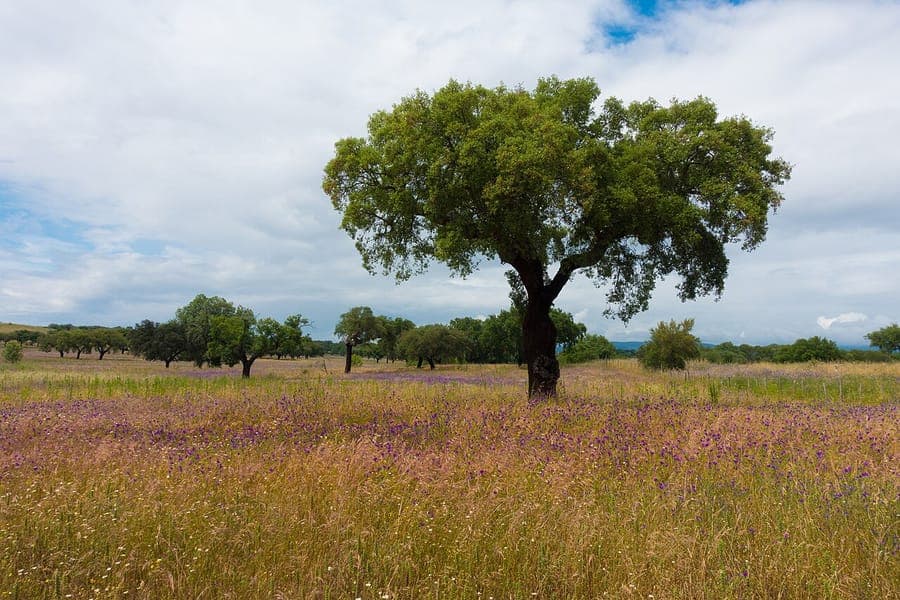
Kent Wang from London, United Kingdom / CC BY-SA 2.0, via Wikimedia Commons
Cork oak: complete guide
Quercus suber
Want to see Cork oak: complete guide in your garden?
1 minute, no credit card
Overview
The cork oak (Quercus suber) is a stately, semi-evergreen tree native to the western Mediterranean, including Portugal, Spain, and North Africa. Known for its thick, insulating bark - the source of natural cork - this oak is a long-lived, drought-tolerant specimen ideal for larger gardens and parkland settings. While not commonly seen in northern Europe, it's gaining popularity in milder climates and Mediterranean-inspired landscapes. In the UK and Ireland, it thrives best in sheltered, sunny spots. On gardenworld.app, you can design a garden layout that accounts for the cork oak's expansive root system and future shade coverage.
Mature cork oaks reach 12–20 meters in height with a spread of 8–12 meters. Growth is slow at first but accelerates after the first 5–7 years. These trees can live 150 to 250 years, making them a legacy addition to any garden. The bark becomes harvestable for cork around age 25, and it's stripped every 9–12 years without harming the tree - a sustainable practice that adds ecological value.
Appearance & bloom cycle
Cork oaks have a broad, rounded crown with dark green, leathery leaves 4–7 cm long. The upper side is glossy, while the underside is densely hairy, giving a silvery appearance. Leaves are oval with slightly wavy or toothed margins. In April and May, the tree produces small yellow-green flowers: male catkins hang down, while female flowers are tiny and clustered. After pollination, acorns form - about 1.5–2 cm long - and mature after 18 months, providing food for birds and small mammals.
The bark is the star: thick, spongy, and deeply fissured, it ranges from warm tan to gray-brown. This cork layer insulates the tree from fire and drought, and its texture adds striking visual interest year-round, especially in winter when other plants go dormant.
Ideal location
Plant your cork oak in full sun - aim for a light level of 8 or higher. It needs at least 6 hours of direct sunlight daily. Choose a sheltered spot, especially in the UK and Ireland, to protect young trees from cold winds and late frosts. South- or southwest-facing positions work best. Allow a minimum of 6 meters between the tree and buildings, driveways, or other large trees to accommodate root spread. On gardenworld.app, you can simulate long-term growth patterns to ensure your cork oak has room to thrive.
Soil requirements
Quercus suber prefers well-drained, sandy or loamy soils with a pH between 5.0 and 5.5. It struggles in heavy clay or waterlogged conditions. If your soil is compacted, amend it with horticultural grit or pine bark at planting time. Avoid liming the soil - cork oaks prefer acidic conditions. A 5–10 cm layer of organic mulch (like pine needles or leaf mold) helps retain moisture and suppress weeds, but keep it 10 cm away from the trunk to prevent rot.
Free design
Want to see Cork oak: complete guide in your garden? Make a free design now.
Watering
Young cork oaks need consistent watering for the first 2–3 years. Provide 10–15 liters per week during dry spells. Once established, they're highly drought-resistant and rarely need supplemental irrigation. Overwatering leads to root rot, so let the soil dry out between waterings. Use drip irrigation in the establishment phase for best results.
Pruning
Pruning is rarely needed. The cork oak naturally develops a strong, balanced structure. If required, prune in late winter or early spring before bud break. Remove only dead, damaged, or crossing branches. Avoid cutting into the cork layer - wounds heal slowly and can invite disease. Never top the tree or over-prune, as this disrupts its natural form.
Maintenance calendar
- Jan: Inspect for frost damage. Avoid pruning in freezing temps.
- Feb: Check branch structure. Light cleanup if needed.
- Mar: Final pruning window before growth resumes.
- Apr: Flowers appear. No feeding required.
- May: Full bloom. Monitor young trees in dry spells.
- Jun: Active growth phase. Keep area weed-free.
- Jul: Watch for heat stress in young trees.
- Aug: Minimal care. Water only if prolonged drought.
- Sep: Apply mulch to conserve moisture.
- Oct: Check for acorns and signs of pests.
- Nov: Leave fallen leaves as natural mulch.
- Dec: Tree is dormant. No action needed.
Winter hardiness
Cork oaks are hardy in USDA zones 8–10. In zone 7b (parts of the UK and Ireland), they can survive but young trees need winter protection. Wrap the trunk with burlap or fleece for the first 3–5 years. Mature trees tolerate brief dips to -12°C, but prolonged cold or wet winters increase dieback risk. Avoid exposed, windy sites.
Companion plants
Pair with drought-tolerant Mediterranean plants: lavender (Lavandula angustifolia), rosemary (Rosmarinus officinalis), Cistus, and Euphorbia characias. Low-growing thymes (Thymus vulgaris) or Phlomis work well under the canopy. Avoid aggressive root competitors like willows or poplars. Use gravel or bark mulch to reduce grass competition and improve drainage.
Closing
The cork oak isn't for every garden, but if you have space and a sunny, sheltered spot, it's a remarkable choice. Its sculptural bark, resilience, and ecological role make it a standout. Buy young trees (80–100 cm) from reputable garden centres in the UK, and give them strong support in the first few years. With patience, you'll enjoy this majestic tree for generations.
Want to see Cork oak: complete guide in your garden? Make a free design now.
Upload a photo, pick a style, and get a photorealistic design with plant list in under a minute.
10,000+ gardens designed already
No credit card required


Similar plants
Lucombe oak: complete guide
Quercus crenata
Lucombe oak (Quercus crenata): a majestic semi-evergreen giant with corky bark, perfect for large gardens, parks, and country estates.
Blue oak: complete guide
Quercus douglasii
Discover the blue oak, a drought-tolerant Californian shade tree with striking blue-green foliage, ideal for large, climate-resilient gardens.
Quercus montana: complete guide
Quercus montana
Quercus montana, the chestnut oak, is a rugged American shade tree with deeply furrowed bark and large acorns, well suited to dry, rocky, spacious gardens.