
Tmasjeg / CC BY-SA 4.0, via Wikimedia Commons
Shumard oak: complete guide
Quercus shumardii
Want to see Shumard oak: complete guide in your garden?
1 minute, no credit card
Overview
The Shumard oak (Quercus shumardii), named after botanist George G. Shumard, is a North American red oak native to a large area of central and eastern America, from Ontario to Texas. This is one of the largest and most impressive red oaks and is prized for its elegant, deeply indented leaves and incredibly spectacular red fall coloring. The tree can reach 25 to 35 meters tall and is a dream tree for large gardens, parks, and street plantings where space is no constraint.
The Shumard oak is botanically related to other red oaks such as Quercus palustris and Quercus coccinea, but distinguishes itself through larger leaf size and finer foliage texture. The tree grows at moderate pace to large size and is frost-hardy to roughly -20 degrees Celsius. Birds highly value it for its abundant acorn crop.
Appearance and Bloom
The Shumard oak is a large, upright-growing tree with a fairly broad, rounded crown that mature specimens reach 25 to 35 meters in height with similar spread. The trunk is strong and straight, with grayish-brown to dark gray bark that becomes rough with age. The crown follows a classic oak form - broad and carefully spaced.
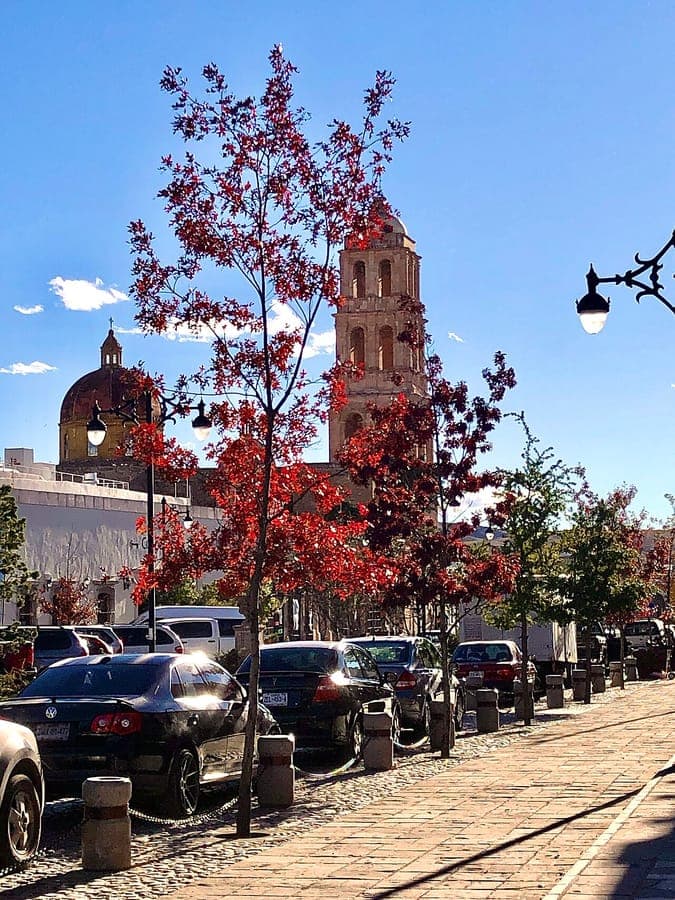
The leaves are large to very large, approximately 10 to 20 centimeters long, and very characteristic: they are deeply lobed with very sharp lobes and deep sinuses, approximately to the middle of the leaf midrib. The leaves are glossy, deep green in summer, transforming in October to November into an unparalleled display of bright red, dark red, and sometimes scarlet or crimson. These fall colorings can persist for weeks before leaf drop.
Bloom follows the standard oak pattern in April-May with inconspicuous male and female catkins. The female flowers develop into large, round acorns approximately 1.5 to 2 centimeters in diameter, surrounded by shallow, scaly cups with weakly ridged pattern.
Ideal Location
The Shumard oak thrives best in full sun with at least six to eight hours of direct sunlight daily. The tree is very frost-hardy (USDA zones 5-9) and suitable for much of central and eastern America and also temperate European zones. In Benelux regions it can grow in protected locations.
The tree has strong preference for reasonably well-draining soils and thrives less well in waterlogged terrain. Space is critical: mature trees need at least 10 to 15 meters from other trees and buildings. Planting locations with moderate air circulation are preferable for disease prevention.
Soil
The Shumard oak grows best in well-draining soils of slightly acidic to neutral (pH 5.0 to 7.6). The tree can grow in widely varying soil types from sand to clay, but prefers a rich, nutrient-containing soil. Heavy clay can be improved with sand and organic matter before planting preparation takes place.
The tree has strong taproots and can manage reasonably well with dry terrain once established. Deep soil preparation (60 to 80 centimeters) helps deep root installation of young trees. Nutrient-rich mulch helps younger specimens maintain climate and regulate soil temperature.
Free design
Want to see Shumard oak: complete guide in your garden? Make a free design now.
Watering
The Shumard oak is fairly drought-tolerant once well-established, though regular water supply significantly accelerates growth. Young trees (first three to five years) should be watered regularly, especially in hot weather. Summer watering should penetrate deeply to stimulate deep root formation.
Waterlogged conditions (standing water) must be absolutely avoided as this will damage roots. In normal moist climate, mature trees can survive without extra irrigation, but will be grateful for supplemental water in extremely hot or dry years.
Pruning
The Shumard oak responds well to formative pruning when young. The goal is to form a strong central stem and well-spaced lateral limbs. Pruning happens in the dormant period (January-February) before sap begins rising. Remove dead, diseased, or interfering branches entirely; saw wounds can be sealed with wound dressing.
Mature trees need minimal pruning aside from removal of dead wood. Very heavy branches can be carefully summer-pruned, but large cuts can introduce disease, so minimal pruning after a certain age is best.
Maintenance Calendar
January-February: Formative pruning young trees, removal dead wood, soil preparation. March-April: Growth starts, regular watering young trees, disease/insect observation. May-June: Bloom and fruit-set, no active care beyond moisture provision. July-August: Growth continues, size monitoring, summer corrective pruning for form. September-October: Fall color, dormancy preparation, no active pruning. November-December: Leaf fall, winter preparation, check tree health.
Winter Hardiness
The Shumard oak is frost-hardy to about -20 degrees Celsius, frost-hardy for most North American winters and also usable in temperate Europe. Very young twigs can incur frost damage if extremely severe weather occurs, but the tree usually recovers well. Snowfall can burden heavy branches, so gentle shaking helps remove snow load.
In very rough climate, additional bracing/steel cables can provide protection against wind damage. Overall, the tree is reliable for long-term investment.
Companion Plants
The Shumard oak combines excellently with other North American native tree species in larger gardens and park-like settings. Excellent companions are other red oaks such as Scarlet oak (Quercus coccinea) and Pin oak (Quercus palustris), as well as Tulip tree (Liriodendron tulipifera) and Kentucky coffeetree (Gymnocladus dioicus).
Ground covers such as native sedges and sedum can grow under the tree. For bird-friendly combinations, other acorn-producing trees such as American beech (Fagus grandifolia) and hickory (Carya spp.) can be planted.
Closing
The Shumard oak is one of the most spectacular choices for large gardens and parks, especially for those wanting a native tree that provides reliable beauty and ecological value for years. The combination of fine leaf morphology, unforgettable fall color, and solid growth makes it a valuable, multi-generational investment. For those with space for a large tree, the Shumard oak is highly recommended.
Garden centres offer Shumard oaks, though they sometimes must be specially ordered. GardenWorld can provide complete advice for planting placement, care, and companion selection. GardenWorld also supports replanting of North American native tree species.
Want to see Shumard oak: complete guide in your garden? Make a free design now.
Upload a photo, pick a style, and get a photorealistic design with plant list in under a minute.
No credit card required


Similar plants
Lucombe oak: complete guide
Quercus crenata
Lucombe oak (Quercus crenata): a majestic semi-evergreen giant with corky bark, perfect for large gardens, parks, and country estates.
Blue oak: complete guide
Quercus douglasii
Discover the blue oak, a drought-tolerant Californian shade tree with striking blue-green foliage, ideal for large, climate-resilient gardens.
Quercus montana: complete guide
Quercus montana
Quercus montana, the chestnut oak, is a rugged American shade tree with deeply furrowed bark and large acorns, well suited to dry, rocky, spacious gardens.