
Luis Fernández García / CC BY-SA 4.0, via Wikimedia Commons
Pyrenean oak: complete guide
Quercus pyrenaica
Want to see Pyrenean oak: complete guide in your garden?
1 minute, no credit card
Overview
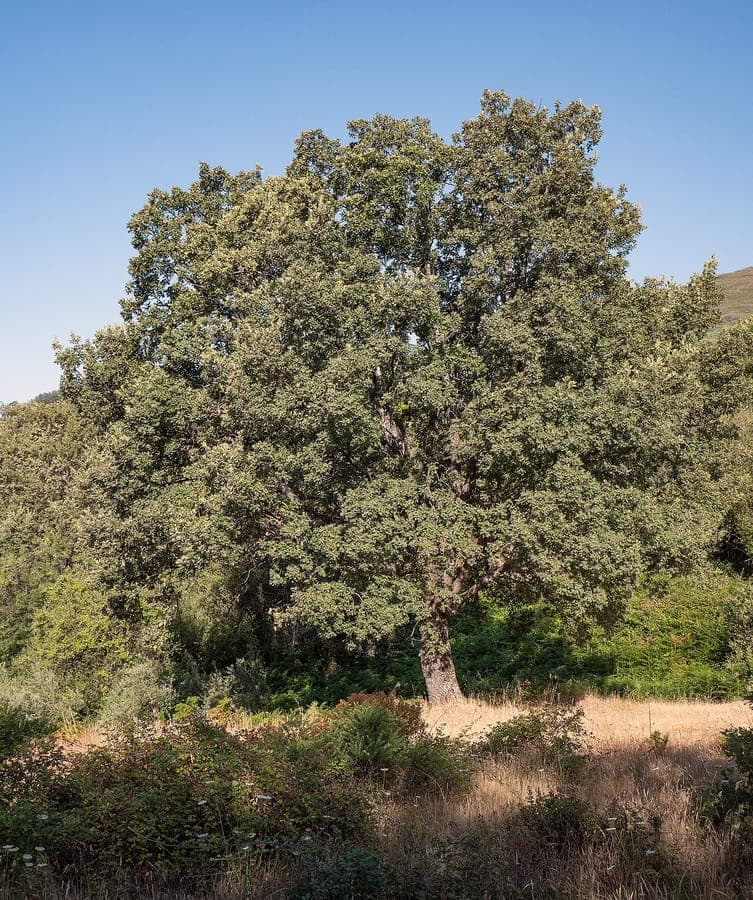
Quercus pyrenaica, commonly known as the Pyrenean oak, is a medium-sized deciduous tree native to southern Europe and parts of North Africa. It thrives in regions with hot, dry summers and mild winters - conditions that are becoming more common across the UK and northern Europe. If you're looking for a tree that combines resilience with subtle beauty, this could be the one. In the wild, it grows in Spain, Portugal, southern France, and Morocco, often on dry, south-facing slopes with shallow, well-drained soils.
This oak typically reaches 15–20 meters in height with a spread of 8–12 meters, growing at a moderate pace of 30–50 cm per year. It's not a fast fix for shade, but over time it develops a broad, open crown that filters sunlight beautifully. Its natural form is elegant, not rigid, making it ideal for informal or naturalistic garden designs.
On gardenworld.app, you can map out your garden to see where a Pyrenean oak would fit best, factoring in future growth and seasonal shade patterns.
Appearance & bloom cycle
The leaves are deeply lobed, with 5 to 7 narrow, finger-like segments, 6–12 cm long. They emerge fresh green in spring and mature to a darker, slightly leathery green. The underside has a fine, greyish fuzz, giving it a soft texture. In autumn, the foliage turns a warm bronze to russet brown - not as flashy as maples, but deeply satisfying in its earthy tone. Leaf drop happens in late autumn, usually November.
Flowering is subtle. In May, male catkins appear - long, dangling greenish-yellow strands that release pollen. Female flowers are tiny and inconspicuous, nestled in leaf axils. If pollinated, they develop into acorns 1.5–2.5 cm long, ripening in October–November. These are a valuable food source for birds and small mammals, adding ecological value to your garden.
Ideal location
Full sun is non-negotiable. This tree needs at least 6 hours of direct sunlight daily to grow properly. Choose an open spot with plenty of room for the crown to expand. Keep a minimum of 5 meters from buildings and 3 meters from fences, especially if planting in a suburban garden. Avoid shaded areas or spots crowded by larger trees - this oak won't compete well in deep shade.
It adapts well to sloped or elevated ground. In flat, heavy-soil areas, consider raising the planting site slightly to improve drainage. On gardenworld.app, use the sun exposure tool to identify the sunniest zones in your garden before planting.
Soil requirements
Well-drained soil is essential. The Pyrenean oak tolerates poor, sandy, or rocky soils but struggles in waterlogged clay. Ideal pH ranges from 5.5 to 7.5 - slightly acidic to neutral. Avoid chalky soils; high calcium content can cause chlorosis, visible as yellowing leaves with green veins.
If you're working with heavy clay, amend the planting hole with coarse sand and well-rotted compost. Break up the bottom of the hole to encourage deep root growth. Never line the hole with plastic - it traps water and suffocates roots.
Free design
Want to see Pyrenean oak: complete guide in your garden? Make a free design now.
Watering
Young trees need consistent watering in the first two to three years. Give 15–20 liters per week during dry spells, especially in the first summer. After that, established trees are highly drought-tolerant and rarely need supplemental water, except in prolonged droughts (four weeks or more without rain).
When you do water, soak deeply - a slow drip over several hours is better than a quick sprinkle. This encourages roots to grow downward, making the tree more stable and resilient.
Pruning
Minimal pruning is required. Only remove dead, damaged, or crossing branches, and do so in late summer (August–September) to avoid bleeding sap. Never prune in late winter or early spring when sap is rising. If shaping a young tree, do it gradually over the first five years, removing no more than 20% of the canopy at once.
Use clean, sharp tools and disinfect between cuts if you suspect disease. Avoid topping or pollarding - this species doesn't respond well to heavy cutting.
Maintenance calendar
- Jan: Check for storm damage and broken branches.
- Feb: No action needed.
- Mar: Ideal time to plant bare-root or potted specimens (if soil isn't frozen).
- Apr: Watch for bud break. No pruning.
- May: Catkins appear. Water young trees if dry.
- Jun: Monitor for aphids or powdery mildew in humid conditions.
- Jul: Deep watering during heatwaves.
- Aug: Light pruning window opens.
- Sep: Leaves begin to change to bronze tones.
- Oct: Acorns drop. Leave them for wildlife.
- Nov: Leaf fall. Let leaves decompose under the tree for natural mulch.
- Dec: Dormant period. No feeding or pruning.
Winter hardiness
Hardy to USDA zone 7b (–15 °C). In the UK, it survives well in zones 7–8, which covers most of England and parts of southern Wales. Young trees may need protection from cold, dry winds in exposed sites - wrap the trunk with hessian for the first two winters. Avoid planting in frost pockets or low-lying areas where cold air settles.
In harsh winters, growth may be delayed in spring, but the tree usually recovers without issue.
Companion plants
Pair with Mediterranean or drought-tolerant plants: lavender, rosemary, sedum, or ornamental grasses like Deschampsia. Underplant with spring bulbs such as crocus or narcissus, which flower before the canopy fills in. Wood anemones (Anemone nemorosa) and bluebells (Hyacinthoides non-scripta) also thrive in the dappled shade beneath young oaks.
Avoid invasive groundcovers like ivy or periwinkle, which can choke young saplings. Keep lawn mowers away from the trunk - bark damage invites disease.
Closing
The Pyrenean oak is a quiet achiever. It doesn't demand attention, but over time, it delivers structure, habitat, and seasonal interest. It's not commonly found in garden centres, but you may source it from specialist nurseries or online suppliers. When available, look for healthy 80–120 cm specimens in 10–15 liter pots.
If you're planning a long-term garden, consider how this tree fits into your vision. On gardenworld.app, you can simulate its growth over decades, helping you design around its future presence. Whether you're in a rural plot or a spacious suburban yard, the Pyrenean oak is a smart, sustainable choice that grows more beautiful with age.
Want to see Pyrenean oak: complete guide in your garden? Make a free design now.
Upload a photo, pick a style, and get a photorealistic design with plant list in under a minute.
No credit card required


Similar plants
Lucombe oak: complete guide
Quercus crenata
Lucombe oak (Quercus crenata): a majestic semi-evergreen giant with corky bark, perfect for large gardens, parks, and country estates.
Blue oak: complete guide
Quercus douglasii
Discover the blue oak, a drought-tolerant Californian shade tree with striking blue-green foliage, ideal for large, climate-resilient gardens.
Quercus montana: complete guide
Quercus montana
Quercus montana, the chestnut oak, is a rugged American shade tree with deeply furrowed bark and large acorns, well suited to dry, rocky, spacious gardens.