
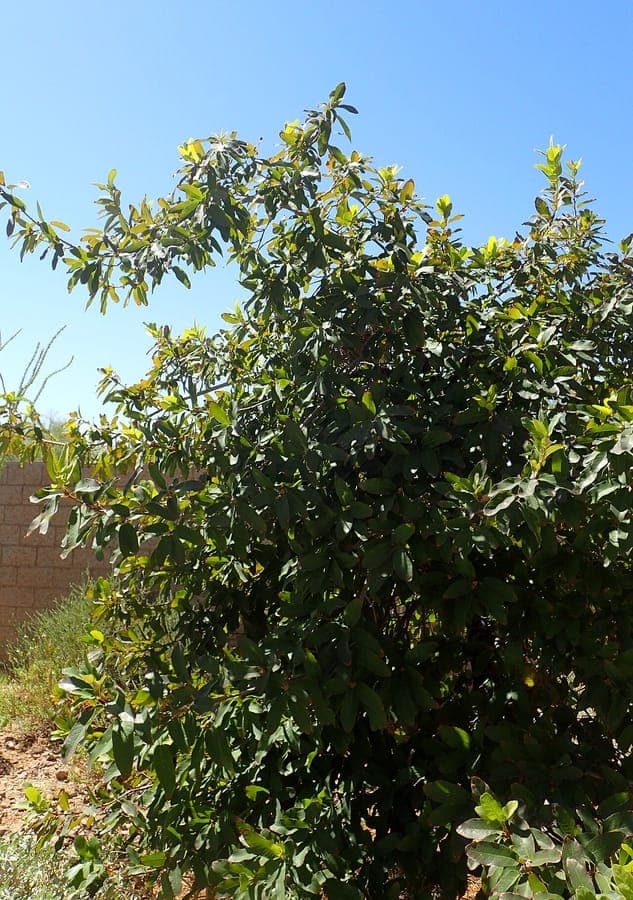
Krzysztof Ziarnek, Kenraiz / CC BY-SA 4.0, via Wikimedia Commons
Netleaf white oak: complete guide
Quercus polymorpha
Want to see Netleaf white oak: complete guide in your garden?
1 minute, no credit card
Overview
The netleaf white oak or Mexican white oak (Quercus polymorpha) is a fascinating species native from southeastern Texas to Honduras. This tree derives its species name "polymorpha" from its variable leaf morphology, which can differ from tree to tree.
This tree reaches 15 to 20 meters in height and forms an open, light crown. It is particularly suited to warm climates and can grow as either a tree or shrub. The variability in leaf forms makes this species botanically interesting.
Appearance and bloom
The netleaf oak is renowned for its characteristic fine or netted venation. The vein network is very fine and regular, hence the common name "netleaf." Leaves are small to moderate, green in summer.
Male flowers appear as yellow catkins in spring. Female flowers are smaller structures but produce interesting acorns with characteristic cups. Acorns mature in autumn.
The bark is gray to dark brown. In its natural habitat, the tree often assumes a more shrub-like form.
Ideal location
The netleaf oak thrives best in warm, sunny locations with full light exposure. The tree is extremely light-demanding.
This oak is perfect for warm and dry regions. It is extremely tolerant of wind exposure and can grow in open landscapes.
Avoid cold, wet locations.
Soil
The netleaf oak grows on varied soils from acidic to alkaline. Preference is for well-drained substrates. This tree is very tolerant of dry soils and often grows in rocky or gravelly terrain.
Waterlogging is poorly tolerated. In its natural habitat, it grows in dry mountain areas.
Free design
Want to see Netleaf white oak: complete guide in your garden? Make a free design now.
Watering
Once established, the netleaf oak is extremely drought-tolerant. Young trees require regular water during the establishment year, especially in very dry regions.
Excessive water can lead to disease, particularly in dry, warm regions.
Pruning
The netleaf oak can be cultivated as either a tree or shrub. In tree form, selective pruning can help develop a central stem. The natural open crown form is attractive.
Remove dead or damaged branches as needed.
Maintenance calendar
January-February: inspection, pruning as needed March-May: growing period, water during dry spells June-August: continued growth, minimal intervention September-October: acorn production November-December: leaf drop in dry regions
Winter hardiness
The netleaf oak is hardy to USDA zone 8 (-7 degrees Celsius). This makes it suitable for milder climates but not for severe winters. In cold regions, it should be considered as a shrub.
Companion plants
The netleaf oak partners well with other Mexican or warm-climate species. Consider other Quercus variants, acacias, and various drought-tolerant shrubs.
Closing
The netleaf oak is an interesting choice for those in warm climates seeking a versatile specimen. Its fine-textured foliage and open crown provide ornamental value, while its drought tolerance makes it low-maintenance. Ideal for xerophytic landscapes.
For sourcing, consult specialized tree nurseries in warm regions. GardenWorld.app can help optimize this remarkable oak in warm garden concepts. GardenWorld.app also offers tips for xerophytic plantings.
Want to see Netleaf white oak: complete guide in your garden? Make a free design now.
Upload a photo, pick a style, and get a photorealistic design with plant list in under a minute.
No credit card required


Similar plants
Lucombe oak: complete guide
Quercus crenata
Lucombe oak (Quercus crenata): a majestic semi-evergreen giant with corky bark, perfect for large gardens, parks, and country estates.
Blue oak: complete guide
Quercus douglasii
Discover the blue oak, a drought-tolerant Californian shade tree with striking blue-green foliage, ideal for large, climate-resilient gardens.
Quercus montana: complete guide
Quercus montana
Quercus montana, the chestnut oak, is a rugged American shade tree with deeply furrowed bark and large acorns, well suited to dry, rocky, spacious gardens.