
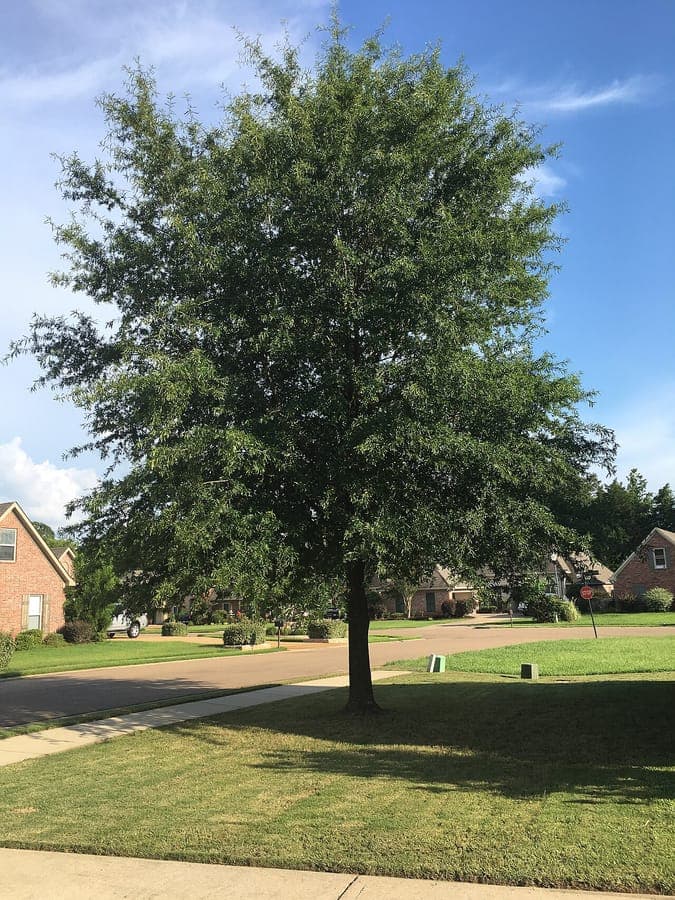
Freekhou5 / CC BY-SA 4.0, via Wikimedia Commons
Willow oak: complete guide
Quercus phellos
Want to see Willow oak: complete guide in your garden?
1 minute, no credit card
Overview
The willow oak (Quercus phellos) stands out among oaks for its slender, willow-like foliage and graceful form. Native to the southeastern United States - including Alabama, Georgia, and Maryland - this tree thrives in temperate to subtropical climates but adapts well to UK and Northwest European gardens. It grows to a height of 15–20 meters with a spread of 8–12 meters, making it ideal for larger gardens or park-like spaces. Unlike many oaks, it doesn't develop a massive, gnarled trunk early on, instead maintaining a tidy, upright habit for decades. With proper care, it can live over 100 years. If you're planning a long-term landscape, gardenworld.app offers design tools to visualize how this tree will mature in your space.
Appearance & bloom cycle
From a distance, the willow oak looks more like a linden or poplar than a traditional oak. Its leaves are narrow, 5–10 cm long, and a soft green in spring, deepening to a rich dark green in summer. In autumn, they turn a modest yellow before dropping - not flashy, but clean and elegant. Yellowish catkins appear in April, before or just as new leaves emerge. These are the male flowers, while the female flowers are tiny and inconspicuous. By September, small acorns (1–1.5 cm long) develop and persist into winter, providing food for birds, squirrels, and small mammals.
Ideal location
Plant in full sun for the best growth and form, though it tolerates light shade. Avoid tight urban spots - allow at least 6 meters from buildings, driveways, or underground utilities. The willow oak's root system spreads widely and deeply, so it needs room. It's excellent as a specimen tree on a lawn or as part of a mixed woodland planting. Avoid planting near patios or paved areas, as roots can lift slabs over time. Use gardenworld.app to map out spacing and future canopy spread in your garden layout.
Soil requirements
It grows best in moist, well-drained loam or clay-loam soils with a pH between 4.5 and 6.5. While adaptable to various soils, it struggles in highly alkaline or compacted conditions. It can handle occasional spring flooding but not permanently waterlogged sites. When planting, dig a hole twice as wide as the root ball and mix in compost to improve structure. Avoid high-nitrogen fertilizers - oaks prefer low-input environments. In sandy soils, add organic matter to retain moisture.
Free design
Want to see Willow oak: complete guide in your garden? Make a free design now.
Watering
Young trees need consistent watering during their first 2–3 growing seasons. Provide 20–30 liters per week during dry spells, soaking deeply once a week rather than frequent light watering. After establishment, the willow oak is moderately drought-tolerant, but prolonged dry periods (over 4 weeks without rain) call for supplemental irrigation, especially in summer. Deep watering encourages root development and long-term resilience.
Pruning
Minimal pruning is needed. The natural form is upright and well-structured. Only remove dead, broken, or crossing branches, and do so in late winter or early spring before sap flow begins. Avoid pruning in summer to prevent excessive bleeding. Use clean, sharp tools and disinfect between cuts if other oaks are nearby, as fungal diseases like oak wilt can spread through wounds.
Maintenance calendar
- January: Inspect for storm damage. Check lower branches.
- February: Final pruning window. Protect young trunks from rodents with guards.
- March: Assess soil moisture. Begin watering if dry.
- April: Catkins appear. New leaves unfurl.
- May: Monitor for aphids or scale. Rarely problematic.
- June: No routine care needed.
- July: Water young trees in prolonged drought.
- August: Continue monitoring moisture.
- September: Acorns mature. Wildlife activity increases.
- October: Leaves turn yellow. Begin dropping late in the month.
- November: Rake and compost leaves. Leave some for habitat.
- December: Dormant period. No action required.
Winter hardiness
Hardy in USDA zones 6–9 (-23°C to -1°C), the willow oak survives most UK and Western European winters. Young trees may suffer tip dieback in harsh conditions; protect with horticultural fleece if needed. Mature trees are highly resilient. Avoid de-icing salts near the root zone, as they can damage roots and foliage.
Companion plants
Underplant with shade-tolerant, drought-resistant species. Good choices include Carex appalachica, Asarum europaeum, and Dryopteris erythrosora. Low shrubs like Mahonia aquifolium or Ilex crenata add structure without competing aggressively. Avoid thirsty perennials - the oak's roots will outcompete them for water. Consider native woodland wildflowers such as Hepatica nobilis or Anemone nemorosa for spring interest.
Closing
The willow oak isn't flashy, but it's dependable. It grows steadily - about 30–50 cm per year - and asks for little once established. It's a wildlife asset, a shade provider, and a long-term investment in your garden's structure. Start with a healthy young tree from reputable garden centres. With thoughtful placement and basic care, it will thrive for generations. Plan your layout wisely - a tool like gardenworld.app can help you anticipate growth and spacing.
Want to see Willow oak: complete guide in your garden? Make a free design now.
Upload a photo, pick a style, and get a photorealistic design with plant list in under a minute.
No credit card required


Similar plants
Lucombe oak: complete guide
Quercus crenata
Lucombe oak (Quercus crenata): a majestic semi-evergreen giant with corky bark, perfect for large gardens, parks, and country estates.
Blue oak: complete guide
Quercus douglasii
Discover the blue oak, a drought-tolerant Californian shade tree with striking blue-green foliage, ideal for large, climate-resilient gardens.
Quercus montana: complete guide
Quercus montana
Quercus montana, the chestnut oak, is a rugged American shade tree with deeply furrowed bark and large acorns, well suited to dry, rocky, spacious gardens.