
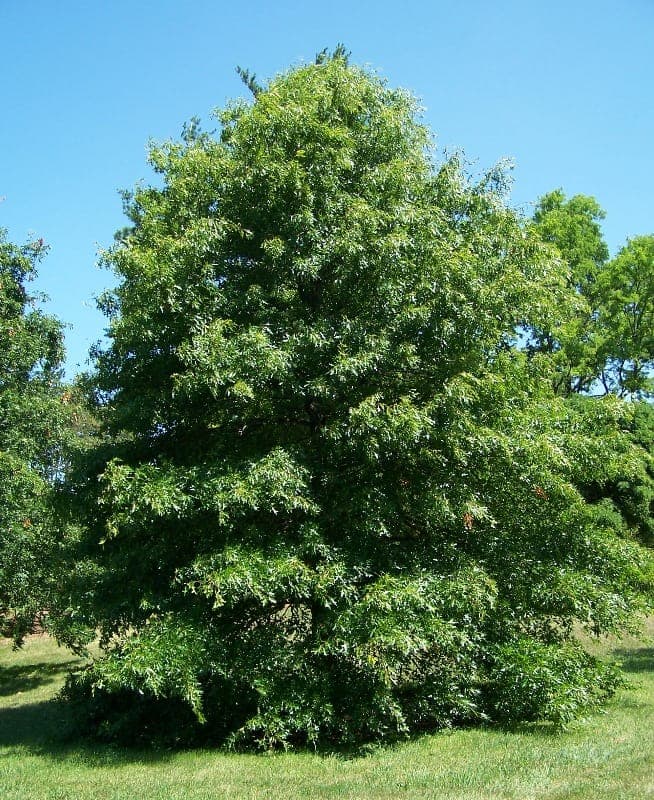
Bruce Marlin / CC BY-SA 2.5, via Wikimedia Commons
Pin oak: complete guide
Quercus palustris
Want to see Pin oak: complete guide in your garden?
1 minute, no credit card
Overview
Quercus palustris, commonly known as pin oak, is a fast-growing, deciduous hardwood tree native to the eastern and central United States. It thrives in moist, acidic soils but adapts well to urban and suburban landscapes when given proper space. Reaching heights of 18–20 meters with a spread of up to 12 meters, pin oak is best suited for large gardens, parks, and open spaces. Its upright, pyramidal form makes it a popular choice for formal avenues and shade planting.
Although not native to the UK or much of Europe, pin oak performs reliably in temperate climates, particularly in USDA hardiness zones 4 to 8. It's known for its resilience, rapid growth rate (60–90 cm per year under ideal conditions), and minimal pest issues once established. However, its shallow, fibrous root system means it doesn't transplant easily after the first few years.
Garden centres across the UK and Europe often stock young pin oaks in 10–15 liter containers. For best results, plan the planting location carefully-use gardenworld.app to visualise spacing and canopy spread before committing to a spot.
Appearance & bloom cycle
Pin oak has deeply lobed, glossy green leaves that turn a striking, deep red in autumn-often one of the first oaks to colour up, usually in early October. The fall display lasts 3–4 weeks and is one of the tree's most admired features. The bark is smooth and gray on young trees, becoming slightly ridged with age, but never as rugged as white oak.
Flowering occurs in May, with small, inconspicuous greenish-yellow catkins appearing alongside new leaves. Male and female flowers are on the same tree (monoecious). The acorns are small (1–1.5 cm), borne on short stalks, and mature in one season. They are a valuable food source for wildlife, including squirrels, jays, and woodpeckers.
Pin oak maintains a strong central leader and horizontal lower branches that often droop slightly, giving it a distinctive layered look. This natural shape rarely needs corrective pruning if given enough room to develop.
Ideal location
Plant pin oak in full sun for optimal growth and autumn colour. It tolerates partial shade, but dense shade will result in a sparse canopy and weak structure. Choose a site with at least 6–8 hours of direct sunlight daily.
Due to its size and root spread, keep it at least 5 meters from buildings, driveways, and underground utilities. The shallow roots compete poorly with turfgrass, so avoid planting in lawns unless you're willing to maintain a wide, grass-free mulch ring (at least 1.5 meters in diameter). On gardenworld.app, you can overlay root zones to avoid conflicts with hardscaping.
Free design
Want to see Pin oak: complete guide in your garden? Make a free design now.
Soil requirements
Pin oak prefers moist, well-drained, acidic soils (pH 5.0–6.5). It struggles in alkaline or compacted soils, where iron chlorosis often develops-this shows as yellowing between leaf veins while veins remain green. If your soil is neutral or alkaline, consider amending with sulfur or choosing a different oak species like Quercus robur.
It tolerates occasional flooding and does well in clay-loam mixes, but avoid prolonged standing water. In sandy soils, mulch heavily and irrigate during dry spells to retain moisture.
Watering
Young trees need consistent watering during the first two growing seasons. Apply 20–30 liters twice weekly during dry periods. After establishment, pin oak is moderately drought-tolerant but benefits from deep watering during extended summer droughts (over 3 weeks without rain).
Avoid overwatering-saturated soil leads to root rot, especially in poorly drained sites. A 5–8 cm layer of organic mulch helps regulate soil moisture and temperature.
Pruning
Pruning is rarely needed. Remove only dead, damaged, or crossing branches, and do so in late autumn or winter when the tree is dormant. Avoid pruning in spring when sap is flowing, as this can cause excessive bleeding.
Never top a pin oak-this ruins its natural form and invites disease. If lower branches interfere with walkways, prune them gradually over several years, removing no more than 25% of the canopy in a single season.
Maintenance calendar
- January: Inspect for structural issues. Prune if needed.
- February: Final pruning window before bud break.
- March: Apply compost mulch around the base, keeping it away from the trunk.
- April: Monitor for aphids or scale.
- May: Flowers appear. No intervention needed.
- June: Check for signs of chlorosis in alkaline areas.
- July: Water during dry spells.
- August: Avoid pruning; new growth is hardening.
- September: Prepare for leaf drop.
- October: Enjoy fall colour. Collect acorns for propagation.
- November: Clean up fallen leaves if disease is present.
- December: Protect young trunks from rodents with mesh guards.
Winter hardiness
Pin oak is hardy in USDA zones 4–8 (down to -34°C). It handles cold winters well but young trees benefit from trunk wrapping in areas with harsh winter sun or animal activity. In the UK, it thrives in zones 7–8 with no special protection.
Companion plants
Underplant with shade-tolerant, non-competitive species. Good choices include Carex plantaginea, Geranium macrorrhizum, and ferns like Dryopteris erythrosora. Avoid aggressive groundcovers like ivy or periwinkle. Spring bulbs such as Muscari and Scilla siberica bloom before canopy closure and add seasonal interest.
Closing
Pin oak is a reliable, low-maintenance tree that brings long-term structure and seasonal drama to large landscapes. With its fast growth, vibrant fall colour, and wildlife value, it's a smart choice for spacious gardens. Plan ahead, plant young, and give it room to breathe. For layout ideas, check gardenworld.app.
Want to see Pin oak: complete guide in your garden? Make a free design now.
Upload a photo, pick a style, and get a photorealistic design with plant list in under a minute.
No credit card required


Similar plants
Lucombe oak: complete guide
Quercus crenata
Lucombe oak (Quercus crenata): a majestic semi-evergreen giant with corky bark, perfect for large gardens, parks, and country estates.
Blue oak: complete guide
Quercus douglasii
Discover the blue oak, a drought-tolerant Californian shade tree with striking blue-green foliage, ideal for large, climate-resilient gardens.
Quercus montana: complete guide
Quercus montana
Quercus montana, the chestnut oak, is a rugged American shade tree with deeply furrowed bark and large acorns, well suited to dry, rocky, spacious gardens.