
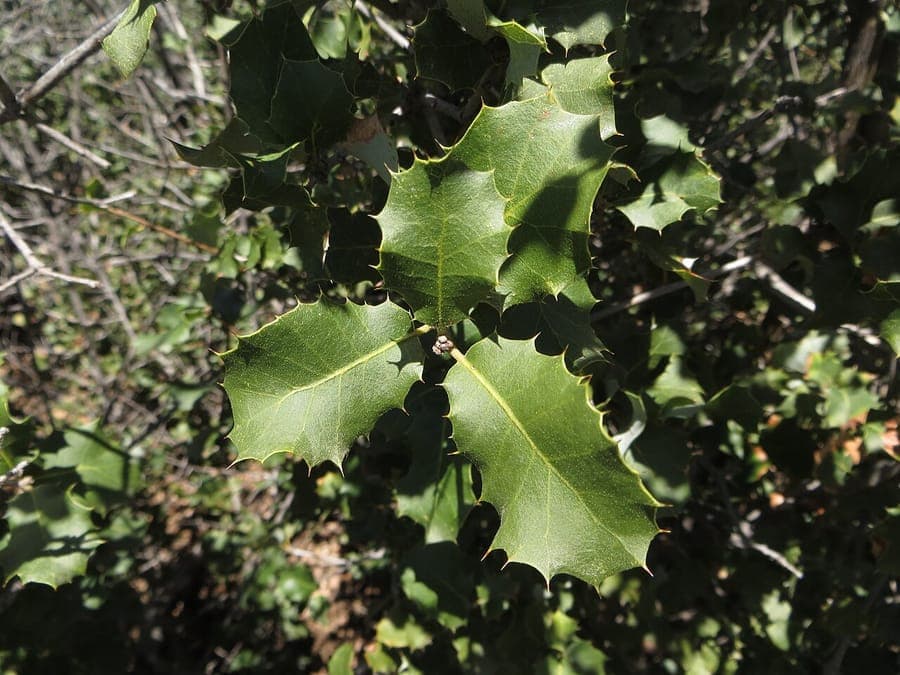
Tentaculata / CC BY-SA 4.0, via Wikimedia Commons
Quercus palmeri: complete guide
Quercus palmeri
Want to see Quercus palmeri: complete guide in your garden?
1 minute, no credit card
Overview
Palmer oak (Quercus palmeri), also known as Palmer's oak or Dunn oak, is an interesting shrubby oak from mountainous California, Arizona, and Mexico. With its fine foliage and compact growth habit, this tree offers a different character than larger oaks. It prefers mountain slopes with dry, rocky soils and forms a useful part of California chaparral vegetation.
Appearance and bloom
Palmer oak typically grows as a dense, many-stemmed shrub to small tree, 3-6 meters tall. The leaves are characteristically very narrow and fine - approximately 0.5-2 centimeters wide and 1.5-4 centimeters long, with a grayish-green color that feels rough to the touch on both sides. This gives the tree a very subtle, grayish-green appearance. In spring, male catkins appear in yellowish-gray, followed by female flowers that develop into small, hairy acorns. The foliage remains largely on the tree throughout winter.
Ideal location
Palmer oak requires full sun - at least 6-8 hours of direct sunlight daily. This is a mountain tree that tolerates wind and hot conditions very well. It grows best on dry, high locations where other plants struggle. Ideal for slopes, rooftops, or other hot, dry spots. This is not a tree for low, moist gardens.
Soil
Palmer oak strongly prefers rocky, sandy, nutrient-poor soil. It grows best on slopes where water drains well. Heavy clay or regularly wet soil will cause problems - ensure good drainage. Alkaline soil is not an issue; in fact, more sand and stone is actually better. Adding nutrients is unnecessary; this tree thrives on the poorest possible soils.
Watering
Once established, Palmer oak is very drought-tolerant. In the first growing season, water, but sparingly - the tree needs a dry regime to develop strength. After the first year, watering can be drastically reduced. In normal conditions in a drier region, you can allow the tree to grow almost entirely without supplemental water.
Free design
Want to see Quercus palmeri: complete guide in your garden? Make a free design now.
Pruning
Palmer oak naturally grows in an attractive, dense form. Prune lightly as needed to control shape, but avoid heavy pruning. Remove dead wood as you notice it. This tree grows slowly and requires no aggressive pruning; let nature do its work.
Maintenance calendar
- Spring (March-May): Light pruning as needed. Check for dead wood.
- Summer (June-October): Minimal watering needed; tree is drought-tolerant.
- Autumn (October-November): No special care.
- Winter (December-February): Tree is mostly dormant; no pruning after November.
Winter hardiness
Palmer oak is frost-hardy to approximately -10 to -12 degrees Celsius, meaning it is suitable for warmer parts of the Netherlands, southern Germany, and much of France. In very cold, wet winters, frost damage can occur, especially on young plants. This is truly a tree for warmer microclimates.
Companion plants
Palmer oak pairs well with other California mountain plants such as manzanita, ceanothus, and California lilac. Combine with rock plants, lavender, and other dry-region companions. This is a tree for native plant gardens in warmer climates. Avoid moisture-loving plants nearby - this is unsuitable.
Conclusion
Palmer oak is a fascinating choice for those wanting a different oak, something smaller with more subtle characteristics. This is not a tree for everyone or for wet climates, but for warmer regions with dry soils, it is valuable. It is also good for someone wanting to introduce California flora. Available through specialized nurseries in warmer regions.
Fun fact: The name "palmeri" honors Edward Frederick Palmer, a 19th-century plant collector and botanist who did extensive work in southwestern America.
Want to see Quercus palmeri: complete guide in your garden? Make a free design now.
Upload a photo, pick a style, and get a photorealistic design with plant list in under a minute.
No credit card required


Similar plants
Lucombe oak: complete guide
Quercus crenata
Lucombe oak (Quercus crenata): a majestic semi-evergreen giant with corky bark, perfect for large gardens, parks, and country estates.
Blue oak: complete guide
Quercus douglasii
Discover the blue oak, a drought-tolerant Californian shade tree with striking blue-green foliage, ideal for large, climate-resilient gardens.
Quercus montana: complete guide
Quercus montana
Quercus montana, the chestnut oak, is a rugged American shade tree with deeply furrowed bark and large acorns, well suited to dry, rocky, spacious gardens.