
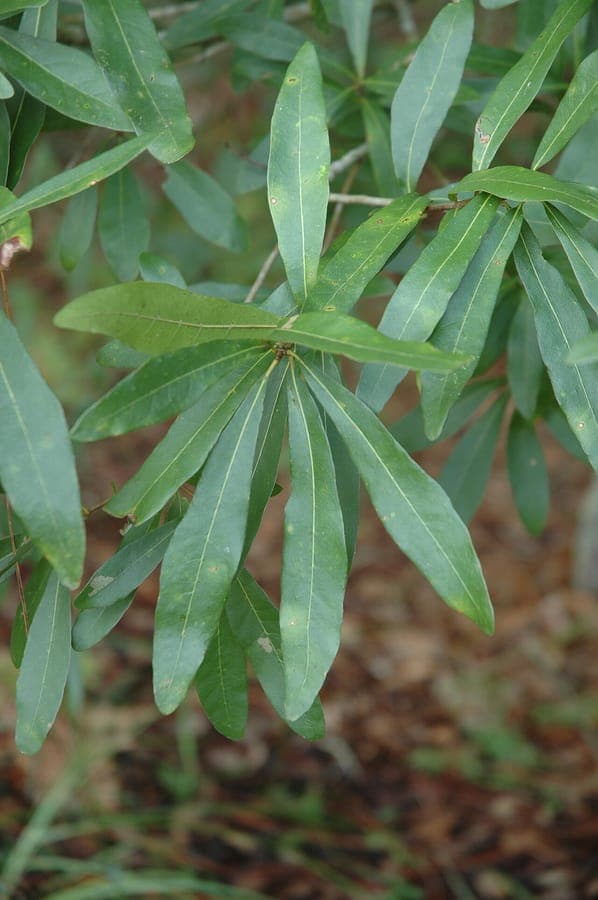
Bruce Kirchoff from Greensboro, NC, USA / CC BY 2.0, via Wikimedia Commons
Laurel oak: complete guide
Quercus laurifolia
Want to see Laurel oak: complete guide in your garden?
1 minute, no credit card
Overview
The laurel oak (Quercus laurifolia) is a robust American oak species widely appreciated for its rapid growth, elegant form, and glossy foliage. This versatile tree is native to the southeastern United States, ranging from North Carolina to Texas, where it thrives in both native forests and cultivated landscapes.
This oak is particularly valued for creating quick screen effects and substantial shade in a relatively short timeframe. The tree typically reaches 60 to 80 feet in height with a broad, rounded crown that provides excellent visual appeal. Its tolerance for various soil and moisture conditions makes it an excellent choice for diverse planting scenarios.
Appearance and bloom
The laurel oak is distinguished by its characteristic foliage. Leaves are typically oblong to obovate, glossy dark green above with a lighter underside, and display remarkable morphological variability. This leaf diversity gave rise to the scientific name "laurifolia," reflecting similarities to true laurel (Laurus) foliage.
Flowering occurs in spring, with separate male and female flowers. The male catkins are notably yellow and drape from branches, while female flowers are inconspicuous but essential for acorn development. Acorns mature in autumn to winter, offering food for wildlife and contributing to the tree's ecological value.
Fall color varies from year to year and by individual tree; some specimens display attractive yellow-green to russet tones before leaf drop. The bark is smooth when young, becoming darker and furrowed with age.
Ideal location
The laurel oak performs best in full sun, requiring a minimum of 6 to 8 hours of direct daily sunlight. While it tolerates partial shade, growth rate diminishes and crown density decreases in shadier situations.
This species is notably adaptable to diverse soil moisture conditions. In its native range, it frequently inhabits wet bottomlands, indicating excellent flood and moisture tolerance. In landscape settings, it equally thrives in well-drained soils, making it suitable for various moisture regimes.
Exposure to wind is generally acceptable due to the tree's strong apical dominance and well-structured branching pattern. Avoid severely shaded conditions beneath established tree canopies.
Soil
The laurel oak is remarkably soil-tolerant, growing across a pH range of 5.0 to 7.5 (acidic to neutral). It accepts heavy clay soils as readily as lighter sandy substrates, making it exceptionally versatile.
Optimal establishment occurs in soils enriched with organic matter and offering moderate drainage in the establishment year. Once rooted, the tree can endure extended dry periods, particularly if roots penetrate deeply.
When planting, incorporate compost or well-rotted organic matter into the planting hole to enhance water retention and encourage rapid root establishment.
Free design
Want to see Laurel oak: complete guide in your garden? Make a free design now.
Watering
Young trees require consistent moisture during the growing season. During the first two years of establishment, maintain evenly moist (but not waterlogged) soil conditions. Established trees exhibit considerable drought tolerance.
Drip irrigation or ground-level watering is preferable to overhead sprinkling, which can promote fungal diseases. In hot, dry summers, supplemental irrigation may be necessary, particularly on sandy substrates.
During the dormant season, water requirements diminish significantly. Avoid waterlogged conditions that can precipitate root pathologies.
Pruning
The laurel oak requires minimal pruning when developing a naturalistic form. The species exhibits an inherently attractive, balanced growth pattern. To encourage strong structure in young trees, you can selectively favor a dominant central leader.
Remove dead, diseased, or crossing branches as encountered. This work is optimally performed during the dormant season but can be conducted judiciously during the growing season.
As this is a vigorous species, periodic inspection for growth imbalances allows early corrective action to maintain desired form.
Maintenance calendar
January-February: assess winter damage, perform structural pruning if needed March-May: active growing season, supplemental water during dry spells, pest monitoring June-August: continued growth, irrigation essential in hot, dry periods September-October: fall color development, continued monitoring November-December: leaf drop, leaf cleanup, dormancy preparation
Winter hardiness
The laurel oak is hardy to USDA zone 7a (-12 degrees Celsius). In temperate zones such as the UK and much of continental Europe, this tree thrives. In extreme continental climates or colder regions, frost damage to new growth can occur.
Where hard freezes occur, delay heavy pruning until after the last frost to avoid damage to emerging shoots.
Companion plants
The laurel oak partners excellently with other native North American species in landscape contexts. Consider plantings with elm species (Ulmus), other oaks, American tulip tree (Liriodendron tulipifera), and various dogwoods (Cornus spp.).
Once established and casting shade, shade-tolerant plants such as thornless brambles, woodland violets, and ferns thrive beneath its canopy, creating rich woodland understory effects.
Closing
The laurel oak is a dependable, fast-growing species offering substantial landscape value. With minimal maintenance requirements and excellent hardiness in temperate climates, it represents a durable long-term investment. Plant in full sun with ample space for complete crown development, and it will provide decades of shade, screening, and visual interest.
For sourcing, consult local quality nurseries for healthy specimens. GardenWorld.app can help optimize the laurel oak within your overall garden design scheme. GardenWorld.app also offers inspiration for comprehensive landscape solutions featuring this magnificent American species.
Want to see Laurel oak: complete guide in your garden? Make a free design now.
Upload a photo, pick a style, and get a photorealistic design with plant list in under a minute.
No credit card required


Similar plants
Lucombe oak: complete guide
Quercus crenata
Lucombe oak (Quercus crenata): a majestic semi-evergreen giant with corky bark, perfect for large gardens, parks, and country estates.
Blue oak: complete guide
Quercus douglasii
Discover the blue oak, a drought-tolerant Californian shade tree with striking blue-green foliage, ideal for large, climate-resilient gardens.
Quercus montana: complete guide
Quercus montana
Quercus montana, the chestnut oak, is a rugged American shade tree with deeply furrowed bark and large acorns, well suited to dry, rocky, spacious gardens.