
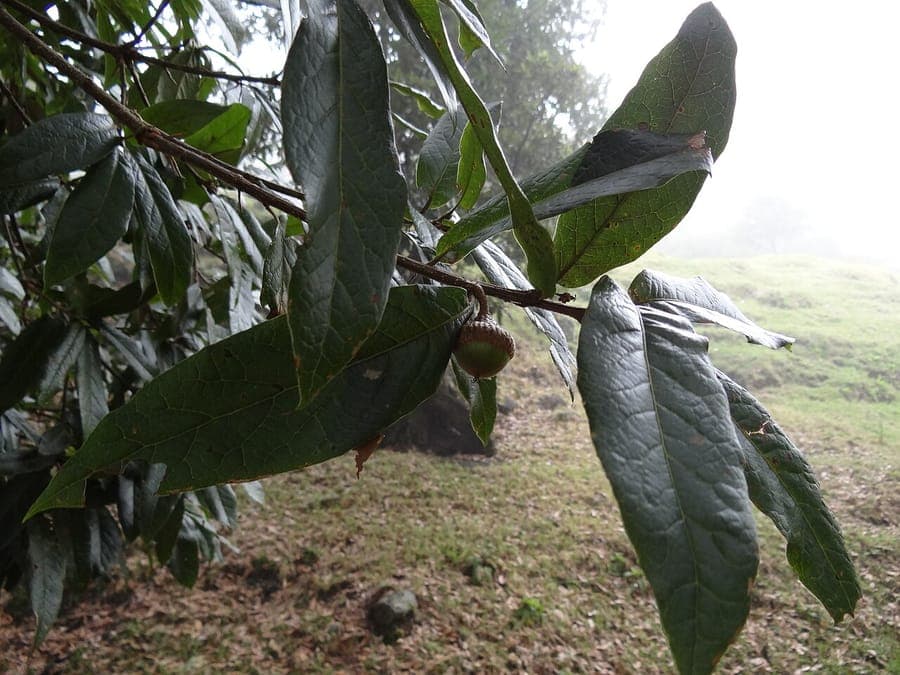
Petruss / CC BY-SA 3.0, via Wikimedia Commons
Andean oak: complete guide
Quercus humboldtii
Want to see Andean oak: complete guide in your garden?
1 minute, no credit card
Overview
The Andean oak (Quercus humboldtii), also known as the Humboldt oak, is a majestic tree species from the Fagaceae family. This native species grows in the mountains of southern Panama and Colombia, where it forms an essential part of montane ecosystems. The name humboldtii honors Alexander von Humboldt, the famous German-French naturalist who extensively studied this region.
This tree is excellently adapted to mountainous areas at higher altitudes. In its natural habitat, it grows in forests at elevations between 1500 and 3200 meters. The Andean oak plays a crucial role in the local ecosystem and also holds cultural significance for indigenous peoples and local communities in Colombia and Panama.
Appearance and Bloom
The Andean oak has elegant, leathery leaves that are dark green. The leaves are oblong to elliptic in shape, with subtle venation. In early spring, inconspicuous male and female flowers appear, as is typical for oaks.
The fruits are characteristic acorns in cupules. These form after pollination and ripen over the seasons. The tree eventually forms an impressive crown with strong, broad branches.
The Andean oak grows moderately to slowly in mixed mountain forests. It is a long-lived tree that can reach centuries old. The tree bark is smooth to slightly ridged, gray-brown in color.
Ideal Location
The Andean oak prefers mountainous locations at considerable elevation. In gardens, it works best in mountainous regions with moderate temperatures. This is not a tree for lowlands or tropical lowland areas.
The tree thrives best in part-shaded to partially sunny environments, though it can also grow in full sun. In its natural habitat, it grows in mixed mountain forests where it is partially shaded by other tall trees.
The Andean oak is ideal for landscapes that want to preserve and emphasize the mountainous character of its original habitat.
Soil
The Andean oak grows on nutrient-rich mountain soils that drain well. The tree prefers soils with significant organic matter and moderate moisture. The pH can range between 5.5 and 7.5.
In mountain regions with regular rainfall, this tree thrives excellently. However, the soil must be well-draining to prevent root rot, despite preference for regular moisture.
Mulching around the tree helps regulate soil temperature and maintain organic matter.
Free design
Want to see Andean oak: complete guide in your garden? Make a free design now.
Watering
The Andean oak prefers regular moisture, unlike some other oaks. In its natural mountain habitat, it experiences regular rainfall and mist. This means supplemental irrigation is important in drier climates.
Young trees require regular watering to establish their root system. Mature trees can better handle short dry spells, but prefer regular moisture.
In very dry climates, supplemental irrigation may be needed year-round. This makes the tree less suitable for very arid regions.
Pruning
The Andean oak has a naturally strong structure and requires minimal pruning. If pruning is needed, do it in late spring after growth starts.
Remove only dead or damaged branches. The tree heals slowly from heavy pruning, so caution is recommended.
The tree's natural form is usually attractive enough that little shape adjustments are needed.
Maintenance Calendar
January-March: Minimal activity. Check for winter damage in cold regions.
April-May: Growing season begins. Ensure adequate water. Monitor new growth.
June-August: Peak growth period. Support may be needed for young trees.
September-October: Growth slows. Preparation for dormancy.
November-December: Dormant period. Maintenance focus on protection.
Winter Hardiness
The Andean oak is adapted to mountainous climates with cold mountain winters at higher elevations. In its natural habitat, it regularly experiences frost, but grows in regions where extreme freezing is rare.
The tree is not suitable for areas with very severe winters or prolonged freeze periods. It thrives best in moderate mountain climates.
Companion Plants
In mountain gardens, the Andean oak can function well with:
Andean berry plants (Rubus and Solanum species) Mountain heathers (Erica and Rhododendron species) Mountain laurel (Kalmia species) Other mountain trees like cedars and pines Shade-loving plants beneath the tree
Closing
The Andean oak is a special choice for gardeners in mountainous regions of North and South America. This tree offers not only natural beauty but also ecological and cultural significance. With regular care and appropriate location, this majestic oak can provide decades of beauty and shade. For more information about mountain garden landscapes, visit gardenworld.app.
Want to see Andean oak: complete guide in your garden? Make a free design now.
Upload a photo, pick a style, and get a photorealistic design with plant list in under a minute.
No credit card required


Similar plants
Lucombe oak: complete guide
Quercus crenata
Lucombe oak (Quercus crenata): a majestic semi-evergreen giant with corky bark, perfect for large gardens, parks, and country estates.
Blue oak: complete guide
Quercus douglasii
Discover the blue oak, a drought-tolerant Californian shade tree with striking blue-green foliage, ideal for large, climate-resilient gardens.
Quercus montana: complete guide
Quercus montana
Quercus montana, the chestnut oak, is a rugged American shade tree with deeply furrowed bark and large acorns, well suited to dry, rocky, spacious gardens.