
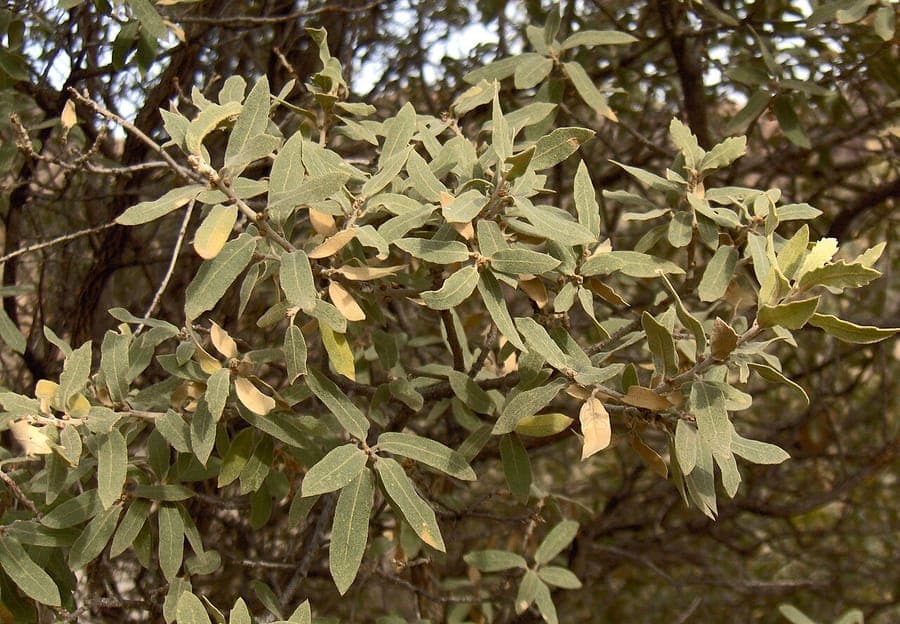
homeredwardprice / CC BY 2.0, via Wikimedia Commons
Gray oak: complete guide
Quercus grisea
Want to see Gray oak: complete guide in your garden?
1 minute, no credit card
Overview
The gray oak (Quercus grisea), also called shin oak, is a semi-deciduous tree native to Arizona, New Mexico, West Texas, and Mexico. This tree is one of the most drought-resistant oaks in North America and grows on dry mountain slopes at elevations of 2,000 to 8,000 feet. With its characteristic gray bark and compact form, it creates an interesting ornament in desert landscapes.
The gray oak reaches a height of 20 to 50 feet and develops an open, spreading crown. This is an ideal tree for xeriscaping projects in low desert to mountain desert.
Appearance & Bloom
The gray oak distinguishes itself with characteristic gray bark that remains smooth on the trunk and twigs. This gives the tree a distinctive appearance year-round, even without foliage. The leaves are small to medium-sized, 1 to 1.5 inches long, and gray-silvered green. They are semi-deciduous, meaning they may lose some leaves during winter in colder years.
The flowers are small and inconspicuous, in catkins in early spring. The acorns are small, about 0.4 inches, with a shallow cup. Many animals use these acorns as food, especially in late fall and winter.
The gray bark is one of the most distinctive features of this tree and offers interesting winter visual interest.
Ideal Location
The gray oak grows best in full sun. At least 6 to 8 hours of direct sunlight daily is necessary for optimal growth and bark coloring. This tree grows well on slopes, plateaus, and mountain terrain.
In the landscape, place this tree as a specimen or in groups on rocky or elevated ground. The open crown provides light shadow play.
Soil
The gray oak is very tolerant of diverse soil types, as long as they drain well:
- Rocky, rocky soils
- Clayey soils
- Sandy soils
- Moderately nutrient-rich to poor soils
- pH from 6.5 to 8.0
The tree accepts poor soils where few other plants grow. This is one of its most remarkable characteristics.
Watering
Once established, the gray oak is exceptionally drought-resistant.
At planting: Water well the first two weeks, then gradually reduce as the tree roots in.
First growing season: Ensure soil doesn't completely dry out, but don't keep it wet.
Established trees: After two years, this tree needs virtually no water. In extreme drought, you can water deeply, but it's not necessary.
Semi-deciduous character: In colder years, the tree may lose more water; this is normal.
Free design
Want to see Gray oak: complete guide in your garden? Make a free design now.
Pruning
The gray oak requires minimal pruning and naturally maintains its form.
- Remove only dead or damaged branches
- Pruning can best be done in late winter
- Avoid heavy pruning
- The tree naturally forms an interesting, open crown
- The gray bark is only visible if you keep the tree open
Minimal pruning is the best approach.
Maintenance Calendar
Spring (March-May): Check for winter deadwood. Prune if needed. Add mulch around young trees.
Summer (June-August): Rarely need water for established trees. Check young trees for drought stress, especially in the first year.
Fall (September-November): In mild years, leaves may remain; in cold years, they may drop. This is normal. Monitor for pest insects.
Winter (December-February): No maintenance needed. The gray bark is decorative without foliage.
Winter Hardiness
The gray oak is frost-sensitive at lower limits. It thrives in USDA zones 7b to 10b, which is a larger range than many other southern oaks. In zone 7a, hard winters can damage young plant material.
The tree is exceptionally heat-tolerant and does not scorch even in extreme desert heat.
Companion Plants
The gray oak combines well with:
- Shrubs: Esperanza, Desert marigold, Rosemary, Quercus turbinella (other scrub oak)
- Groundcovers: Damianita, Texas privet, Acanthus, Salvia species
- Succulents: Agaves (especially smaller species), Yuccas
- Ornamental grasses: Blue grama, Sideoats grama
This combination creates an authentic desert landscape with low water requirements.
Closing
The gray oak is a particularly valuable element for gardens on higher mountain ground in warmer climates. With its native heritage, strong drought tolerance, interesting gray bark details, and open growth, it offers four-season visual interest. Once established, this tree provides decades of low-maintenance beauty.
On gardenworld.app, find more information about choosing native trees for high desert and xeriscaping projects.
Intratuin and Gamma offer gray oak plant material.
Want to see Gray oak: complete guide in your garden? Make a free design now.
Upload a photo, pick a style, and get a photorealistic design with plant list in under a minute.
No credit card required


Similar plants
Lucombe oak: complete guide
Quercus crenata
Lucombe oak (Quercus crenata): a majestic semi-evergreen giant with corky bark, perfect for large gardens, parks, and country estates.
Blue oak: complete guide
Quercus douglasii
Discover the blue oak, a drought-tolerant Californian shade tree with striking blue-green foliage, ideal for large, climate-resilient gardens.
Quercus montana: complete guide
Quercus montana
Quercus montana, the chestnut oak, is a rugged American shade tree with deeply furrowed bark and large acorns, well suited to dry, rocky, spacious gardens.