
Meghan Cassidy / CC BY-SA 4.0, via Wikimedia Commons
Chisos Red Oak: complete guide
Quercus gravesii
Want to see Chisos Red Oak: complete guide in your garden?
1 minute, no credit card
Overview
The Chisos Red Oak (Quercus gravesii) is a magnificent oak tree native to southwestern United States and northeastern Mexico. This tree is renowned for its imposing growth, deep root system and extraordinary autumn coloration. The species takes its name from the Chisos Mountains in Texas, where it occurs naturally. For gardeners seeking a long-lived, structurally bold tree that endures for centuries, the Chisos Red Oak is an excellent choice.
This tree grows abundantly in dry, rocky areas and displays remarkable tolerance for poor soil conditions. While less known in Europe than other oaks, it offers enthusiasts of North American flora an authentic way to bring continental character to the landscape.
Appearance and Bloom
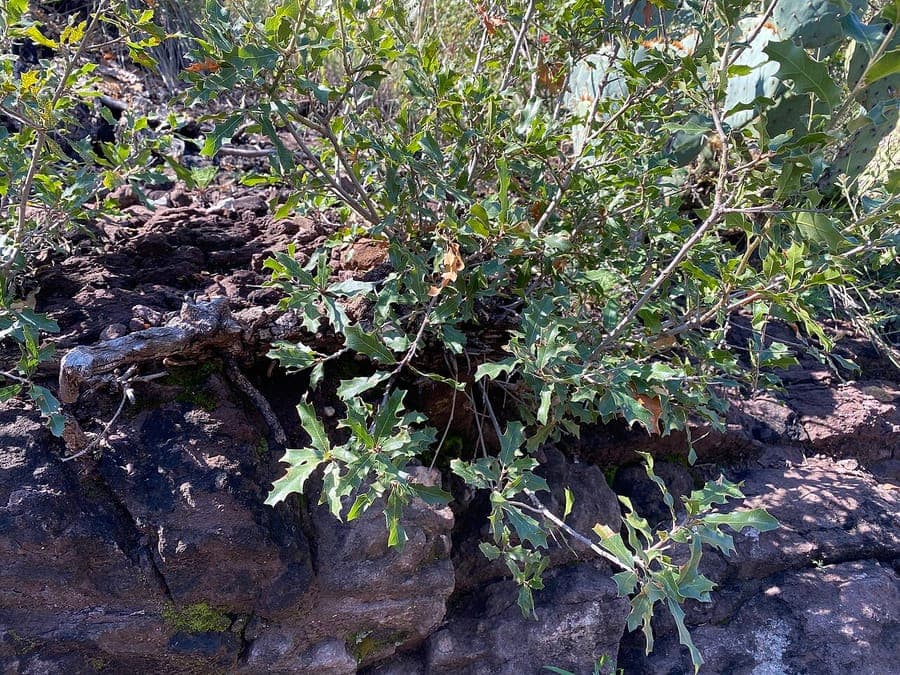
The Chisos Red Oak reaches an average height of 15 to 20 meters and forms a broad, open crown. The leaves are small to medium-sized, simple, and often bearing shallow lobes. In autumn, the foliage turns fiery red to orange-red, creating a spectacular contrast against the dark bark pattern.
The trunk grows vigorously and develops characteristic bark that is initially smooth and grey, becoming rougher and more furrowed with age. Flowering occurs in spring with inconspicuous male flowers in drooping catkins. Female flowers are equally subtle. After pollination, acorns form approximately 1.5 centimeters in size, surrounded by a moderately deep cup.
The tree is known for its lifespan exceeding 200 years under ideal conditions, making it a true legacy tree for the landscape.
Ideal Location
Full sun is essential for healthy growth of the Chisos Red Oak: at least 6 to 8 hours of direct sunlight daily. The tree grows slowly in partial shade and will not develop optimally.
Place the tree where it receives sufficient space: it can eventually reach 15 to 20 meters in height and width. A freestanding position in the landscape suits it best. Avoid confined spaces between other large trees, as this hinders crown formation.
Protection from strong winds is important for young trees that have not yet established strong roots. A location sheltered by shrubs or taller trees can help.
Soil
The Chisos Red Oak is extremely tolerant of poor soils. Its natural habitat consists of rocky, chalky soil types with low nutrient content. This makes it ideal for gardens on poor soil where other trees struggle.
Perfect soil conditions are:
- Well-draining, sandy or stony soil
- pH 6.5 to 8.0 (also on chalky soils)
- Low to moderate nutrient content
- No waterlogged or compacted ground
When planting, it is important not to add much organic material. This can cause more harm than good. Sand and gravel are actually beneficial. Once established, the tree asks for almost no human intervention.
Free design
Want to see Chisos Red Oak: complete guide in your garden? Make a free design now.
Watering
Once established, the Chisos Red Oak is extremely drought tolerant. Deep roots extract water from layers where other plants cannot reach. In the first season after planting, the tree needs regular water: 1 to 2 times per week, depending on temperature.
Once well rooted (after 1 to 2 years), supplemental watering is usually unnecessary. During normal rainfall periods, natural precipitation suffices.
During summer drought, supplemental watering may be beneficial, especially for young specimens. Ensure water soaks deeply and does not pool: oaks hate wet feet long-term.
Pruning
The Chisos Red Oak requires very little pruning. The natural growth pattern is already beautiful. Wait until the tree is mature (at least 5 years) before any formative pruning.
Perform maintenance pruning only in late winter (February-March) before growth begins. Remove:
- Dead or damaged branches
- Branches that cross or rub together
- Inward-growing branches that disturb crown shape
Avoid severe pruning: it disrupts natural form and attracts pests. A gentle hand is better than a heavy one.
Maintenance Calendar
March: Light pruning before growth; check for winter damage. April-May: Establish watering if dry; check above ground for pests. June-July: Water during dry periods; inspect bark for insects. August-September: No regular work needed, enjoy the growth. October-November: Follow autumn color; remove leaf litter if moisture problems occur. December-February: Quiet period; no work needed unless heavy winter storms break branches.
Winter Hardiness
The Chisos Red Oak is absolutely hardy throughout Europe. The tree originates from regions where temperatures fall below minus 15 Celsius, so frost to minus 20 is no threat.
Young trees may experience light winter damage on branch tips during severe winters (minus 25 or worse), but this is rare and not fatal. The hardy wood of established trees offers more resistance.
Snow load can be heavy on dense-crowned trees. Gently shake snow from branches during heavy snowfall, but not violently, as this breaks twigs.
Companion Plants
The Chisos Red Oak combines well with other drought-tolerant trees and shrubs.
Co-trees:
- Other oaks such as English oak (Quercus robur)
- Sweet chestnuts (Castanea sativa)
- Pine trees (Pinus sylvestris)
Underplantings (base, partial shade):
- Wild rosemary (Rosmarinus officinalis)
- Red-leaf bramble (Rubus cockburnianus)
- Common sage (Salvia officinalis)
Grass lawn directly under the tree grows cautiously due to moisture competition: combine with drought lovers.
Closing
The Chisos Red Oak is a noble tree for those with patience and respect for natural growth patterns. Not for quick, maintenance-intensive gardens, but for slow, sustained landscape development. Once established, this tree stands for generations displaying its autumn glory and deep roots.
Available at major nurseries in UK and Northern Europe. For more information on suitable garden designs, visit gardenworld.app.
Want to see Chisos Red Oak: complete guide in your garden? Make a free design now.
Upload a photo, pick a style, and get a photorealistic design with plant list in under a minute.
No credit card required


Similar plants
Lucombe oak: complete guide
Quercus crenata
Lucombe oak (Quercus crenata): a majestic semi-evergreen giant with corky bark, perfect for large gardens, parks, and country estates.
Blue oak: complete guide
Quercus douglasii
Discover the blue oak, a drought-tolerant Californian shade tree with striking blue-green foliage, ideal for large, climate-resilient gardens.
Quercus montana: complete guide
Quercus montana
Quercus montana, the chestnut oak, is a rugged American shade tree with deeply furrowed bark and large acorns, well suited to dry, rocky, spacious gardens.