
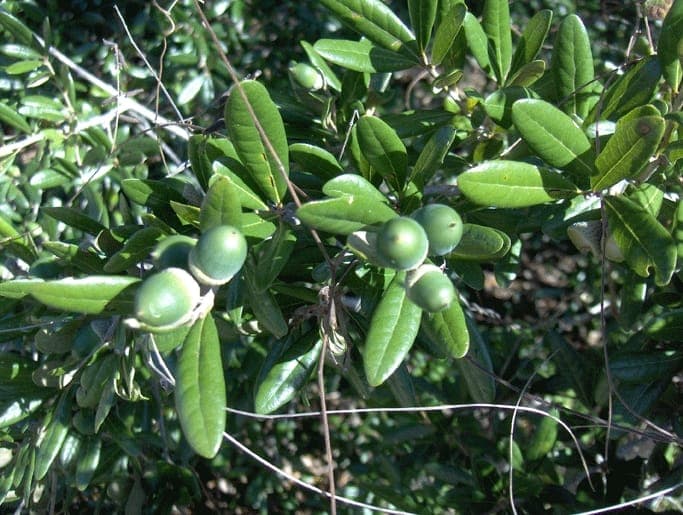
homeredwardprice / CC BY 2.0, via Wikimedia Commons
Quercus geminata: complete guide
Quercus geminata
Want to see Quercus geminata: complete guide in your garden?
1 minute, no credit card
Overview
The sand live oak (Quercus geminata) is a remarkable North American oak naturally occurring in the southeastern United States. This semi-evergreen to evergreen tree thrives exceptionally well on sandy soils and develops a dense crown of glossy green foliage. While less famous than some other oak species, this small to medium-sized tree offers numerous advantages for contemporary gardens.
Appearance and bloom
The sand live oak reaches heights of 8-15 meters with an equally broad spread. The leaves are highly distinctive: they are linear to lanceolate, only 3-6 centimeters long and extremely narrow, giving the tree a refined appearance. The foliage remains predominantly green throughout winter, though some leaves drop in early spring. The bark is dark gray and smooth on young trees, becoming rougher with age. Like all oaks, this species produces male catkins in spring and female flowers that develop into acorns.
Ideal location
This oak demands full sun - at least 6 to 8 hours of direct sunlight daily results in optimal growth and foliage color. Position the tree where it has room to expand without colliding with buildings or other large plants. The tree is wind-resistant and tolerates alkaline conditions well, making it suitable for many locations across the Netherlands, Germany, and France.
Soil
The sand live oak requires well-drained, slightly acidic to neutral soil. This oak is remarkably tolerant of sandy, nutrient-poor substrates - in fact, it prefers sandy soil to heavy clay. Avoid waterlogged conditions, as roots are susceptible to rot. If you have heavy clay, add sand and composted leaves to improve drainage. The tree accepts poor soils and requires minimal supplemental nutrition, except in severely depleted soils.
Watering
Once established, this oak is highly drought-tolerant thanks to a deep root system. During the first growing season after planting, water regularly, especially during dry periods - the soil should remain moist but not wet. After 2-3 years, the tree can withstand extended dry periods. Overwatering is more detrimental than underwatering; if rainfall is adequate, skip supplemental watering.
Free design
Want to see Quercus geminata: complete guide in your garden? Make a free design now.
Pruning
The sand live oak naturally forms a pleasing dense shape and requires minimal pruning. In the first one or two years, you can remove weak, crossing, or downward-growing branches to encourage strong structure. Avoid heavy pruning, as this results in significant foliage loss. When removing dead or diseased wood, do so in winter when the tree is dormant. Conversely, never prune in late autumn, as this stimulates new growth vulnerable to frost damage.
Maintenance calendar
- Spring (March-April): Check for dead branches and remove if found. Refresh mulch around the base.
- Summer (June-August): Water during dry periods; inspect for pests.
- Autumn (September-November): Foliage gradually begins dropping; collect leaves for other plants.
- Winter (December-February): Perform structural pruning as needed; tree is dormant.
Winter hardiness
The sand live oak is frost-hardy to approximately -12 to -15 degrees Celsius, making it suitable for most regions of the Netherlands, Germany, and France except the harshest alpine areas. In very cold winters, some foliage may be damaged, but the tree will recover in spring. In northwestern Europe, it thrives well, particularly in slightly warmer microclimates.
Companion plants
The sand live oak pairs beautifully with other sand-loving plants. Consider accompanying shrubs such as junipers, dwarf pines, or cotoneaster. Underplanting with drought-tolerant perennials like sage, lavender, and thyme complements it well. Proximity to bird-supporting species like elderberry or hawthorn increases wildlife activity.
Conclusion
The sand live oak is a refined choice for those wanting a semi-evergreen tree with elegant qualities. This North American oak tolerates difficult conditions, especially sandy soils, while delivering years of ornamental value. This is a tree for those who appreciate patience and are willing to try something different. Available at gardenworld.app and specialty nurseries.
Fun fact: The scientific name "geminata" means "paired" or "coupled," referring to leaves often growing two-by-two.
Want to see Quercus geminata: complete guide in your garden? Make a free design now.
Upload a photo, pick a style, and get a photorealistic design with plant list in under a minute.
No credit card required


Similar plants
Lucombe oak: complete guide
Quercus crenata
Lucombe oak (Quercus crenata): a majestic semi-evergreen giant with corky bark, perfect for large gardens, parks, and country estates.
Blue oak: complete guide
Quercus douglasii
Discover the blue oak, a drought-tolerant Californian shade tree with striking blue-green foliage, ideal for large, climate-resilient gardens.
Quercus montana: complete guide
Quercus montana
Quercus montana, the chestnut oak, is a rugged American shade tree with deeply furrowed bark and large acorns, well suited to dry, rocky, spacious gardens.