
Larry D. Moore / CC BY 4.0, via Wikimedia Commons
Texas live oak: complete guide
Quercus fusiformis
Want to see Texas live oak: complete guide in your garden?
1 minute, no credit card
Overview
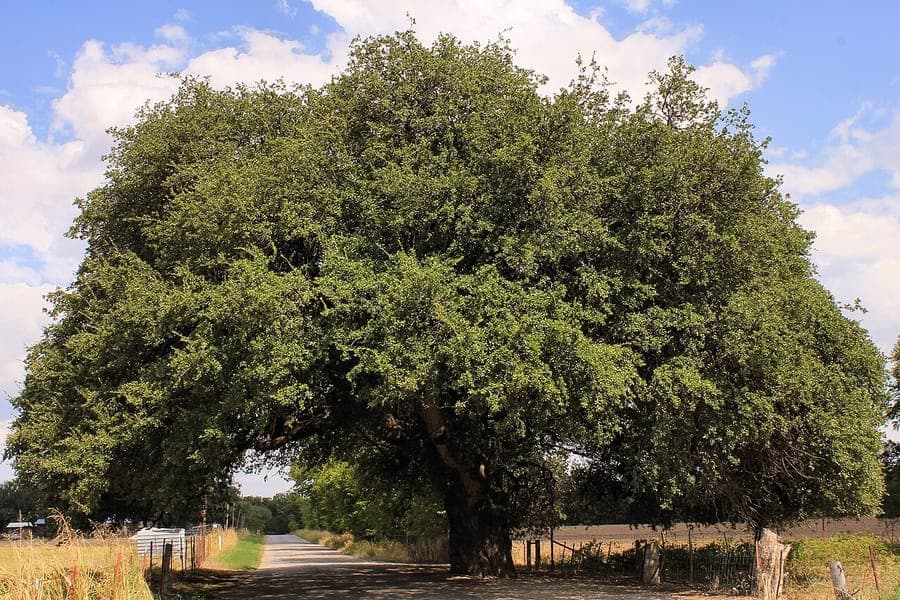
The Texas live oak (Quercus fusiformis), also called plateau oak or escarpment live oak, is an evergreen tree native to Texas, Oklahoma, and northeastern Mexico. This tree is one of the most drought-resistant and hardy oaks in North America. With its gray-green, lance-shaped leaves and compact, sturdy branches, it has a distinctive appearance that remains ornamental year-round.
The Texas live oak reaches a height of 25 to 60 feet and forms a dense, broad crown. This is an ideal tree for creating shade patches in xeriscape designs.
Appearance & Bloom
The Texas live oak distinguishes itself with narrow, lance-shaped leaves 1 to 2 inches long. These leaves are dark green above and gray-silvered beneath, which creates a beautiful silvering effect when moved by wind. The tree retains its leaves year-round, making it valuable in winter landscapes.
The flowers are small, in catkins and inconspicuous. They appear in early spring. The acorns are small, usually less than 0.5 inches, and have a deep, bumpy cup. Many animals eat these acorns, especially in late fall and winter.
The bark is thin and smooth on young trees, but becomes thicker and more furrowed as the tree ages.
Ideal Location
The Texas live oak grows best in full sun, although it tolerates partial shade. At least 6 hours of direct sunlight daily ensures optimal growth. This tree is not particular about location; it grows well on slopes, plateaus, and flat terrain.
In the landscape, place this tree as a specimen or in groups of 3 to 5. The compact form makes it suitable for smaller gardens.
Soil
The Texas live oak is very tolerant of diverse soil types:
- Rocky, calcareous soils
- Clayey soils
- Sandy soils
- Moderately nutrient-rich to poor soils
- pH from 6.5 to 8.5 (can be alkaline)
The tree accepts even compacted soils, although good drainage is preferred. This is one of its most remarkable characteristics.
Watering
Once established, the Texas live oak is incredibly drought-resistant. This is one of its most striking advantages.
At planting: Water regularly the first two weeks, then gradually reduce.
First growing season: Ensure soil doesn't completely dry out, but don't keep it wet.
Established trees: After two years, this tree needs virtually no water. In extreme drought, you can water deeply, but it's not necessary.
Rainy regions: In areas with regular rainfall, supplemental water is completely unnecessary.
Free design
Want to see Texas live oak: complete guide in your garden? Make a free design now.
Pruning
The Texas live oak requires minimal pruning and naturally maintains its form well.
- Remove only dead or damaged branches
- Pruning can best be done in late winter
- Avoid heavy pruning
- Thin out carefully if needed for better form
- The tree naturally forms a beautiful, dense crown
This is a tree best left alone with minimal pruning.
Maintenance Calendar
Spring (March-May): Check for winter damage. Prune if needed. Begin adding a mulch layer around young trees.
Summer (June-August): Rarely need water for established trees. Check young trees for drought stress, especially the first two years.
Fall (September-November): Leaves remain; no cleanup needed. Monitor for pest insects.
Winter (December-February): No maintenance needed. The tree retains its full foliage.
Winter Hardiness
The Texas live oak is frost-sensitive at lower limits. It thrives in USDA zones 8a to 10b. In zone 8a, hard winters can damage young plant material. In zone 7 and colder, this tree is unsuitable.
However, the tree is exceptionally heat-tolerant and does not scorch even in extreme desert heat.
Companion Plants
The Texas live oak combines well with:
- Shrubs: Esperanza, Rosemary, Lantana, Agarito
- Groundcovers: Esperanza-twigs, Damianita, Zinnias
- Ornamental grasses: Bluestem, Sideoats grama
- Succulents: Agaves, Yuccas
This combination creates an authentic Texas landscape with low water requirements.
Closing
The Texas live oak is one of the most worthwhile native trees for gardens in hot, dry climates. Its evergreen appearance, extreme drought tolerance, and limited maintenance needs make it ideal for modern, sustainable landscape design. Once established, this tree provides decades of beauty with zero maintenance.
On gardenworld.app, discover more about native trees that can withstand deserts.
Intratuin and Gamma offer Texas live oak plant material.
Want to see Texas live oak: complete guide in your garden? Make a free design now.
Upload a photo, pick a style, and get a photorealistic design with plant list in under a minute.
10,000+ gardens designed already
No credit card required


Similar plants
Lucombe oak: complete guide
Quercus crenata
Lucombe oak (Quercus crenata): a majestic semi-evergreen giant with corky bark, perfect for large gardens, parks, and country estates.
Blue oak: complete guide
Quercus douglasii
Discover the blue oak, a drought-tolerant Californian shade tree with striking blue-green foliage, ideal for large, climate-resilient gardens.
Quercus montana: complete guide
Quercus montana
Quercus montana, the chestnut oak, is a rugged American shade tree with deeply furrowed bark and large acorns, well suited to dry, rocky, spacious gardens.