
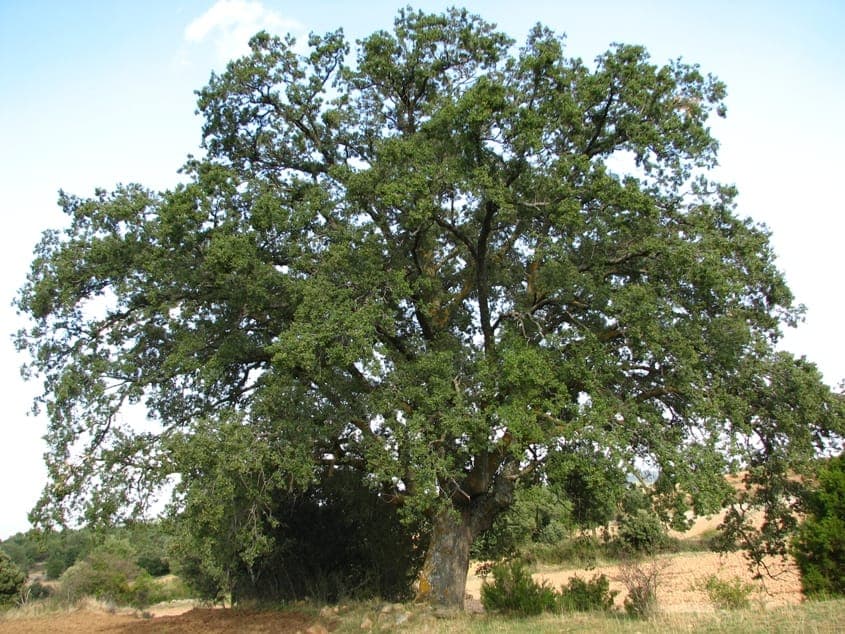
Picamaderos / CC BY-SA 3.0, via Wikimedia Commons
Honeydew oak: complete guide
Quercus faginea
Want to see Honeydew oak: complete guide in your garden?
1 minute, no credit card
Overview
Quercus faginea, commonly known as the honeydew oak, is a stately, long-lived tree native to the western Mediterranean basin - specifically Portugal, Spain, Algeria, Morocco, and Tunisia. In the UK and northern Europe, it's increasingly chosen for larger gardens, parks, and avenues where its resilience and graceful form shine. It typically reaches 12–18 metres in height with a spread of 8–10 metres, forming a dense, rounded crown that provides excellent shade without overwhelming the space.
Unlike many oaks, Quercus faginea grows at a moderate pace - 30 to 50 cm per year in its early years - and adapts well to urban conditions. It's hardy to USDA zone 8 (-12°C), so it performs best in southern and sheltered parts of the UK and Ireland. In colder regions, plant in a south- or southwest-facing wall to benefit from radiant heat. This oak is a true long-term investment: plant it, and it could stand in your garden for centuries.
On gardenworld.app, you can design a garden layout that accounts for the honeydew oak's future canopy spread and seasonal shade patterns.
Appearance & bloom cycle
The honeydew oak earns its name not from the flowers (which are inconspicuous) but from the sticky honeydew secreted by aphids feeding on the leaves - a sign of a healthy, active ecosystem. The leaves are lanceolate, 5–10 cm long, with a glossy dark green upper surface and a paler, sometimes downy underside. They resemble beech leaves, which explains the species name 'faginea' (from Fagus).
In autumn, the foliage turns a soft yellow-brown before gradually falling. The tree is semi-evergreen: older specimens may hold onto their leaves through winter, especially in milder climates. New growth emerges in May, fresh and bright. Flowering occurs in April–May with the appearance of slender, greenish catkins. These release pollen into the wind - no bees needed. By late summer, acorns form: slender, 2–3 cm long, seated in shallow cups. They ripen in autumn and feed birds, squirrels, and insects.
Ideal location
Full sun is best - at least 6 hours of direct sunlight daily. The honeydew oak tolerates light shade, but full exposure encourages denser growth and better acorn production. Choose a spacious spot: allow at least 4 metres clearance from buildings or paved areas. Roots are deep and spreading, so avoid planting near drains or patios. A south- or southwest-facing position against a warm wall offers ideal microclimate benefits, especially in cooler zones.
In smaller gardens, consider the long-term impact. This tree will dominate the space in 20–30 years. Use gardenworld.app to visualise the future canopy and plan companion planting accordingly.
Free design
Want to see Honeydew oak: complete guide in your garden? Make a free design now.
Soil requirements
Quercus faginea thrives in well-drained soils, preferably alkaline to neutral (pH 6.5–8.0). It handles chalky, sandy, or loamy soils with ease. Avoid heavy, waterlogged clays - if that's your soil type, amend with grit and compost to improve drainage. No fertiliser is needed; oaks are adapted to extract nutrients efficiently from poor soils. Over-fertilising can do more harm than good, encouraging weak growth.
Watering
Water deeply and regularly during the first growing season, especially in dry spells. Give 20–30 litres per week, applied at the base. After year one, the tree becomes highly drought-tolerant. Established trees rarely need watering, except during prolonged droughts (4+ weeks without rain), particularly if under 3 metres tall. Avoid frequent shallow watering - it promotes weak root development.
Pruning
Minimal pruning required. Remove only damaged, crossing, or dead branches, and do so in late winter (February) or early spring (March) before bud break. Avoid summer pruning to prevent sap bleeding. Use clean, sharp tools and disinfect between cuts to reduce the risk of spreading pathogens like Phytophthora. Never top or heavily shape this oak - it ruins its natural form and weakens the structure.
Maintenance calendar
- Jan: inspect for loose bark, pests, and storm damage
- Feb: light corrective pruning if needed
- Mar: check for early growth, clear weeds from base
- Apr: catkins appear, no action required
- May: new leaves emerge, monitor for aphids
- Jun: inspect for oak processionary moth (rare but serious)
- Jul-Aug: no maintenance unless extreme drought
- Sep: acorns ripen, provide wildlife food
- Oct: leaf fall begins, collect and mulch
- Nov: protect young trunks from rodents, mulch root zone
- Dec: observe structure, plan next year's care
Winter hardiness
Hardy to USDA zone 8 (-12°C). In colder areas (zone 7), grow in a sheltered spot with wall protection. Young trees benefit from winter mulch (bark or leaf mould) to insulate roots. Container-grown oaks should be moved to a cold frame during hard frosts. Avoid wet, exposed sites - winter wetness is more damaging than cold.
Companion plants
Underplant with drought-tolerant, sun-loving species. Try Lavandula angustifolia, Stipa tenuissima, or Euphorbia myrsinites. For colour and texture: Cistus × cyprius or Salvia officinalis. Avoid vigorous groundcovers like ivy that may climb and smother young trees. On chalky soils, Rhamnus alaternus or Phillyrea latifolia make excellent evergreen partners.
Closing
The honeydew oak isn't flashy, but it's deeply rewarding. With little care, it becomes a living landmark. It fits well in Mediterranean-style gardens, formal avenues, or as a solitary specimen in a lawn. Buy from reputable garden centres, especially those specialising in trees - look for healthy, straight trunks and well-formed root balls. Remember: on gardenworld.app, you can create a planting plan that evolves with your honeydew oak, ensuring balance and harmony for decades to come.
Want to see Honeydew oak: complete guide in your garden? Make a free design now.
Upload a photo, pick a style, and get a photorealistic design with plant list in under a minute.
No credit card required


Similar plants
Lucombe oak: complete guide
Quercus crenata
Lucombe oak (Quercus crenata): a majestic semi-evergreen giant with corky bark, perfect for large gardens, parks, and country estates.
Blue oak: complete guide
Quercus douglasii
Discover the blue oak, a drought-tolerant Californian shade tree with striking blue-green foliage, ideal for large, climate-resilient gardens.
Quercus montana: complete guide
Quercus montana
Quercus montana, the chestnut oak, is a rugged American shade tree with deeply furrowed bark and large acorns, well suited to dry, rocky, spacious gardens.