
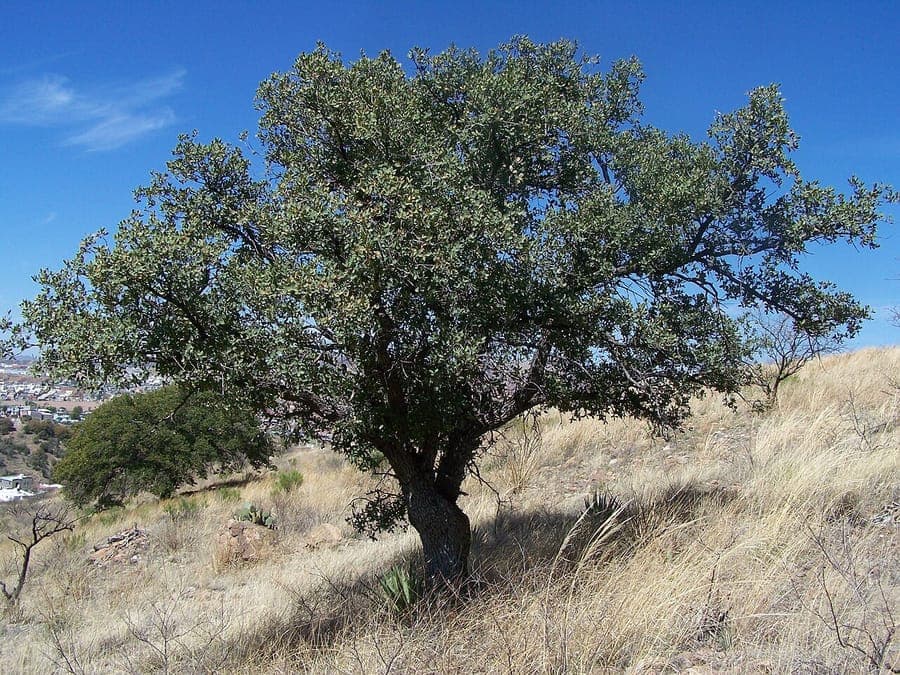
Deiv mm / Public domain, via Wikimedia Commons
Emory oak: complete guide
Quercus emoryi
Want to see Emory oak: complete guide in your garden?
1 minute, no credit card
Overview
The Emory oak (Quercus emoryi) is a semi-evergreen to evergreen deciduous tree native to Arizona, West Texas, and northern Mexico. This hardy, drought-resistant tree grows on dry mountain slopes and in desert regions where few other trees can survive. With its deep root system and adaptations to extreme heat and drought, the Emory oak is an excellent choice for landscape projects in warmer, drier climates.
The tree reaches a height of 20 to 50 feet and develops an impressive spread. It is frost-sensitive and thrives best in USDA zones 8 to 9, where it can develop fully.
Appearance & Bloom
The Emory oak has relatively larger leaves compared to many other southern oaks, often 2 to 4 inches long with slightly wavy edges. The foliage is dull green to gray-green and can remain green year-round in warmer regions. In colder parts of its range, it sheds its leaves partially during winter.
The flowers are small and inconspicuous, grouped in catkins. Male flowers hang downward, while female flowers discretely settle on the twigs. Flowering occurs in early spring, inconspicuously but necessary for acorn formation.
The acorns are small to medium-sized with a deep, bumpy cup. These are food sources for wildlife, especially squirrels and birds.
Ideal Location
The Emory oak grows best in full sun (6 to 8 hours of direct sunlight daily). This tree requires full sunlight to grow strong and healthy. A south or west-facing position works best in areas with intense summer sun.
In the landscape, place this tree on a higher point or slope where water doesn't stagnate. It fits perfectly in xeriscaping projects, desert gardens, and landscapes that can withstand drought.
Soil
The Emory oak is extremely tolerant of many different soil types, as long as they drain well. It thrives on:
- Rocky, clayey soils
- Sandy to gravelly soils
- Moderately nutrient-rich to poor soils
- Soils with pH 6.5 to 7.5
Ensure that the soil drains well after planting. This tree does not tolerate swampy or waterlogged areas. Proper drainage is essential, especially in the first two growing seasons.
Watering
Once established (after 2-3 years), the Emory oak requires very little water. This is one of its most desirable characteristics.
At planting: Water well in the first week, then gradually reduce as the tree roots in.
Established trees: Water during dry periods only deeply and infrequently. Allow soil to dry between waterings.
In regions with annual rainfall under 20 inches: Water several times during summer months, especially the first two summers.
Excessive water is more harmful than insufficient water. Well-established trees can survive for years without supplemental irrigation.
Free design
Want to see Emory oak: complete guide in your garden? Make a free design now.
Pruning
The Emory oak requires minimal pruning. Allow the tree to maintain its natural form.
- Remove only dead, damaged, or crossing branches
- Prune in late winter before the new growing season
- Avoid heavy pruning, which increases stress and disease susceptibility
- Thin out carefully if the tree becomes too dense
- Avoid topping, which damages tree form
You can lift low-hanging branches for accessibility, but the tree performs best when you respect its natural architecture.
Maintenance Calendar
Spring (March-May): Check for dead branches, prune if needed. Add a layer of organic mulch (2-3 inches) around the base for moisture retention.
Summer (June-August): Monitor for drought stress, especially young trees. Water deeply if more than 3 weeks have passed without rainfall.
Fall (September-November): No special care required. Fallen leaves can remain as natural mulch.
Winter (December-February): No maintenance needed. The tree rests. Pruning can be done in late winter.
Winter Hardiness
The Emory oak is frost-sensitive and frost-limited. It survives in USDA zones 8b to 9b, where minimum temperatures do not drop below 10 degrees Fahrenheit. In much of Europe, it is only suitable for Mediterranean and warmer temperate regions.
In marginal cases (zone 8a), protection or microclimate (against south-facing wall) may help. In colder zones, this tree is unsuitable.
Companion Plants
The Emory oak combines well with other drought-tolerant, heat-loving plants:
- Shrubs: Creosote bush, Whitehorn acacia, Jojoba
- Groundcovers: Gray pinkroot, Indian paintbrush, Salvia species
- Succulents: Agaves, Yuccas
These combinations create an authentic desert landscape with low water requirements.
Closing
The Emory oak is a particularly valuable element for gardens in warmer, drier climates. With its native heritage, strong drought tolerance, and useful form, it makes an interesting specimen or group planting. Once established, this tree provides decades of low-maintenance beauty.
On gardenworld.app, find more information about choosing native trees for xeriscaping projects.
Want to see Emory oak: complete guide in your garden? Make a free design now.
Upload a photo, pick a style, and get a photorealistic design with plant list in under a minute.
10,000+ gardens designed already
No credit card required


Similar plants
Lucombe oak: complete guide
Quercus crenata
Lucombe oak (Quercus crenata): a majestic semi-evergreen giant with corky bark, perfect for large gardens, parks, and country estates.
Blue oak: complete guide
Quercus douglasii
Discover the blue oak, a drought-tolerant Californian shade tree with striking blue-green foliage, ideal for large, climate-resilient gardens.
Quercus montana: complete guide
Quercus montana
Quercus montana, the chestnut oak, is a rugged American shade tree with deeply furrowed bark and large acorns, well suited to dry, rocky, spacious gardens.