
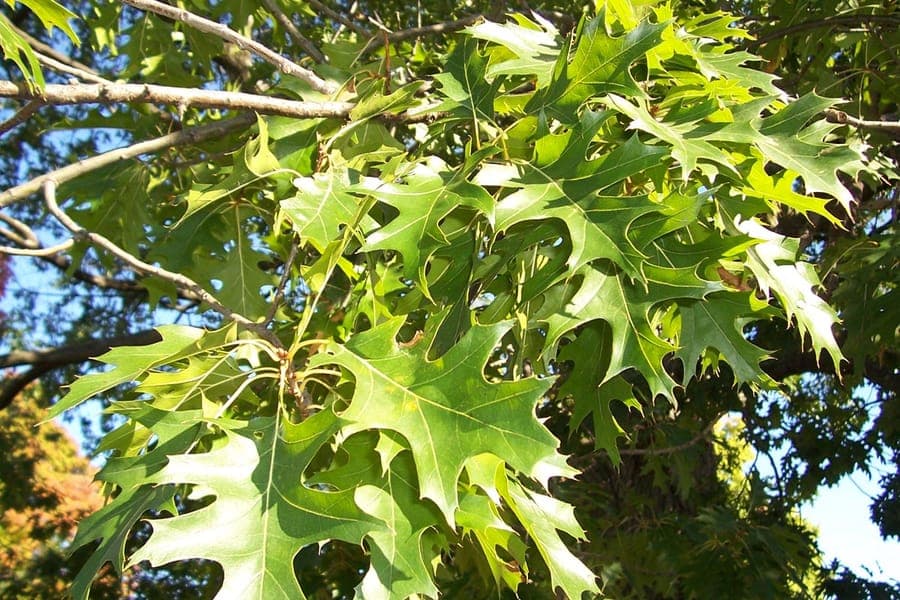
Sulfur at English Wikipedia / CC BY-SA 3.0, via Wikimedia Commons
Hill's oak: complete guide
Quercus ellipsoidalis
Want to see Hill's oak: complete guide in your garden?
1 minute, no credit card
Overview
Hill's oak (Quercus ellipsoidalis), also known as Jack oak or Northern pin oak, is a North American oak native to the Great Lakes region. This tree is an excellent choice for larger gardens wanting native character without the full-scale commitment of a traditional forest oak. The name 'ellipsoidalis' refers to the characteristic shape of its acorns - ellipsoidal small nuts rather than the classic round form. Hill's oak grows more slowly than many oaks but eventually reaches substantial size and is exceptionally cold-hardy.
This oak is invaluable for birds, insects, and soil organisms. The leaves are finely cut with sharp lobes, giving it an elegant appearance. In autumn, the tree transforms into a spectacle of red to purple hues, making it particularly attractive in fall gardens. The tree grows best in moderate climates with regular moisture supply.
Appearance and Bloom
Hill's oak is a moderate-sized tree typically reaching 15 to 25 meters in height with a broad, somewhat pyramidal crown. The bark is dark gray and becomes rough with age, developing characteristic deep grooves. The branch structure is very elegant and open, creating dappled shade with good air flow.
The leaves are small to medium-sized, approximately 7 to 12 centimeters long, with characteristic sharp lobes more resembling aspen leaves than typical oak foliage. Leaves are green to deep green in summer, changing from October to November into a mixture of bright red to dark red and sometimes purple. Leaves fall completely by December.
Bloom follows the typical oak pattern with separate male (staminate) and female catkins in April-May. The flowers are inconspicuous but attract native pollinators. The female flowers eventually develop into small acorns approximately 1 to 1.5 centimeters, enclosed in shallow cups - a characteristic shape that becomes ellipsoid.
Ideal Location
Hill's oak grows best in full sun with at least six hours of direct sunlight daily. In very warm climates, some afternoon shade may be beneficial, but in temperate climates full sun works well. The tree is very frost-hardy (USDA zones 4-6) and suitable for all temperate regions.
The tree prefers good drainage and can grow quite dry once established, though regular moisture supply accelerates growth. Planting locations with moderate air circulation are preferred, as the tree favors open, airy environments. A spot protected from strong winds helps prevent branch breakage.
Soil
Hill's oak thrives in highly varied soil types from acid to neutral (pH 5.5 to 7.0). The tree is considerably less critical than many oaks and can grow in poor, dry soils and even clay. A slightly acidic, well-draining soil with moderate nutrients is however optimal.
The tree has strong taproots that dig deep and handle compacted soil well. Heavy clay soils can be improved with sand and organic matter, but are not essential. Mulching around young trees helps moisture retention and ground temperature regulation.
Free design
Want to see Hill's oak: complete guide in your garden? Make a free design now.
Watering
Hill's oak is moderately drought-tolerant once established and grows well in moderately moist conditions. Young trees (first two to three years) should be watered regularly, especially in hot summers, as deep root formation requires time. Once established, mature trees need relatively little supplemental watering.
It is important to avoid excessive moisture (standing water) as this will damage the deep-rooted tree. Regular thorough soaking is better than daily light sprinkling. In extremely dry years, mature trees may benefit from supplemental irrigation.
Pruning
Hill's oak responds well to formative pruning when young and can be nicely trained to a single stem or multiple leading branches. Pruning occurs in the dormant period (January-February) before sap begins rising. Remove dead, diseased, or interfering branches entirely. Later pruning (July-August) can be used to moderate growth and correct form.
Older trees need minimal pruning aside from removal of dead wood. A pruning wound dressing can be used on larger cuts, though many oaks heal these naturally.
Maintenance Calendar
January-February: Formative pruning on young trees, removal of damaged wood. March-April: Growing season begins, regular watering for young trees, insect activity observation. May-June: Bloom, no specific care needed beyond moisture provision. July-August: Growth continues, summer corrective pruning possible, disease checkpoints. September-October: Fall color display, no active pruning. November-December: Leaf fall, dormancy preparation, check branch integrity for snow load.
Winter Hardiness
Hill's oak is one of the most frost-hardy oaks and can withstand temperatures to -35 degrees Celsius, making it suitable for rougher climates and less sheltered locations. Young twigs may incur frost damage if winter is severe, but the tree usually recovers quickly.
Snow can break heavy branches if they absorb water, so gentle shaking helps remove snow load. In very rough conditions, additional bracing may prevent branch breakage. Generally, Hill's oak is a reliable choice for very cold regions.
Companion Plants
Hill's oak works well with other North American native trees in naturalistic gardens. Excellent companions are River Birch (Betula nigra), American Elm (Ulmus americana), and Kentucky Coffeetree (Gymnocladus dioicus). For understory work, native shrubs like thorns (Crataegus spp.) and willows (Salix spp.) work well.
Ground covers like native woodland sedges and marsh violet accentuate the natural character. In larger gardens, multiple Hill's oaks can be planted together for a woodland effect. The tree is actually very bird-friendly and attracts cavity nesters, acorn-eating birds, and many insects.
Closing
Hill's oak is an ideal tree for those seeking a large, cold-hardy native tree with ornamental value and strong bird-ecological worth. The combination of elegant foliage, spectacular fall colors, and reliable performance makes it a valuable addition to large gardens. The tree grows slowly but reaches impressive scale and is an investment in a tree that will serve generations.
Garden centres offer Hill's oak, though it sometimes must be specially ordered. GardenWorld can advise on planting placement for maximum impact. GardenWorld also supports replanting of North American native tree species.
Want to see Hill's oak: complete guide in your garden? Make a free design now.
Upload a photo, pick a style, and get a photorealistic design with plant list in under a minute.
No credit card required


Similar plants
Lucombe oak: complete guide
Quercus crenata
Lucombe oak (Quercus crenata): a majestic semi-evergreen giant with corky bark, perfect for large gardens, parks, and country estates.
Blue oak: complete guide
Quercus douglasii
Discover the blue oak, a drought-tolerant Californian shade tree with striking blue-green foliage, ideal for large, climate-resilient gardens.
Quercus montana: complete guide
Quercus montana
Quercus montana, the chestnut oak, is a rugged American shade tree with deeply furrowed bark and large acorns, well suited to dry, rocky, spacious gardens.