
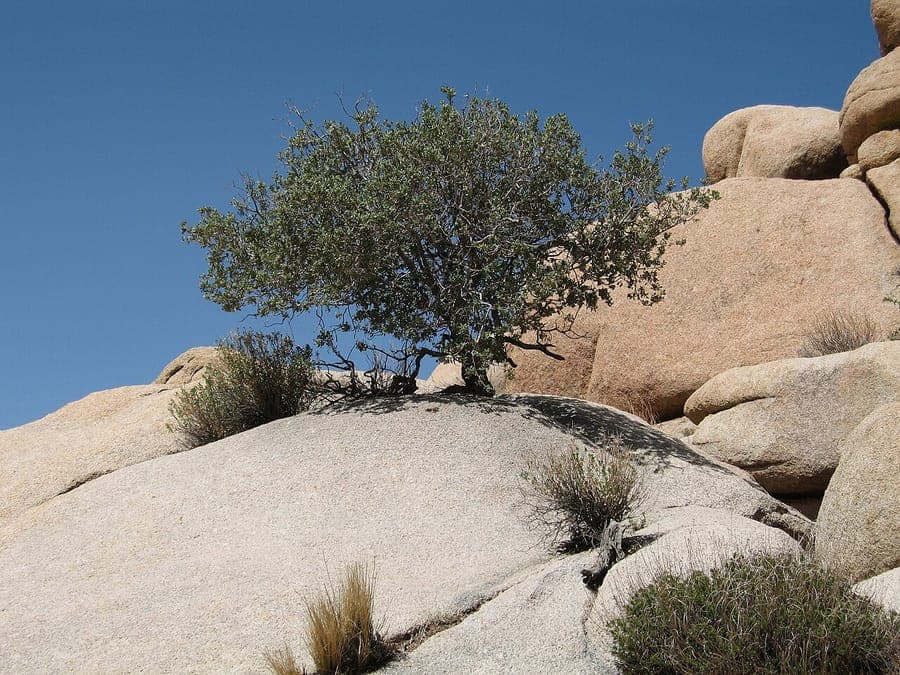
Robb Hannawacker, while working for Joshua Tree National Park / Public domain, via Wikimedia Commons
Quercus cornelius-mulleri: complete guide
Quercus cornelius-mulleri
Want to see Quercus cornelius-mulleri: complete guide in your garden?
1 minute, no credit card
Overview
The Quercus cornelius-mulleri, commonly known as Desert scrub oak or Muller oak, is a remarkable shrubby tree species native to the California-Mexico border region. Named after botanist Cornelius Mulleri and formally described in 1981, this species thrives in some of North America's harshest environments. It represents an excellent choice for gardeners seeking authentic desert landscapes with minimal water consumption.
This oak grows in extreme desert environments where few other plants survive. With its characteristic growth pattern and drought adaptations, the Desert scrub oak makes an outstanding addition to xeriscaping projects and low-maintenance landscapes. It symbolizes botanical resilience and environmental adaptation.
Appearance and Bloom
The Quercus cornelius-mulleri typically grows as a compact shrub to small tree, rarely exceeding 3-4 meters in height. The plant presents itself with small, densely packed leaves that readily adapt to intense sunlight and minimal water availability.
The leaves are distinctly oak-like, with undulating margins and a leathery texture that helps conserve water. During summer, the plant produces inconspicuous flowers - yellow-green male catkins are relatively unnoticed, while female flowers create even smaller reddish structures.
The fruits (acorns) are small and rounded, with distinctive caps covering approximately half the nut. These acorns provide wildlife food sources in their native habitat.
Ideal Location
The Desert scrub oak thrives in open, fully sunny locations. This is not a shade-tolerant plant - at least 8 hours of direct sunlight daily is essential for optimal growth. Position this tree where other plants struggle, such as against south or west-facing walls.
This makes Quercus cornelius-mulleri ideal for roof gardens, dry slopes, and Mediterranean gardens where heat and drought characterize the environment. The plant is exceptionally wind-resistant due to its compact growth habit.
Soil
Soil requirements are minimal - actually, the poorer the soil, the better. The Desert scrub oak prefers well-draining, sandy or clayey soils with low nutrient content. In moist or heavy soils, root rot may occur.
Ensure excellent drainage by adding sand or gravel. The plant tolerates acidic to slightly alkaline soils (pH 6.5-7.5). No fertilizing needed - indeed, excess nutrients can promote rapid growth requiring more water.
Free design
Want to see Quercus cornelius-mulleri: complete guide in your garden? Make a free design now.
Watering
One of this oak's greatest assets is its extremely low water requirement. After the first growing season, supplemental irrigation is practically unnecessary. Young plants (first 1-2 years) benefit from light watering to establish roots.
Water deeply but infrequently - once weekly in extremely hot periods is usually sufficient. Once established, regular rainfall may suffice. Overwatering is the primary cause of failure with this species.
Pruning
The Desert scrub oak requires minimal pruning. Allow the tree to maintain its natural form. Remove only dead, diseased, or heavily crossed branches in late winter. This opens the canopy and promotes healthier growth.
Pruning is best performed between December and February when the plant is dormant. Avoid summer pruning, which can cause stress and sun damage.
Maintenance Calendar
This plant is truly maintenance-friendly:
- March-April: Inspect for winter damage; remove dead branches
- May-September: Monitor growth; water only during extreme drought
- October-November: No action required
- December-February: Light pruning if needed
Winter Hardiness
The Quercus cornelius-mulleri is quite cold-sensitive, especially outside its native range. This plant is limited in suitability for European climates except in protected microclimates.
In zones where frost regularly occurs (below -5 degrees Celsius), the plant should be overwintered in a cold frame or greenhouse. The plant grows best in USDA zones 9-11 (southeastern Spain, southern France, southern Italy).
Companion Plants
In xeric gardens with matching drought tolerance, good companions include:
- Pinus pinea (Stone pine)
- Rosmarinus officinalis (Rosemary)
- Lavandula angustifolia (English lavender)
- Cistus albidus (White rock rose)
- Erica multiflora (Multiflowering heath)
Avoid water-demanding plants in immediate vicinity.
Closing Thoughts
The Quercus cornelius-mulleri offers a unique opportunity for gardening in extreme conditions. With minimal care and water, this Desert scrub oak can provide years of character and texture to xeric gardens. For anyone seeking drought-resistant trees with botanical interest, this is a must-try species.
Discover more remarkable plants on gardenworld.app where you can create fully personalized garden designs, perfectly suited to your climate and preferences.
Want to see Quercus cornelius-mulleri: complete guide in your garden? Make a free design now.
Upload a photo, pick a style, and get a photorealistic design with plant list in under a minute.
No credit card required


Similar plants
Lucombe oak: complete guide
Quercus crenata
Lucombe oak (Quercus crenata): a majestic semi-evergreen giant with corky bark, perfect for large gardens, parks, and country estates.
Blue oak: complete guide
Quercus douglasii
Discover the blue oak, a drought-tolerant Californian shade tree with striking blue-green foliage, ideal for large, climate-resilient gardens.
Quercus montana: complete guide
Quercus montana
Quercus montana, the chestnut oak, is a rugged American shade tree with deeply furrowed bark and large acorns, well suited to dry, rocky, spacious gardens.