
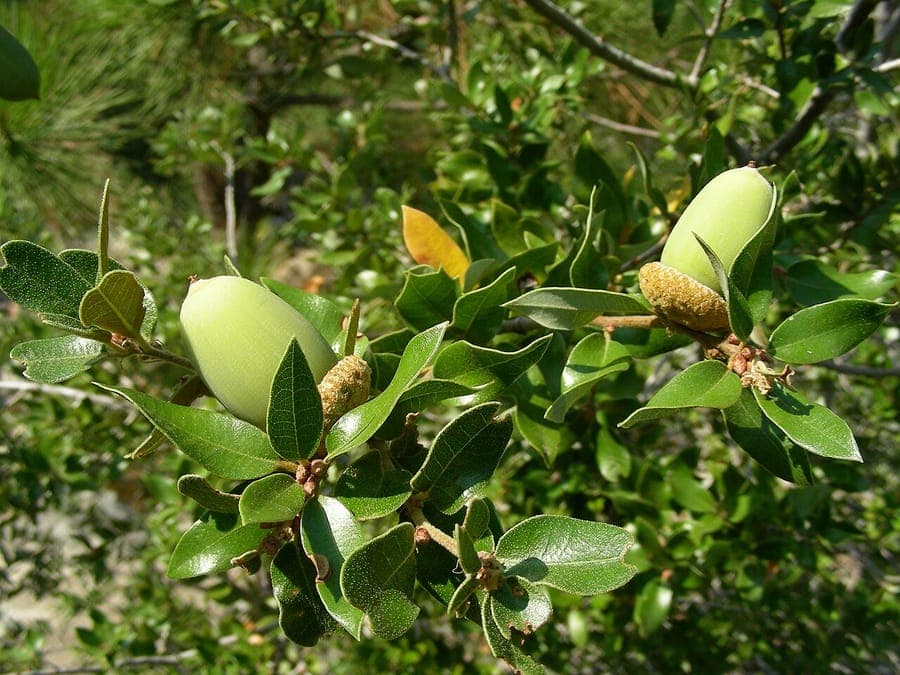
Doug Beckers on Flickr / CC BY-SA 2.0, via Wikimedia Commons
Canyon live oak: complete guide
Quercus chrysolepis
Want to see Canyon live oak: complete guide in your garden?
1 minute, no credit card
Overview
The canyon live oak (Quercus chrysolepis), also known as goldcup oak or canyon oak, is a remarkable shrub-tree from the Fagaceae family. This species grows natively in the mountains of Oregon, California, Arizona, Nevada and New Mexico extending into Mexico. The name "chrysolepis" refers to the distinctive golden leaf buds that distinguish this plant from other oak species.
This evergreen oak is excellent for landscapes with mountainous characteristics. The plant naturally establishes itself in steep canyons and rock faces, where it adapts perfectly to extreme conditions. The tree reaches a maximum height of approximately 15-20 meters in the wild, though in gardens it often remains smaller.
Appearance and Bloom
The canyon live oak has a very characteristic appearance. The leaves are small, leathery and dark green, with a bluish-white bloom on the undersides. The leaf buds display a prominent golden sheen, explaining the scientific name. This golden appearance is especially visible in spring as new growth emerges.
The fruits are nuts (acorns) contained in cup-shaped cupules. These cupules are densely set with fine, golden-shining scales that make them highly characteristic. The flowers are inconspicuous, as is typical for oaks.
The tree grows slowly and eventually forms a broad, rounded crown with widely spreading branches. This gives it a naturally balanced form requiring little pruning.
Ideal Location
The canyon live oak prefers a fully sunny location with at least 6-8 hours of direct sunlight daily. This tree grows on steep slopes and rocky terraces in its natural habitat, so mountainous gardens or slopes are ideal.
It works well in dry mountain areas, xericapes and Mediterranean gardens. It is particularly suited for landscapes in zones where water is scarce or where intensive irrigation is impractical. In urban settings, it can serve as a specimen tree in large public spaces.
The tree tolerates windy conditions well and also grows in salt air. This makes it suitable for coastal areas with rocky terrain.
Soil
The canyon live oak grows best on well-draining soils. Its natural occurrence on steep slopes means it adapts to substrates with limited moisture retention. The tree thrives on both sandy and rocky grounds, provided drainage is optimal.
The pH can range between 4.5 and 7.5, meaning it adapts to both acidic and neutral soils. This gives gardeners much flexibility in placement. The tree can also grow on poor soils, making it ideal for difficult locations where other trees refuse to thrive.
Once established, the canyon live oak requires minimal nutritional supplementation. The tree grows slowly, meaning efficient resource use.
Free design
Want to see Canyon live oak: complete guide in your garden? Make a free design now.
Watering
Once established, the canyon live oak is highly drought-tolerant. This is an essential trait for gardens in dry climates. Young trees do require regular watering until their root system is fully developed.
When planting, water regularly during the first growing season and possibly the second summer. Once the tree is 2-3 years old and its roots have penetrated deep into the soil, irrigation can be significantly reduced.
In the mature stage, the tree only needs water during extreme droughts. In Mediterranean climates, it can even survive without supplemental irrigation. This makes it economically attractive for water-conscious garden designs.
Pruning
The canyon live oak has a naturally beautiful form and requires minimal pruning. It is even advisable to limit pruning, as it grows slowly and removing branches can lead to awkward forms.
If pruning is needed, do it in late winter or early spring, before the growth spurt. Remove only dead, damaged or disease-causing wood. This helps prevent unwanted shapes and maintain tree health.
Avoid heavy pruning, as this can severely damage the tree. Small shape adjustments can be made in summer, but heavy pruning wounds heal slowly.
Maintenance Calendar
January-February: Check for winter damage. Perform maintenance pruning if necessary.
March-May: Growing season begins. Ensure even watering for young trees.
June-July: Peak growth period. Tolerates drought well. Little maintenance needed.
August-October: Growth slows. Reduce watering.
November-December: Dormant period. Minimal maintenance needed.
Winter Hardiness
The canyon live oak is an evergreen resistant to cold. In its natural habitat, it experiences winters with temperatures down to -7 degrees Celsius, especially at higher altitudes. This makes it suitable for temperate climates with cold winters.
While not truly frost-sensitive, it grows best in USDA zones 8-10. In colder zones, protection in the first winter may be necessary.
Companion Plants
The canyon live oak functions well alongside other drought-tolerant species from the same mountainous habitats. Some suitable companion plants include:
Manzanita (Arctostaphylos) - A dwarf shrub that contrasts nicely with the larger tree. Ceanothus (California lilac) - Blue-flowering shrub that works well together. Ceanothus crassifolius (Mahogany Ceanothus) - For dramatic effects. Ponderosa Pine (Pinus ponderosa) - For vertical accent. Madera Oak (Quercus douglasii) - For a woodland effect with related species. Salvia and herbs like Artemisia group well around this tree.
Closing
The canyon live oak is a stunning choice for gardeners with dry, mountainous locations. Its slow growth, minimal maintenance requirements and impressive appearance make it essential for xeriscapes and Mediterranean gardens. With its golden leaf buds and sustainable form, it remains a strong focal point in the landscape for decades.
Whether you live in California or have a dry mountainous climate, the canyon live oak offers sustainable beauty without the need for constant care. Discover this native treasure and elevate your garden with one of nature's most robust oaks. For more information about drought-tolerant landscapes, visit gardenworld.app.
Want to see Canyon live oak: complete guide in your garden? Make a free design now.
Upload a photo, pick a style, and get a photorealistic design with plant list in under a minute.
No credit card required


Similar plants
Lucombe oak: complete guide
Quercus crenata
Lucombe oak (Quercus crenata): a majestic semi-evergreen giant with corky bark, perfect for large gardens, parks, and country estates.
Blue oak: complete guide
Quercus douglasii
Discover the blue oak, a drought-tolerant Californian shade tree with striking blue-green foliage, ideal for large, climate-resilient gardens.
Quercus montana: complete guide
Quercus montana
Quercus montana, the chestnut oak, is a rugged American shade tree with deeply furrowed bark and large acorns, well suited to dry, rocky, spacious gardens.