
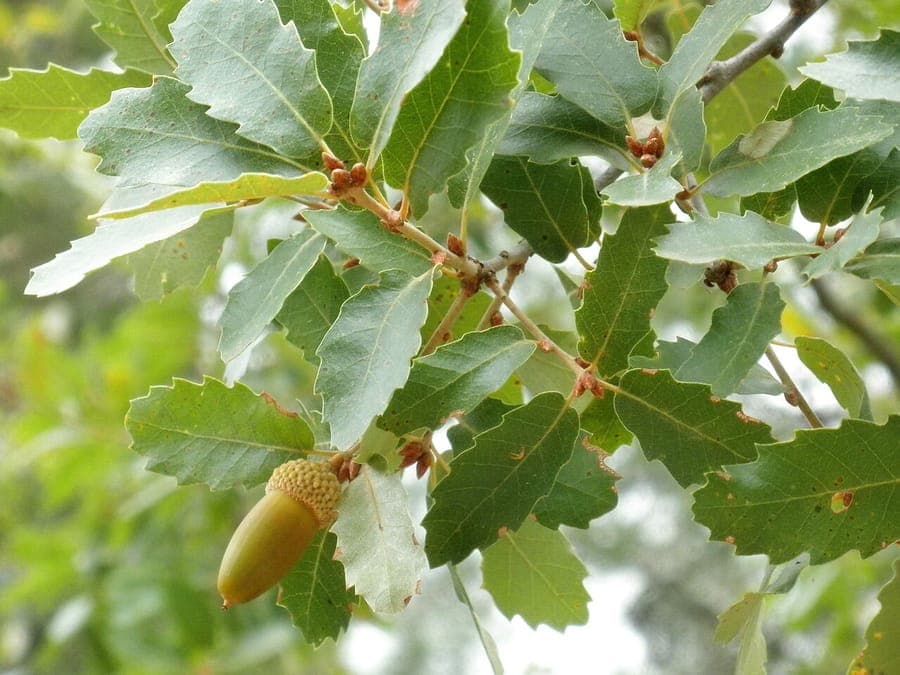
Javier martin / Public domain, via Wikimedia Commons
Algerian oak: complete guide
Quercus canariensis
Want to see Algerian oak: complete guide in your garden?
1 minute, no credit card
Overview
Quercus canariensis, commonly known as the Algerian oak, is a stately deciduous tree that brings both architectural presence and seasonal drama to the garden. Despite its misleading name, it doesn't originate from the Canary Islands but from North Africa - Algeria and Morocco - and parts of southwestern Europe including Portugal, Spain, and occasionally Tunisia. In milder temperate zones, particularly USDA hardiness zones 8a to 10b, it thrives as a long-lived specimen tree, reaching 15–20 meters in height and spreading 10–12 meters wide over time. Its slow to moderate growth rate - about 30–40 cm per year - means it's not a quick fix, but a legacy planting.
If you're planning a large-scale garden design, gardenworld.app lets you visualise how an Algerian oak fits into your space, considering canopy spread and root zone development. This tree isn't for small urban yards unless you're decades ahead in your vision. It demands space, but rewards with decades - even centuries - of beauty.
Appearance & bloom cycle
The Algerian oak features deeply lobed leaves, typically with five to seven pointed segments, growing 10–20 cm long. New foliage emerges in spring with a reddish-bronze sheen, maturing to glossy green by summer. The real show begins in autumn, when leaves turn vibrant shades of golden yellow, burnt orange, and sometimes deep crimson - one of the most striking fall displays among oaks.
Flowering occurs in April and May. Male flowers appear as dangling yellow catkins, up to 8 cm long, while female flowers are tiny and inconspicuous. By late autumn, 2–3 cm long acorns develop, partially enclosed in a fuzzy cup, providing food for birds and small mammals. These acorns can be collected and sown in well-drained compost for propagation.
Ideal location
With a light requirement of 7 out of 10, the Algerian oak grows best in full sun to partial shade. At least six hours of direct sunlight daily ensures optimal leaf development and autumn colouring. It tolerates coastal exposure and urban pollution reasonably well, making it suitable for larger suburban or park-like gardens.
Plant it at least 5 meters from buildings, driveways, or underground utilities to avoid root damage. Young trees benefit from staking in windy sites. Using gardenworld.app, you can map out root expansion zones and plan surrounding plantings without future conflicts.
Soil requirements
This oak prefers moist, well-drained loam or clay-loam soils with a pH between 5.5 and 6.5. It dislikes waterlogged conditions - prolonged saturation leads to root rot. While adaptable to various soil types, it struggles in highly alkaline or compacted sands. At planting, amend the soil with well-rotted compost or leaf mould to improve structure and nutrient retention.
For heavy clay, consider raised planting or adding grit to enhance drainage. In sandy soils, incorporate organic matter annually to boost water and nutrient holding capacity.
Free design
Want to see Algerian oak: complete guide in your garden? Make a free design now.
Watering
Young trees require consistent watering for the first two to three years - about 20 litres per week during dry spells from May to September. Use a slow drip method to encourage deep root development. Once established, mature trees are highly drought-tolerant due to an extensive taproot system. Overwatering, especially in winter, increases fungal risks.
During extreme summer droughts, even mature specimens may benefit from occasional deep soaking, particularly if leaf scorch or premature drop occurs.
Pruning
Pruning is rarely needed, as Quercus canariensis naturally develops a strong central leader and balanced crown. If pruning is necessary, do it in late summer to early autumn (August to October) to avoid bleeding sap and reduce the risk of oak wilt or fungal infection. Remove only dead, damaged, or crossing branches. Use sterilised tools, especially when working around signs of decay.
For a more upright form in early years, train the central stem and remove lower lateral branches gradually up to 1.5 meters.
Maintenance calendar
- Jan: Inspect for storm damage and structural integrity.
- Feb: No action required.
- Mar: Apply organic mulch around the base, keeping it away from the trunk.
- Apr: Protect young trees from late frosts; monitor for pests.
- May: Water during dry periods; watch for emerging catkins.
- Jun: Avoid pruning; check for aphids or mildew.
- Jul: Monitor leaf condition; deep water if prolonged drought.
- Aug: Begin light structural pruning if needed.
- Sep: Add compost around the drip line.
- Oct: Collect acorns or leave them for wildlife.
- Nov: Leave fallen leaves under the canopy as natural mulch.
- Dec: Review overall health and plan for spring.
Winter hardiness
Hardy to around -12°C (USDA zone 8a), the Algerian oak survives mild UK and Pacific Northwest winters. In colder regions, young trees need winter protection - wrap the trunk with hessian or use frost cloth. Prolonged exposure to temperatures below -10°C may cause tip dieback or leaf damage. Mature trees handle cold better but still benefit from a sheltered, south-facing position.
Companion plants
Underplant with shade-tolerant species like Helleborus orientalis, Pachysandra terminalis, or Carex elata 'Aurea'. Avoid aggressive groundcovers with dense root systems. Compatible trees include Carpinus betulus and Fagus sylvatica, which share similar soil and light needs. Avoid planting near shallow-rooted vegetables or annuals that require frequent soil disturbance.
Closing
The Algerian oak is not a trend-driven choice - it's a commitment to time, space, and legacy. It asks for little once mature but demands thoughtful placement from the start. You won't find it at every garden centre, but specialist nurseries and online suppliers occasionally stock it. Check OBI and Hornbach in Germany, Truffaut and Jardiland in France, or inquire at local growers in the UK. When planting Quercus canariensis, remember: you're not gardening for yourself alone, but for generations to come.
Want to see Algerian oak: complete guide in your garden? Make a free design now.
Upload a photo, pick a style, and get a photorealistic design with plant list in under a minute.
No credit card required


Similar plants
Lucombe oak: complete guide
Quercus crenata
Lucombe oak (Quercus crenata): a majestic semi-evergreen giant with corky bark, perfect for large gardens, parks, and country estates.
Blue oak: complete guide
Quercus douglasii
Discover the blue oak, a drought-tolerant Californian shade tree with striking blue-green foliage, ideal for large, climate-resilient gardens.
Quercus montana: complete guide
Quercus montana
Quercus montana, the chestnut oak, is a rugged American shade tree with deeply furrowed bark and large acorns, well suited to dry, rocky, spacious gardens.