
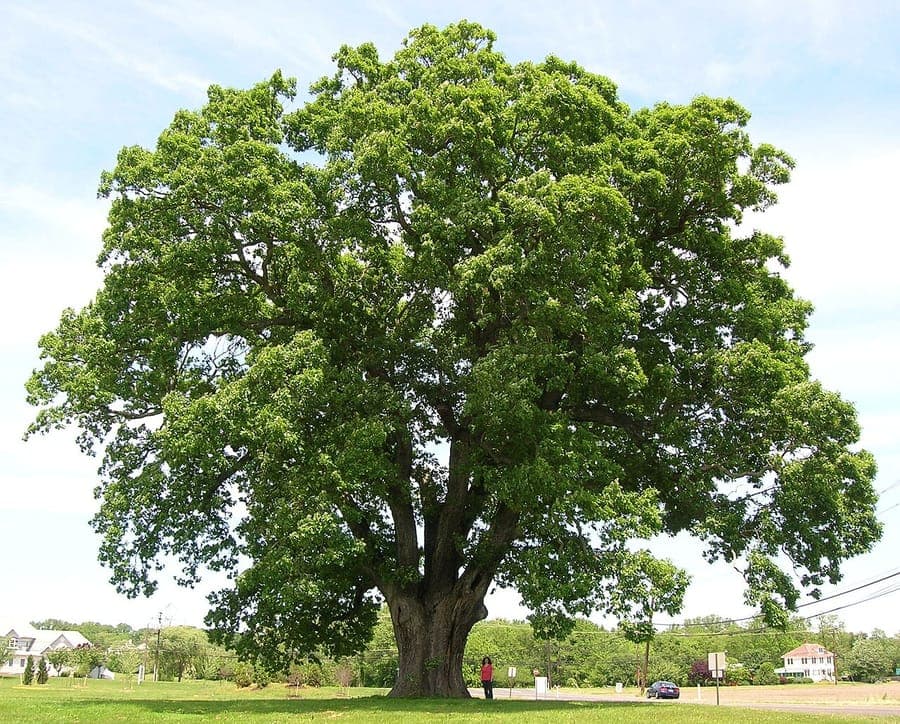
Marty Aligata at English Wikipedia / CC BY-SA 3.0, via Wikimedia Commons
Stave oak: complete guide
Quercus alba
Want to see Stave oak: complete guide in your garden?
1 minute, no credit card
Overview
The Stave oak, or Quercus alba, is a majestic hardwood tree native to eastern North America, stretching from Alabama to Iowa and up into southern Canada. It's a long-lived species, often surviving 200 to 300 years, and sometimes even longer under ideal conditions. In the UK and other temperate regions, it's increasingly planted in large gardens, estates and naturalistic landscapes. On gardenworld.app you can design a garden plan that accounts for the oak's extensive root spread and mature canopy, ensuring your layout grows gracefully over time.
This tree forms a broad, rounded crown, reaching 20–30 meters in height and up to 18 meters in spread. Its growth rate is slow to moderate-around 30 cm per year-making it a thoughtful addition to long-term garden designs. It thrives in USDA hardiness zones 3 to 9, meaning it handles cold winters down to -40°C without damage. If you're planting in a cooler maritime climate like the UK, choose a sheltered spot to protect young trees from harsh winter winds.
Appearance & bloom cycle
The Stave oak has distinctive light grey, scaly bark that becomes deeply furrowed with age. Its leaves are 10–20 cm long, with 7–9 rounded lobes and a pale, slightly fuzzy underside. The foliage emerges a soft green in spring, deepens to a rich green in summer, and turns a striking mix of red, russet and burgundy in autumn-among the most vibrant fall displays of any oak.
In May, yellowish-green catkins appear on male flowers, dangling from the branches. Female flowers are smaller and less noticeable, but after pollination, acorns develop. These mature by autumn, reaching about 2 cm long with a warty cap covering half the nut. Acorns are a vital food source for deer, squirrels, turkeys and woodpeckers, making this tree a wildlife magnet.
Ideal location
Plant the Stave oak where it has room to stretch. Allow at least 8 meters from buildings, driveways and underground utilities. It needs full sun-6 or more hours of direct light daily-for a strong, balanced canopy. Light shade is tolerated, but dense shade slows growth and encourages a leggy form.
Avoid planting near paved areas, since the root system can lift surfaces over time. Also, keep in mind that mature trees are nearly impossible to transplant. Use gardenworld.app to preview how the tree's shade and root zone will affect your garden layout over the next 20 years, helping you make smarter planting decisions today.
Soil requirements
The Stave oak adapts to a wide range of soils but prefers well-drained loam or sandy loam with a pH between 4.5 and 6.8. It tolerates clay and sandy soils as long as they don't stay waterlogged. Avoid low-lying areas where water pools after heavy rain.
When planting, don't amend the soil heavily-oaks prefer native conditions. Instead, add a 5–8 cm layer of organic mulch like leaf litter or shredded bark to retain moisture and suppress weeds. Keep mulch a few inches from the trunk to prevent rot.
Free design
Want to see Stave oak: complete guide in your garden? Make a free design now.
Watering
Young trees need consistent watering during their first two years. Give 10–15 liters per week during dry spells, ideally using a slow-release method like a tree spike or soaker hose. Once established, the Stave oak is highly drought-tolerant thanks to its deep taproot.
Mature trees rarely need supplemental watering, except during prolonged droughts (over 4 weeks without rain). In such cases, deep watering under the drip line helps maintain vitality.
Pruning
Pruning is rarely needed. The tree naturally develops a strong central leader and wide-spreading branches. If necessary, prune during late summer or early autumn to avoid bleeding sap, which can happen in spring.
Remove only dead, damaged or crossing branches, and never remove more than 20% of the canopy in a single year. Use clean, sharp tools, and avoid topping the tree-this weakens its structure and invites disease.
Maintenance calendar
- January–March: Inspect for storm damage. No pruning.
- April: Apply a thin layer of compost around the base, keeping it clear of the trunk.
- May–June: Catkins appear. No care needed.
- July–August: Monitor young trees for drought stress.
- September–October: Acorns drop. Leaves turn color. Let fallen leaves decompose naturally under the tree.
- November–December: Dormant period. No action required.
Winter hardiness
The Stave oak is exceptionally cold-hardy, thriving in USDA zones 3 to 9. Young trees may suffer sunscald on the south-facing bark during freeze-thaw cycles. Wrap the trunk with a tree guard for the first 2–3 winters if planted in an exposed location.
Once established, the tree handles heavy snow and ice loads well, though occasional branch breakage can occur in severe storms.
Companion plants
Under mature oaks, plant shade-tolerant, shallow-rooted species. Good choices include Carex pensylvanica, Erythronium americanum, Pachysandra procumbens and Tiarella cordifolia. Avoid deep-rooted or thirsty plants that compete for moisture.
For a naturalistic look, mix in native wildflowers like Aquilegia canadensis or Phlox divaricata. These attract pollinators and enhance biodiversity.
Closing
The Stave oak is a legacy tree-plant it not for immediate impact, but for the generations that follow. With proper placement and minimal care, it becomes a cornerstone of beauty, shelter and ecological function. For young saplings, visit local garden centres like Wyevale or check online nurseries with strong oak stock. Give it space, time and respect, and it will reward you with centuries of grace.
Want to see Stave oak: complete guide in your garden? Make a free design now.
Upload a photo, pick a style, and get a photorealistic design with plant list in under a minute.
No credit card required


Similar plants
Lucombe oak: complete guide
Quercus crenata
Lucombe oak (Quercus crenata): a majestic semi-evergreen giant with corky bark, perfect for large gardens, parks, and country estates.
Blue oak: complete guide
Quercus douglasii
Discover the blue oak, a drought-tolerant Californian shade tree with striking blue-green foliage, ideal for large, climate-resilient gardens.
Quercus montana: complete guide
Quercus montana
Quercus montana, the chestnut oak, is a rugged American shade tree with deeply furrowed bark and large acorns, well suited to dry, rocky, spacious gardens.