
Elisardojm / CC BY-SA 4.0, via Wikimedia Commons
Plymouth pear: complete guide
Pyrus cordata
Want to see Plymouth pear: complete guide in your garden?
1 minute, no credit card
Overview
The heart-leafed pear (Pyrus cordata), also known as Plymouth pear or coeur de pear, is a distinctive native fruit tree found naturally in West Mediterranean regions, particularly in France, Italy, and Spain. This tree is notable for being considerably smaller than standard pear and apple varieties, with characteristic heart-shaped leaves that give it its common name. With delicate white spring blossoms and small green fruits, it is an elegant choice for smaller gardens seeking natural native character.
The heart-leafed pear is botanically related to the common pear (Pyrus communis) but distinguishes itself through more compact growth, finer foliage, and extremely small fruits measuring only a few centimeters. Though not primarily grown for large fruit harvests like commercial pear varieties, the small fruit has value as bird feed and for medicinal purposes. The tree typically blooms in April and grows best in moist, acidic soils.
Appearance and Bloom
The heart-leafed pear is a small to medium tree typically reaching 5 to 15 meters in height, though often remaining smaller depending on soil conditions. The bark is gray to brownish-gray and develops a rough, irregular pattern with age. The branches grow fairly upright and slender, giving the tree an elegant silhouette.
The most distinctive feature is the foliage: leaves are clearly heart-shaped (cordate) with ribbed veins and soft texture. They are glossy green and measure approximately 4 to 6 centimeters in length. In autumn they turn yellow to orange-red before dropping.
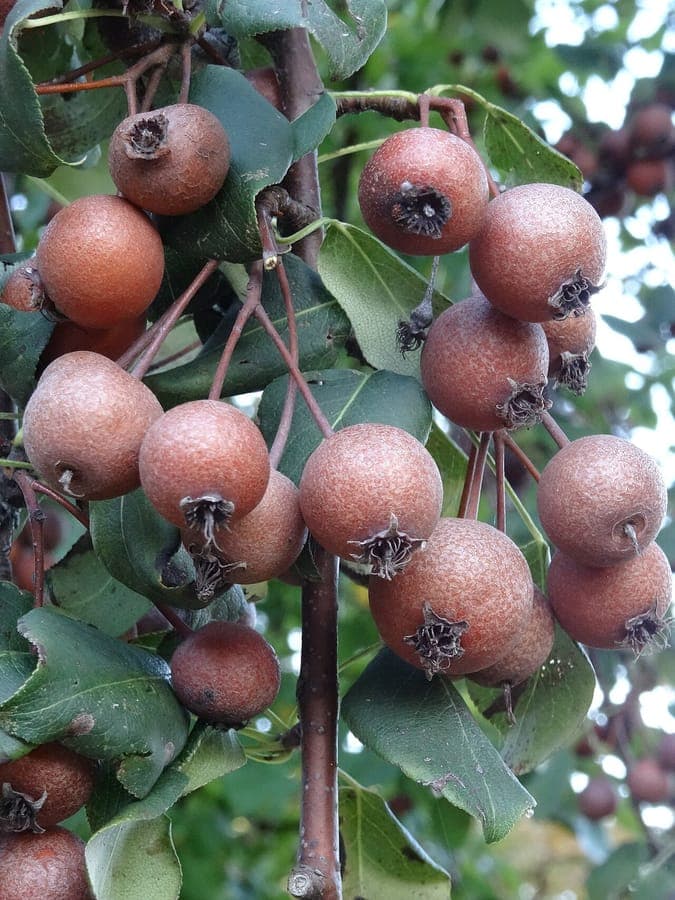
Flowering occurs in April with small white to pale pink blooms measuring about 1.5 centimeters across. While not showy, these flowers are numerous and attract native bees and other pollinators. After pollination, very small spherical fruits develop in May-June, barely 1 to 2 centimeters in diameter, starting green and slowly turning yellow to brown.
Ideal Location
The heart-leafed pear thrives best in semi-shaded to sunny spots with at least four hours of direct sunlight daily. In very warm climates, afternoon partial shade is preferable to regulate moisture uptake. The tree is frost-hardy and suitable for USDA zones 5 to 8, though originally from warmer regions. In temperate climates, it prefers protected locations with moderate winds.
The tree strongly prefers moist soils and blooms less prolifically in deep drought. Planting locations with natural groundwater access or that can be regularly moistened are ideal. However, standing water must be absolutely avoided as it will damage roots. A location with mild air circulation helps prevent fungal diseases.
Soil
The heart-leafed pear grows optimally in slightly acidic soils with a pH between 5.0 and 5.5. This characteristic makes it suitable for gardens where other fruit and ornamental trees struggle. The soil must have good water infiltration but also sufficient moisture retention - heavy clay soils can be improved with compost and sand.
The tree requires moderate nutrients and grows better in soils enriched annually with fully rotted compost or leaf mold. Deep rooting is promoted by subsurface working to about 60 centimeters depth before planting. Mulching around the stem with straw or leaf litter helps improve moisture retention and supplies nutrients gradually.
Free design
Want to see Plymouth pear: complete guide in your garden? Make a free design now.
Watering
The heart-leafed pear is moderately drought-tolerant once well-established, but grows considerably better with regular watering during the growing season. Young trees (first two years) should be watered deeply weekly, especially during dry periods. Thorough soaking is better than surface spraying, as this stimulates deeper root growth.
During the bloom phase (April) and fruit-set (May-June), adequate moisture is essential. Established trees require less water but benefit from extra irrigation during very hot summers. Water requirements increase on sandy soils that retain moisture poorly.
Pruning
The heart-leafed pear responds well to proper pruning and typically regrows vigorously afterwards. Main pruning occurs in January-February before bud break. The goal is to form an open, well-spaced crown allowing sunlight and air flow, and preventing disease.
Old or damaged branches should be removed entirely close to the trunk; saw wounds can be sealed with wound dressing. Young trees benefit from light formative pruning in the early years, targeting a straight main stem and strong lateral limbs. Summer growth pruning can be used to control excessive growth and stimulate flower formation.
Maintenance Calendar
January-February: Dormant pruning, rich compost application, root inspection. March-April: Growth begins, regular watering, fungal disease control with sulfur sprays. May-June: Bloom and fruit-set, moderate feeding, pest control. July-August: High water demand in dry periods, summer pruning for shape. September-October: Fall feeding with potassium-rich fertilizer, dormancy preparation. November-December: Leaf drop, frost protection for young specimens, pruning season preparation.
Winter Hardiness
The heart-leafed pear is reasonably frost-hardy for West European climates and can tolerate temperatures around -20 degrees Celsius, though young wood remains sensitive. In regions where frost pockets exceed -15 degrees, frost damage can be minimized by choosing planting sites that cool slowly in evening and avoid frost pockets.
Young trees may benefit from a protective layer of reed, straw, or burlap around stem and crown in severe winters. In very cold regions, pot cultivation might be preferred so trees can overwinter under glass. Despite good frost hardiness, heavy snow can cause branch breakage - gentle shaking can remove snow loads.
Companion Plants
The heart-leafed pear combines well with other native tree species in more naturalistic gardens. Excellent companions are native hawthorns (Crataegus spp.), where both provide white spring bloom and bird food. Wild apple varieties and blackthorn are also excellent companions, especially if creating an ecologically valuable hedge.
Ground covers like wild strawberry, lily-of-the-valley, and ivy accentuate shaded areas beneath the tree. In damp soil gardens, willows (Salix alba) and birches (Betula pendula) combine well. For bird-friendly combinations, holly (Ilex aquifolium) and yew (Taxus baccata) provide winter food and shelter.
Closing
The heart-leafed pear is a valuable addition to natural and native gardens, especially for those seeking an elegant, bird-friendly tree without major maintenance demands. With its graceful heart-shaped foliage and modest white spring blossoms, the tree fits well in both rural and modern garden styles. The special character of this native species makes it worthy of botanical collectors.
Garden centres offer heart-leafed pear trees in their selection. GardenWorld can advise on proper placement and care for your specific garden. GardenWorld also supports replanting of native tree species.
Want to see Plymouth pear: complete guide in your garden? Make a free design now.
Upload a photo, pick a style, and get a photorealistic design with plant list in under a minute.
No credit card required


Similar plants
Siberian crab apple: complete guide
Malus x robusta
Complete guide to the Siberian crab apple (Malus x robusta): location, soil, pruning, winter hardiness and the best companion plants for your garden.
Chinese flowering crabapple (Malus x spectabilis): complete guide
Malus x spectabilis
Meet the Chinese flowering crabapple (Malus x spectabilis): a classic spring bloomer with carmine buds and pink blossom.
Potentilla crassinervia: complete guide
Potentilla crassinervia
Potentilla crassinervia, the Corsican cinquefoil, grows wild on Corsica and Sardinia's peaks. Discover how to grow this hardy alpine rock garden gem.