
Wikimedia Commons / CC BY-SA 3.0, via Wikimedia Commons
Suffolk lungwort: complete guide
Pulmonaria obscura
Want to see Suffolk lungwort: complete guide in your garden?
1 minute, no credit card
Overview
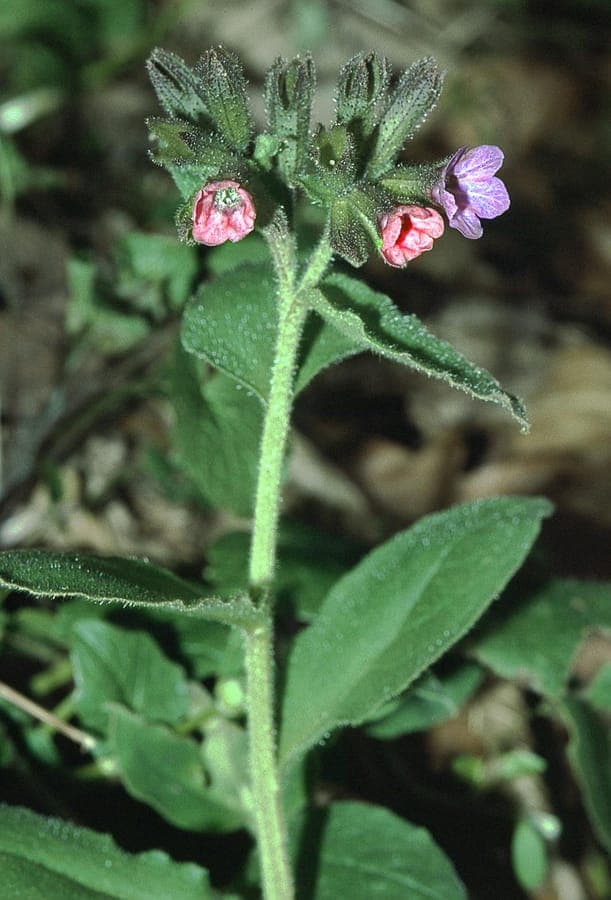
Pulmonaria obscura, commonly known as Suffolk lungwort, is a quietly elegant perennial native to woodlands across central and eastern Europe. Unlike its more flamboyant relatives, this species lacks the speckled foliage typical of many lungworts - hence the name 'obscura', meaning obscure or unmarked. Growing 20–30 cm tall and spreading slowly to about 35 cm wide, it forms dense clumps of deep green, lance-shaped leaves that emerge as early as February. Ideal for naturalistic planting schemes, it thrives in cool, shaded spots where few other perennials succeed. On gardenworld.app, you can design a shade garden layout that highlights the subtle charm of this plant.
Appearance & bloom cycle
The foliage of Pulmonaria obscura is solid green, smooth, and slightly hairy, with a glossy sheen that catches the light in shady areas. Leaves are arranged in a basal rosette and remain evergreen through mild winters, providing structure when little else is growing. The flowering period runs from April through June, peaking in May. Flower stalks rise above the foliage, bearing clusters of tubular blooms that start deep purple or blue and fade to soft lilac as they age - a subtle shift that adds depth to borders.
Each flower is about 1.5 cm long and rich in nectar, attracting early pollinators like bumblebees and hoverflies. Because the plant blooms before tree canopies fully close, it takes full advantage of the brief window of spring light. Its modest stature and natural habit make it perfect for front-of-border plantings, rock gardens with filtered light, or beneath deciduous shrubs.
Ideal location
Suffolk lungwort prefers light to moderate shade, scoring a 4 on the light scale (where 10 is full sun). It performs best under open tree canopies, on north-facing slopes, or along woodland edges. Avoid hot, dry south-facing spots, as direct afternoon sun will scorch leaves and dry the soil too quickly. That said, in cooler maritime climates - such as coastal UK or Pacific Northwest - it can tolerate more light if moisture levels remain consistent.
This plant dislikes competition, so give it space to form colonies without aggressive neighbours. Pair it with other shade-tolerant perennials like Epimedium, Brunnera, or early narcissus. On gardenworld.app, you can simulate plant combinations to see how Suffolk lungwort integrates into your existing garden scheme.
Soil requirements
It demands a fertile, humus-rich soil that retains moisture but drains well. A pH between 7.5 and 8.0 - slightly to moderately alkaline - is ideal. If your soil is acidic (below pH 7), incorporate garden lime in autumn to gradually raise the pH. Avoid sandy soils unless amended with compost, and steer clear of heavy, waterlogged clay unless you improve drainage with organic matter.
A 5 cm mulch of leaf mould or well-rotted compost in early spring boosts fertility and helps maintain even soil moisture. This mimics the natural forest floor where this species thrives.
Free design
Want to see Suffolk lungwort: complete guide in your garden? Make a free design now.
Watering
Keep the soil consistently moist, especially during dry springs. While established plants have some drought tolerance, prolonged dryness causes leaf scorch and stunted growth. Water deeply once a week during dry spells, preferably in the morning. Use rainwater when possible, as lungworts can be sensitive to high mineral content in tap water.
Do not let water pool around the crown, as this encourages fungal diseases. Drip irrigation or careful hand-watering at soil level works best.
Pruning
Pruning is optional but recommended. After flowering in late May or June, cut back spent flower stems and any damaged or tired foliage. This improves air circulation and reduces the risk of powdery mildew. If the leaves deteriorate in summer heat, shear the plant back to the base. It often responds with a fresh flush of foliage in autumn, especially in cooler years.
Avoid cutting too early - the leaves photosynthesize and store energy for next spring's growth.
Maintenance calendar
- January: Check for emerging foliage. Protect from severe frost with a light leaf litter cover.
- February: Clear debris. No feeding needed yet.
- March: Apply compost around the base. Remove any winter-damaged leaves.
- April: Bloom begins. Monitor soil moisture.
- May: Peak flowering. Watch for slugs on young growth.
- June: Deadhead spent blooms. Inspect for mildew in humid weather.
- July–September: Low maintenance. Water during dry spells.
- October: Remove diseased leaves. Leave healthy foliage for winter insulation.
- November: No action unless soil is waterlogged - consider adding grit for drainage.
- December: Evergreen foliage persists. Check for frost heave in freeze-thaw cycles.
Winter hardiness
Pulmonaria obscura is fully hardy in USDA zones 4 to 8, surviving temperatures down to -25°C. The leaves usually stay green or turn bronze in winter, adding texture to the dormant garden. In regions with heavy snow cover, the plant is naturally insulated. In wet winters, however, root rot can occur if soil doesn't drain well. A raised bed or slope can help in poorly drained areas.
Companion plants
Pair with early spring bulbs like Chionodoxa, Scilla, or dwarf irises. Later, it blends well with ferns, Heuchera, and Tiarella. For continuous interest, plant alongside Helleborus orientalis or Epimedium x youngianum. Avoid invasive ground covers like Vinca minor unless carefully contained.
Suffolk lungwort also works well in cottage garden edges or shaded rockeries, where its subtle blooms contrast with bolder foliage.
Closing
Suffolk lungwort is a resilient, low-fuss perennial that brings quiet beauty to shaded corners. Its early bloom time, wildlife value, and year-round presence make it a smart choice for woodland gardens and urban courtyards alike. Available at most garden centres in spring - including larger chains across the UK - it's easy to establish if planted in rich, moist, alkaline soil. Just keep it out of harsh sun, and it will return reliably every year. For planning, visit gardenworld.app to visualise how this plant fits into your long-term garden design.
Want to see Suffolk lungwort: complete guide in your garden? Make a free design now.
Upload a photo, pick a style, and get a photorealistic design with plant list in under a minute.
No credit card required


Similar plants
Western waterleaf: complete guide
Hydrophyllum occidentale
Full growing guide for western waterleaf (Hydrophyllum occidentale): shade tolerance, soil needs, watering, winter hardiness and naturalistic garden use.
Limestone phacelia (Phacelia affinis): complete guide
Phacelia affinis
Full guide to Phacelia affinis, the limestone phacelia: sowing tips, purple-blue bee flowers, drought tolerance and uses in dry or wildlife gardens.
Pyrenean viper's bugloss: complete guide
Echium asperrimum
Echium asperrimum is a striking biennial from the western Mediterranean with rough bristly stems and vivid blue flowers. A magnet for bees and a bold border plant.